
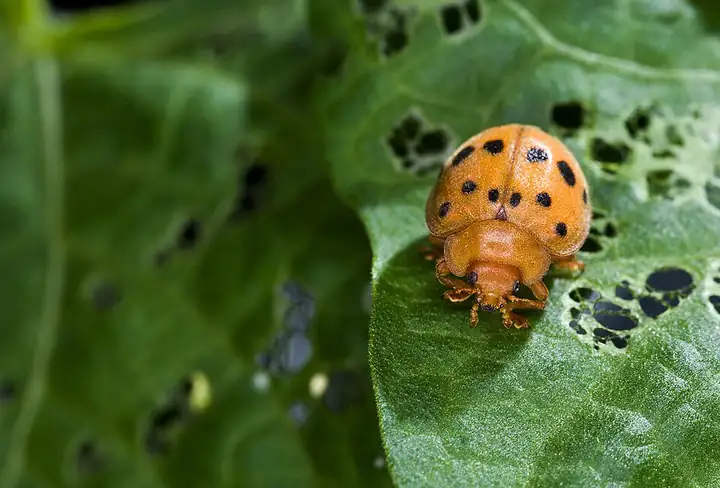
Mexican bean beetle
Epilachna varivestis
| Type | Insect |
|---|---|
| When | Late spring through late summer. |
| Pressure by region | High pressure: Northeast, Southeast |
About
A plant-eating lady beetle about a third of an inch long, coppery orange with 16 black spots, easily mistaken for a helpful ladybug. Its spiny yellow larvae do most of the damage.
Spotting it
Damage
Adults and larvae feed from leaf undersides, scraping away soft tissue between the veins so leaves turn into brown lace.
How to find it early
Check bean leaf undersides from the first true leaves on for upright yellow egg clusters and spiny yellow larvae.
When
Late spring through late summer.
Life cycle
Adults overwinter in leaf litter and woods and emerge in late spring; larvae feed for about 20 days, then pupate on the leaf. A female lays 500 to 1,200 eggs, giving one to three generations depending on summer length.
What to do, gentlest first
Start at the top. Sprays are a last step; always read and follow the product label.
Resistant varieties and planting date Prevent
Snap beans 'Regal' and 'Idaho Refugee' and lima beans 'Baby Fordhook' and 'Baby White' hold up better; wax beans are very susceptible. Planting early or late avoids peak beetle numbers.
Reflective mulch Prevent
Metalized or white plastic mulch reduced beetle numbers and damage.
Hand-pick By hand
Pick adults, larvae and egg clusters from the undersides of leaves.
Floating row cover Barrier
Cover young beans to keep beetles off.
Pediobius foveolatus wasps Natural enemies
Release this parasitic wasp one and two weeks after you first see young larvae.
The wasp cannot survive U.S. winters, so it must be released every year; avoid release in rainy or cold weather.
Spinosad, neem or pyrethrins Organic spray
Maryland Extension suggests these for severe infestations.
Spinosad and pyrethrins are toxic to bees while wet; spray in the evening, keep them off open flowers, and follow the label and pre-harvest interval.
Pyrethroids Conventional spray
Bifenthrin or lambda-cyhalothrin give good control for about 10 days.
Beans can lose about 20 percent of their leaves before bloom (10 percent from bloom to pods) without losing yield, so a few beetles are not an emergency. Pyrethroids are highly toxic to bees (PNW 591); do not spray plants in bloom, and follow the label and pre-harvest interval.
Garden friends that go after it
Spined soldier bug
Protect these helpers: skip broad sprays when they're around.
Plants it goes after
Green beans (snap beans), Lima beans, Scarlet runner bean, Southern peas
Pressure by region
Its range covers most of the U.S., but damaging numbers are most common in the Mid-Atlantic and southern Appalachians, where summers run 77-85°F with regular rain; in the Great Plains and Southwest it stays mostly in irrigated fields and rarely reaches damaging levels. A 1965 University of Idaho bulletin said it had been eradicated from California and Idaho; no newer source was found, so the West is rated low, not absent. The Midwest, South Central, Alaska and Hawaii are rated low for lack of a regional source; all of these low ratings are estimates.
| Northeast | High pressure |
|---|---|
| Southeast | High pressure |
| South Central | Low |
| Midwest | Low |
| Great Plains | Low |
| Mountain West | Low |
| Southwest | Low |
| Pacific Northwest | Low |
| California | Low |
| Alaska | Low |
| Hawaii | Low |
Ratings come from extension sources where available; some are estimates, as noted above.
Sources
Photo: Photo: Stephen Ausmus, USDA ARS, Public domain (USDA ARS), via Wikimedia Commons. Photo resized for the web.

Planting dates and advice are general guidance; check with your local Cooperative Extension office for your area.