
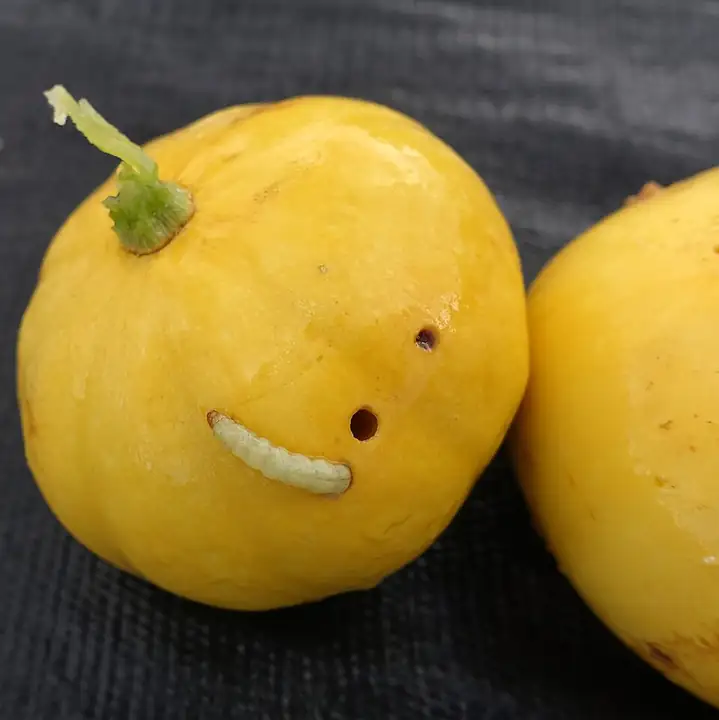
Pickleworm
Diaphania nitidalis
| Type | Insect |
|---|---|
| When | Midsummer to fall; year-round in south Florida. |
| Pressure by region | High pressure: Southeast |
About
A caterpillar pest of squash and its relatives that spends winter only in the far South and spreads north each summer. Larvae favor blossoms but also bore into fruit.
Spotting it
Damage
Blossoms are hollowed out and fruit gets small holes that let in rot. In cantaloupe larvae often feed on the rind surface instead of boring in.
How to find it early
Open squash blossoms and check young fruit for small holes with droppings, especially from midsummer on.
When
Midsummer to fall; year-round in south Florida.
Life cycle
A generation takes about 30 days, with two to four overlapping generations a year. It routinely survives winter only in south Florida and perhaps south Texas.
What to do, gentlest first
Start at the top. Sprays are a last step; always read and follow the product label.
Plant early Prevent
Plant early so you harvest before pickleworm numbers peak.
Squash trap crop Prevent
Summer squash is its favorite host and can draw it away from cantaloupe; destroy the trap plants before larvae move.
Results vary.
Row cover or screening Barrier
Screen or fabric covers keep the moths out. In Hawaii, UH Master Gardeners suggest netting plants at dusk and removing the net each morning.
Pollinators must be able to reach the flowers.
Beneficial nematodes Natural enemies
Steinernema carpocapsae nematodes work in large squash blossoms.
UF/IFAS says Bt usually is not recommended because the larvae feed inside flowers and fruit, though UH Master Gardeners suggest trying it.
Preventive insecticides Conventional spray
Labeled insecticides applied before larvae get inside give the best results.
Spray late in the day, when honeybee activity is minimal (UF/IFAS), and keep sprays off open flowers. Follow the label and pre-harvest interval.
Plants it goes after
Cantaloupe (muskmelon), Cucumber, Winter squash and pumpkin, Zucchini and summer squash
Pressure by region
Overwinters only in the warmest zones (south Florida, perhaps south Texas, and central Florida in mild winters). Moths reach the Carolinas one to two months later and in some summers get as far as Michigan and Connecticut, so it is mainly a southern, late-season pest. It reached Hawaii in 2003 and by 2005 was on Oahu, Kauai, Maui and Hawaii Island (Hawaii Department of Agriculture). Western and Alaska ratings are estimates.
| Northeast | Low |
|---|---|
| Southeast | High pressure |
| South Central | Moderate |
| Midwest | Low |
| Great Plains | Low |
| Mountain West | Low |
| Southwest | Low |
| Pacific Northwest | Low |
| California | Low |
| Alaska | Low |
| Hawaii | Moderate |
Ratings come from extension sources where available; some are estimates, as noted above.
Sources
Photo: Photo: Plant pests and diseases (Flickr), CC0, via Wikimedia Commons (CC0). Photo resized for the web.

Planting dates and advice are general guidance; check with your local Cooperative Extension office for your area.