
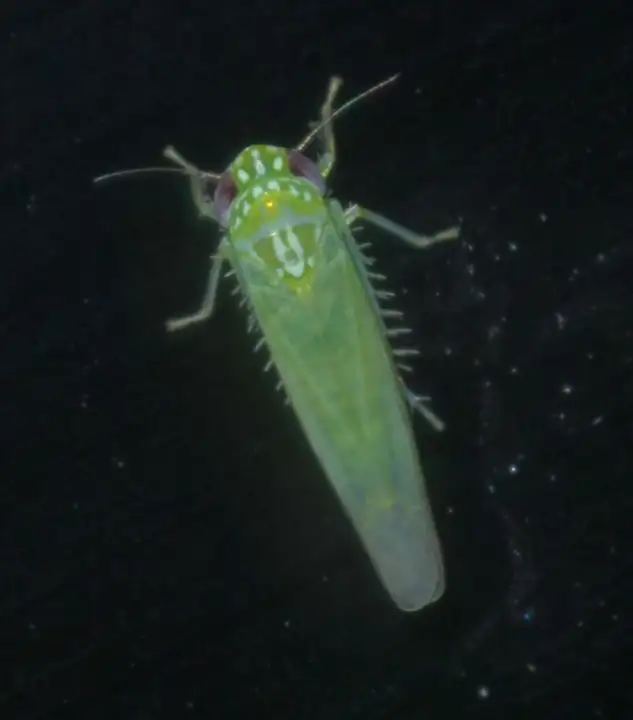
Potato leafhopper
Empoasca fabae
| Type | Insect |
|---|---|
| When | Late spring through summer. |
| Pressure by region | Moderate: Northeast, Southeast, Midwest |
About
A small, wedge-shaped, pale green insect about an eighth of an inch long. It feeds on more than 200 kinds of plants, mostly legumes.
Spotting it
Damage
On potatoes it causes hopperburn: a triangular brown patch at the leaf tip, then edges that roll inward and look scorched. Bean leaves whiten and curl.
How to find it early
Brush potato and bean foliage and watch for tiny green insects flying up, and turn leaves to find the pale nymphs.
When
Late spring through summer.
Life cycle
It overwinters only in the Gulf Coast states and nearby southern areas and rides warm spring winds north, reaching northern areas by May. A generation takes about four weeks, allowing up to six a year.
What to do, gentlest first
Start at the top. Sprays are a last step; always read and follow the product label.
Remove nearby host weeds Prevent
Clear nearby dandelion, thistle and other host plants, and choose resistant varieties where seed packets list them.
Scout early By hand
Start checking potatoes when they are 4 to 8 inches tall.
Labeled insecticides Conventional spray
If adults or nymphs are present on young potatoes, spray all leaf surfaces and repeat 7 to 10 days later if needed.
Follow the label, protect bees, and observe the pre-harvest interval.
Garden friends that go after it
Minute pirate bugs
Protect these helpers: skip broad sprays when they're around.
Plants it goes after
Apple (backyard tree), Chestnut, Goji (wolfberry), Green beans (snap beans), Potato
Pressure by region
Its range runs from the East Coast west to the Rocky Mountains; it overwinters only in the Gulf Coast states and the southern pine region (Louisiana, Mississippi, Alabama, parts of Florida and Texas, eastern Arkansas, Tennessee, the Carolinas and Virginia). Reports from California's Central Valley may be misidentified relatives, so the West is rated low.
| Northeast | Moderate |
|---|---|
| Southeast | Moderate |
| South Central | Low |
| Midwest | Moderate |
| Great Plains | Low |
| Mountain West | Low |
| Southwest | Low |
| Pacific Northwest | Low |
| California | Low |
| Alaska | Low |
| Hawaii | Low |
Ratings come from extension sources where available; some are estimates, as noted above.
Sources
Photo: Photo: xpda, CC BY-SA 4.0, via Wikimedia Commons (CC BY-SA 4.0). Photo resized for the web.

Planting dates and advice are general guidance; check with your local Cooperative Extension office for your area.