
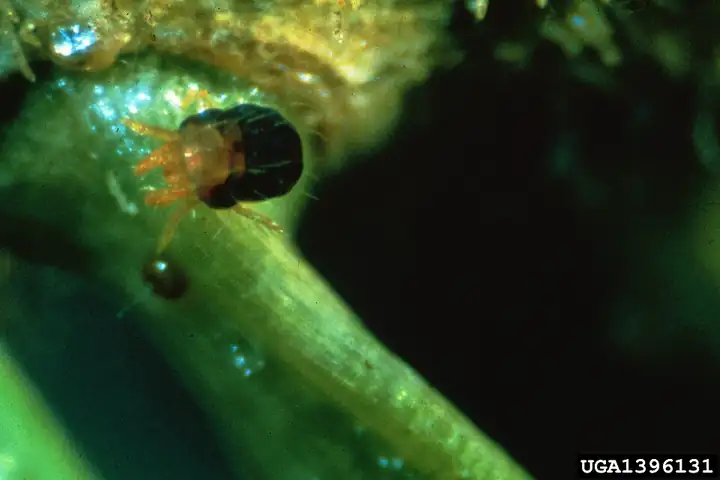
Spruce spider mite
Oligonychus ununguis
| Type | Mite |
|---|---|
| When | Spring and fall; quiet in hot summer weather. |
| Pressure by region | High pressure: Northeast, Midwest |
About
A native, cool-season spider mite that Penn State calls one of the most destructive spider mites in the United States. It feeds on spruces, especially Colorado blue, Norway, white and dwarf Alberta spruce, and also on arborvitae, juniper, hemlock, pine, Douglas-fir and other conifers (Penn State, IPM of Midwest Landscapes).
Spotting it
Damage
Needles get speckled and yellowish, then turn bronze or rusty and may drop early, starting on older needles low and inside the tree and spreading as the season goes on; fine webbing may cover the twigs (Penn State, WSU). Severe, repeated attacks can kill twigs and branches and even stressed trees (IPM of Midwest Landscapes).
How to find it early
Hold a white sheet of paper under a branch and strike the branch sharply; spider mites show up as tiny dark specks that crawl. Check three or four spots; Penn State suggests treating if you find 10 or more mites per spot. A hand lens also shows eggs and helpful predators (IPM of Midwest Landscapes).
When
Spring and fall; quiet in hot summer weather.
Life cycle
Brown eggs spend winter tucked at needle bases and bud scales and hatch in April and May, about when PJM rhododendron blooms; there are 7 to 10 overlapping generations a year (Penn State, IPM of Midwest Landscapes). Activity drops in summer heat near 90°F and picks up again in fall.
What to do, gentlest first
Start at the top. Sprays are a last step; always read and follow the product label.
Spare the predators Prevent
Spray only when mites are numerous and natural enemies are scarce. Broad-spectrum insecticides kill predatory mites and can make spider mite outbreaks worse (IPM of Midwest Landscapes, WSU, Penn State).
Hose them off By hand
Where you can reach, wash mites off with a strong stream of water (WSU, IPM of Midwest Landscapes).
Natural enemies Natural enemies
Predatory mites, minute pirate bugs, lacewings, lady beetles, a tiny rove beetle and predatory midges all eat spruce spider mites (IPM of Midwest Landscapes).
Horticultural oil or insecticidal soap Organic spray
A 2% horticultural oil or insecticidal soap spray in spring (early to mid-May), with a second spray in early September if needed, fits this cool-season mite (Penn State timing, IPM of Midwest Landscapes). A dormant oil spray helps if fall numbers were heavy.
Oils and soaps can discolor needles, especially the blue color of Colorado blue spruce; test a small area first (WSU). Homeowners shouldn't spray trees taller than about 10 feet (WSU). Follow the label.
Miticides Conventional spray
Newer miticides such as bifenazate, clofentezine and hexythiazox are gentler on beneficial insects; they are mainly for commercial applicators (IPM of Midwest Landscapes).
Rotate miticide classes after every third spray to slow resistance, and use only on plants listed on the label (Penn State).
Plants it goes after
Arborvitae, Colorado blue spruce, Eastern white pine, Fir, Juniper
Pressure by region
Ratings are estimates; dusty roadside trees are often hit hardest (WSU).
| Northeast | High pressure |
|---|---|
| Southeast | Moderate |
| South Central | Low |
| Midwest | High pressure |
| Great Plains | Moderate |
| Mountain West | Moderate |
| Southwest | Low |
| Pacific Northwest | Moderate |
| California | Low |
| Alaska | Low |
| Hawaii | Low |
Ratings come from extension sources where available; some are estimates, as noted above.
Sources
Photo: Photo: USDA Forest Service - Northeastern Area, Bugwood.org / Wikimedia Commons, Public domain. Photo resized for the web.

Planting dates and advice are general guidance; check with your local Cooperative Extension office for your area.