
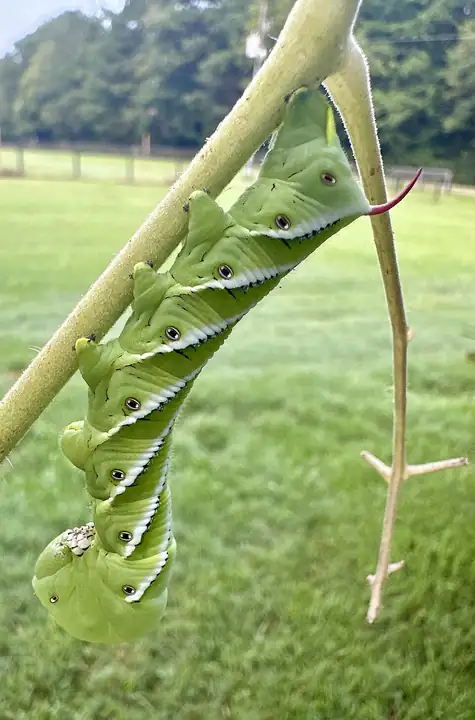
Tomato hornworm
Manduca quinquemaculata (the look-alike tobacco hornworm, Manduca sexta, does the same damage)
| Type | Insect |
|---|---|
| Pressure by region | Moderate: Northeast, Southeast, South Central, Midwest, Great Plains, Mountain West, Southwest, Pacific Northwest, California |
About
One of the biggest caterpillars in North American gardens, up to four inches long, green with white V-shaped marks and a horn on its tail. The adult is a large gray-brown sphinx moth with a four- to five-inch wingspan.
Spotting it
Damage
Leaves and stems are stripped, usually starting near the top of the plant, and large dark green or black droppings pile up on the leaves below. Big caterpillars also chew into the fruit.
How to find it early
Look for fresh droppings and bare stems, then search the leaves just above. A UV flashlight at night makes hornworms glow and easy to find.
When
Early summer to early fall; UC IPM says damage peaks in midsummer with a second surge in late summer.
Life cycle
Pupae spend winter in the soil and moths emerge in spring to lay eggs on the leaves; caterpillars mature in three to four weeks. Two generations a year is typical, and the second round of pupae is the one that overwinters.
What to do, gentlest first
Start at the top. Sprays are a last step; always read and follow the product label.
Weed and till Prevent
Pull horsenettle, jimsonweed and nightshade, which also feed hornworms. Till the bed after harvest to destroy pupae in the soil.
Hand-pick By hand
Check plants twice a week and drop hornworms into soapy water. A UV flashlight after dark makes them easy to spot.
In Hawaii, a look-alike caterpillar is the endangered Blackburn's sphinx moth; check with your local Extension office before killing hornworm-like caterpillars there.
Leave parasitized hornworms Natural enemies
A hornworm covered in white, rice-like cocoons has been parasitized by Cotesia wasps and has stopped feeding. Leave it so the wasps can hatch and attack the next generation.
Bt (Bacillus thuringiensis) Natural enemies
Spray Bt on leaves while caterpillars are small. It affects only caterpillars and does not harm bees.
Works poorly on full-grown hornworms.
Spinosad Organic spray
Effective on smaller caterpillars and lasts one to two weeks.
Toxic to bees while wet, much less once dry (UMN). Spray in the evening when bees are not foraging, keep it off open flowers, and follow the label and pre-harvest interval.
Pyrethroid insecticides Conventional spray
Broad-spectrum products such as bifenthrin or permethrin last longer but are rarely needed for a pest this easy to pick off.
Highly toxic to bees (PNW 591), and they kill beneficial insects, including the parasitic wasps. Keep sprays off open flowers, follow the label and wait the stated days before harvest.
Garden friends that go after it
Braconid wasps (incl. hornworm cocoon wasps and aphid mummy wasps), Trichogramma wasps
Protect these helpers: skip broad sprays when they're around.
Plants it goes after
Datura (jimsonweed, moonflower datura), Eggplant, Flowering tobacco (nicotiana), Ground cherry, Pepper (sweet and chili), Potato, Tomatillo, Tomato
Pressure by region
The tomato hornworm is more common in the North and the tobacco hornworm in the South (UF/IFAS); you manage them the same way. UC IPM notes they are worse in warm inland areas. No source reported either species as a garden pest in Alaska or Hawaii, so the low ratings there are estimates. In Hawaii, caterpillars of the Blackburn's sphinx moth, a close relative that is federally and state listed as endangered, have been recorded on tomato and eggplant, so do not kill hornworm-like caterpillars there until you know what they are.
| Northeast | Moderate |
|---|---|
| Southeast | Moderate |
| South Central | Moderate |
| Midwest | Moderate |
| Great Plains | Moderate |
| Mountain West | Moderate |
| Southwest | Moderate |
| Pacific Northwest | Moderate |
| California | Moderate |
| Alaska | Low |
| Hawaii | Low |
Ratings come from extension sources where available; some are estimates, as noted above.
Sources
- extension.umn.edu
- ipm.ucanr.edu
- ask.ifas.ufl.edu
- extension.unr.edu
- bygl.osu.edu
- xerces.org
- dlnr.hawaii.gov
- s3.wp.wsu.edu
Photo: Photo: KelleyA-99, CC BY 4.0, via Wikimedia Commons (CC BY 4.0). Photo resized for the web.

Planting dates and advice are general guidance; check with your local Cooperative Extension office for your area.