
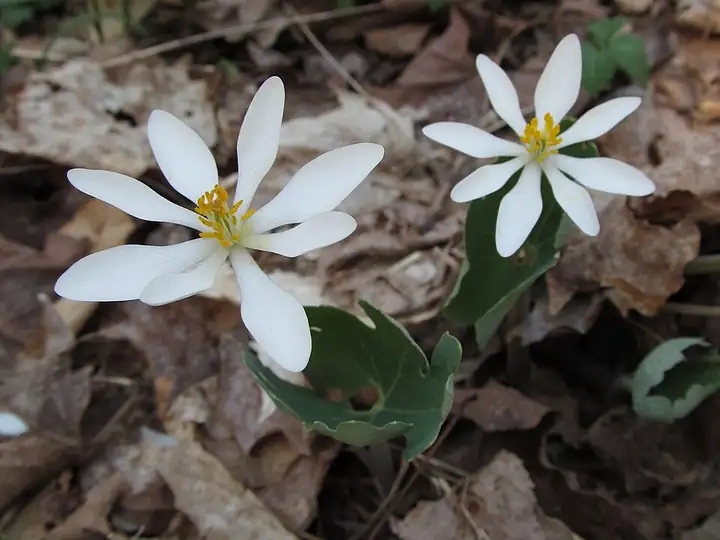
Bloodroot
Sanguinaria canadensis · Poppy family (Papaveraceae)
| Hardiness zones | 3 to 8 |
|---|---|
| Sun | part shade |
| Water | moderate |
| Life cycle | perennial |
| Frost | Hardy: takes frost |
| Soil pH | 6.8–7.2 |
| Spacing | 6 inches |
About Bloodroot
Bloodroot is one of the first wildflowers of spring: a single white, gold-centered flower opens while its one lobed leaf is still wrapped around the stem, and the leaf then unfurls into a handsome groundcover until midsummer (Wisconsin Extension, NC State). It is native across the eastern half of the U.S. and Canada, from Florida and Texas north to Quebec and Manitoba (wildflower.org). Every part bleeds a red-orange sap that irritates skin, and the root is highly poisonous if eaten (NC State, wildflower.org). Over-collection has caused big declines in wild stands, so buy plants from growers who did not dig them from the wild (Wisconsin Extension).
Hardy in zones 3-8 (Wisconsin Extension). Native and not invasive; it spreads slowly into colonies, helped by ants that carry its seeds.
When to plant
Timing is counted from your average last spring frost (and first fall frost). Sow & Tell works out the actual dates for your ZIP code.
Move or divide plants in summer as they go dormant (or in fall or early spring), about 6 inches apart with the rhizomes no more than 1 inch deep; wear gloves (Wisconsin Extension, wildflower.org). Sow seed right after it ripens, 1/2 inch deep, and keep it moist: it sprouts the next spring, and plants reach blooming size in 2-3 years. We found no sourced day count to first bloom.
Soil
Moist, well-drained soil rich in organic matter, near neutral (about pH 6.8-7.2); it needs a few hours of early-spring sun before the trees leaf out (Wisconsin Extension, wildflower.org).
Plant in moist, well-drained soil rich in organic matter (Wisconsin Extension).
Feeding
- Late fall, after the leaves drop: a thin mulch of deciduous tree leaves. A light leaf layer over the bed in winter is what wildflower.org recommends; no fertilizer schedule is given.
Don't disturb the roots once planted; divisions can take a year or more to settle in unless left alone (Wisconsin Extension).
Harvest
Blooms very early in spring (March-April) for about 2 weeks; each flower closes at night and in cloudy weather and drops its petals a day or two after pollination (Wisconsin Extension, NC State). No deadheading needed. Leave the leaf until it dies back in midsummer, and wear gloves if you handle the roots.
Varieties (1)
Extension sources document one named double form; we found no others.
| Variety | Type | Days | Notes |
|---|---|---|---|
| Multiplex | Double-flowered bloodroot | Fully double white flowers that last longer than the single kind; makes no seed. |
Good neighbors
Virginia bluebells, Garden ferns (ostrich, Christmas, lady, Japanese painted), Hosta (plantain lily)
A design pairing, not a pest-control companion: Wisconsin Extension pairs bloodroot with Virginia bluebells, and with ferns or hostas that hide its leaves as they die back in midsummer.
In the kitchen
Safety: Poisonous: NC State rates it highly toxic, and eating the root (rhizome) can cause vomiting, dizziness, fainting, diarrhea and heart failure; the red-orange sap is caustic and irritates skin, so wear gloves (NC State, wildflower.org, Wisconsin Extension). Never use bloodroot or 'black salve' on moles, warts or skin spots: the FDA calls bloodroot a corrosive agent that destroys healthy skin and warns that self-treating can let skin cancer grow, and MSKCC reports disfiguring scars.
Pets: Not listed by the ASPCA (no bloodroot or Sanguinaria entry on its dog, cat or horse lists that we could check). NC State rates the root highly poisonous, so keep pets from chewing it.
Sources
- plants.ces.ncsu.edu
- hort.extension.wisc.edu
- wildflower.org
- yardandgarden.extension.iastate.edu
- extension.missouri.edu
- mskcc.org
- fda.gov
- aspca.org
- aspca.org
- aspca.org
- aspca.org
Photo: Photo: Cbaile19, CC0, via Wikimedia Commons (CC0). Photo resized for the web.

Planting dates and advice are general guidance; check with your local Cooperative Extension office for your area.