
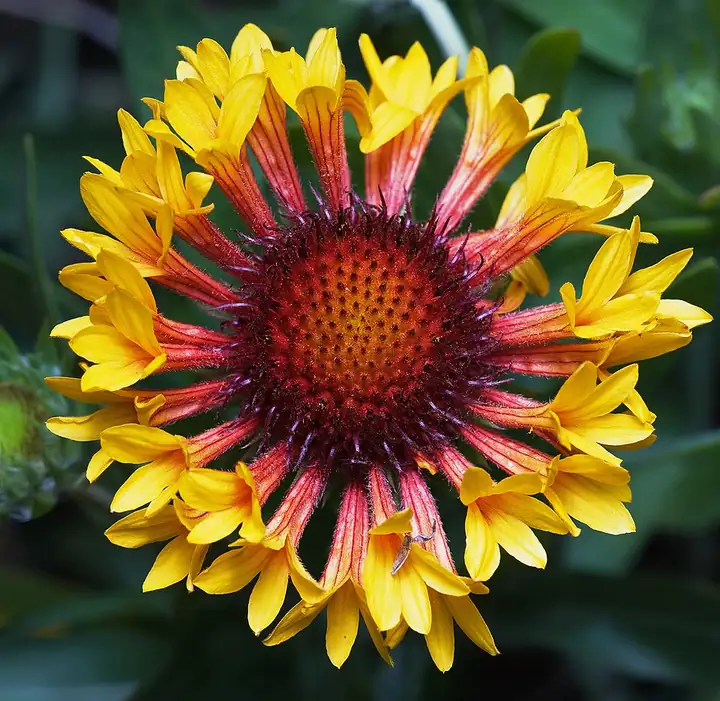
Blanket flower (gaillardia)
Gaillardia x grandiflora (hybrid of G. aristata and G. pulchella); also G. aristata and the annual G. pulchella · Aster family (Asteraceae)
| Hardiness zones | 3 to 10 |
|---|---|
| Sun | full sun |
| Water | low |
| Life cycle | perennial |
| Frost | Hardy: takes frost |
| Soil pH | 6.0–8.0 |
| Spacing | 12 to 36 inches |
| Days to harvest | 105 to 150 days |
About Blanket flower (gaillardia)
Blanket flower is a hot-colored daisy in red, orange, yellow and burgundy, often banded, that blooms from early summer until frost. It loves heat, sun, sand and drought and is visited by bees and butterflies, while goldfinches eat the seeds. The garden hybrid is short-lived (about two years on average, per Wisconsin Extension) but reseeds; G. pulchella is usually grown as an annual. Heads-up: NRCS says blanketflower may become weedy or invasive in some regions, NC State notes it reseeds and can turn weedy, and UF/IFAS says G. pulchella is probably not native to Florida.
Wisconsin lists G. aristata and most G. x grandiflora for zone 3 (some cultivars 4-5); NC State lists G. aristata for 3-8 and the hybrid for 7-10. It rarely survives winter in heavy, wet soil.
When to plant
Timing is counted from your average last spring frost (and first fall frost). Sow & Tell works out the actual dates for your ZIP code.
- Start seeds indoors: 4 to 8 weeks before the last frost
- Sow seeds outdoors: around the last frost
Days to bloom count from sowing: Wisconsin says 4-5 months, and AAS lists about 105 days for 'Arizona Apricot' and 120 for 'Mesa Yellow', which flower the first year. Start seed indoors 6-8 weeks before the last frost (Wisconsin; UC says 4-6) or sow outdoors right after the last frost; seed needs light to sprout, so barely cover it. In the desert, fall planting works best (UC).
Soil
Sharply drained sandy or loamy soil, even poor soil; it tolerates salt (UF/IFAS) and rarely survives winter in heavy clay (Wisconsin; NC State).
Plant in sharply drained, even poor, sandy or loamy soil; add humus and keep evenly moist only while plants settle in (NC State; Wisconsin).
Feeding
Avoid overwatering and fertilizing (UC Master Gardeners); blanket flower needs little fertilizer (Wisconsin), and rich, wet soil shortens its already short life.
Harvest
Flowers from early summer to frost. Deadheading isn't required but keeps flowers coming and may help plants live longer; cutting plants back to about 6 inches in late summer may improve winter survival (Wisconsin). Wear gloves: the hairy leaves can irritate skin.
Varieties (20)
| Variety | Type | Days | Notes |
|---|---|---|---|
| Lorenziana | Annual blanket flower (G. pulchella) | About 12 in with double flowers in yellow and red. | |
| Red Plume | Annual blanket flower (G. pulchella) | About 12 in, mounded, with double red tubular flowers. | |
| Arizona Sun | Blanket flower (AAS lists G. aristata) | 8-10 in tall with 3-in mahogany-red flowers edged in yellow. | |
| Amber Wheels | Common blanket flower (G. aristata) | About 20 in with fringed yellow rays around an amber-red center. | |
| Bijou | Common blanket flower (G. aristata) | Dwarf, 10-12 in tall. | |
| Meriwether Germplasm | Common blanket flower (G. aristata) | Native seed release made from 14 Montana and 1 Wyoming wild collections, for meadows and conservation plantings. | |
| Sunrita series | Common blanket flower (G. aristata) | 14-18 in with large 3-4 in flowers in several colors. | |
| Arizona Apricot | Hybrid blanket flower (G. x grandiflora) | 105 days | About 12 in tall with 3-3.5 in apricot flowers edged in yellow. |
| Baby Cole | Hybrid blanket flower (G. x grandiflora) | Dwarf type. | |
| Burgundy | Hybrid blanket flower (G. x grandiflora) | Taller, 2-2.5 ft, with wine-red flowers that fade softer. | |
| Dazzler | Hybrid blanket flower (G. x grandiflora) | Tall type. | |
| Goblin ('Kobold') | Hybrid blanket flower (G. x grandiflora) | Dwarf, 12-14 in, with red flowers tipped in yellow. | |
| Golden Goblin | Hybrid blanket flower (G. x grandiflora) | Dwarf with yellow flowers. | |
| Gusto series | Hybrid blanket flower (G. x grandiflora) | Very low, 5-8 in, in several colors. | |
| Lunar series | Hybrid blanket flower (G. x grandiflora) | 8-10 in with flat rays; includes 'Harvest Moon' and 'Two Moon'. | |
| Mesa series | Hybrid blanket flower (G. x grandiflora) | 14-16 in, several colors. | |
| Mesa Yellow | Hybrid blanket flower (G. x grandiflora) | 120 days | 16-18 in tall, sturdy mound of bright yellow 3-in flowers. |
| Oranges and Lemons | Hybrid blanket flower (G. x grandiflora) | 18-24 in tall with peachy-orange rays tipped in yellow. | |
| Sundance Bicolor | Hybrid blanket flower (G. x grandiflora) | Low, trailing plant with double, globe-shaped red-and-yellow flowers. | |
| Torchlight | Hybrid blanket flower (G. x grandiflora) | Red centers with yellow tips. |
Good neighbors
Coreopsis (tickseed), Sunflower, Purple coneflower (echinacea), Blazing star (liatris), Black-eyed Susan
Wisconsin Extension suggests blanket flower with coreopsis, sunflowers, purple coneflower, blazing star and black-eyed Susan in a sunny border; these are design pairings. Penn State and Wisconsin list blanketflower among flowers for beneficial insects, a modest, extension-level recommendation rather than trial evidence.
Pests to watch for
Aphids, Thrips, Four-lined plant bug
Diseases and problems
Aster yellows, Powdery mildew, Leaf spot, Root rot
In the kitchen
Safety: The hairy leaves contain lactones that can cause an itchy skin rash, so wear gloves (Wisconsin; NC State).
Pets: Not listed by the ASPCA
Sources
- plants.ces.ncsu.edu
- plants.ces.ncsu.edu
- plants.ces.ncsu.edu
- hort.extension.wisc.edu
- ucanr.edu
- gardeningsolutions.ifas.ufl.edu
- nrcs.usda.gov
- all-americaselections.org
- all-americaselections.org
- extension.psu.edu
- hort.extension.wisc.edu
- aspca.org
- aspca.org
Photo: Photo: JJ Harrison, CC BY-SA 3.0, via Wikimedia Commons (CC BY-SA 3.0). Photo resized for the web.

Planting dates and advice are general guidance; check with your local Cooperative Extension office for your area.