
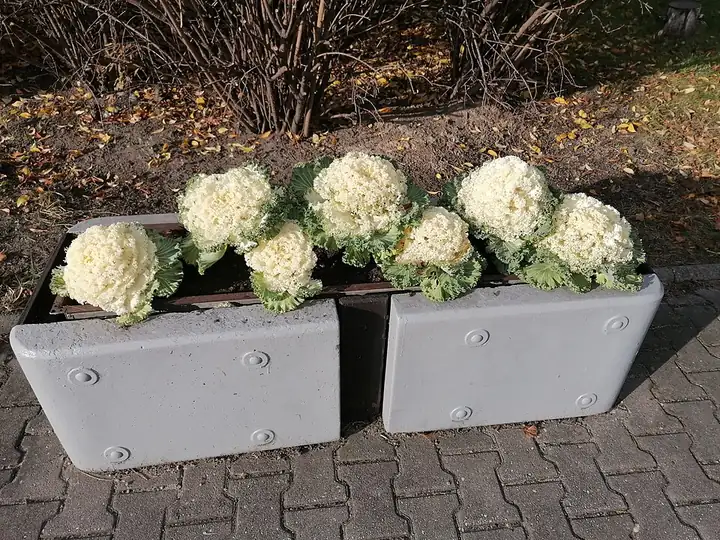
Ornamental kale and cabbage
Brassica oleracea (ornamental kale group; flowering kale and flowering cabbage) · Mustard family (Brassicaceae)
| Hardiness zones | 2 to 11 |
|---|---|
| Sun | full sun |
| Water | moderate |
| Life cycle | biennial |
| Frost | Hardy: takes frost |
| Soil pH | 6.0–8.0 |
| Spacing | 12 to 18 inches |
About Ornamental kale and cabbage
Ornamental (flowering) kale and cabbage are the same species as garden kale and cabbage, bred for big rosettes with white, pink, red or purple centers instead of for eating. In the trade, 'kale' types have fringed, curly or feathery leaves and 'cabbage' types have broad, flat leaves edged in color. They are the star of fall and winter beds and pots, coloring up as nights turn cold and holding on into winter. For eating, see the kale record.
Grown as a cool-season annual in every zone (UF lists it for all zones); once used to the cold, plants survive down to about 5 F and may last into spring in the South (NC State).
When to plant
Timing is counted from your average last spring frost (and first fall frost). Sow & Tell works out the actual dates for your ZIP code.
No bloom count here: it's grown for colored leaves. For fall color, sow in early summer: UMass sows in June for September plants (about 11 weeks to a finished pot), and Cornell sows about 3 months before cool fall weather and transplants after 4-5 weeks. Seed sprouts in 4-6 days at 65-70 F (UMass); keep seedlings cool or they may bolt (NC State). Most gardeners buy transplants in fall and set them deep, so the lowest leaves sit right at the soil (NC State Brunswick, Mississippi State); plants won't grow much bigger after planting. In Florida, UF plants from November to February.
Soil
Rich, moist, well-drained garden soil with plenty of organic matter; keep it evenly moist, since cold, dry fronts can parch it (NC State, Mississippi State).
Work 3-4 inches of organic matter into the bed with about 2 lb of slow-release 12-6-6 per 100 sq ft (NC State Brunswick); follow a soil test.
Feeding
- About every 4 weeks after planting: water-soluble fertilizer such as 20-10-20 or 20-20-20. Mix and apply as the label directs; keep it up through the cool season (Mississippi State).
- Once nights turn cool and centers start to color: less fertilizer. Cut back on feeding: too much nitrogen now keeps the centers from coloring well (UMass).
Heavy nitrogen as the weather cools dulls the color (UMass); letting plants dry out yellows and drops the lower leaves (UMass).
Harvest
Centers color up after several nights below 50 F, with the best color 2-4 weeks after cool nights begin (55-60 F nights are ideal, UMass); plants hold their color into winter. In spring of their second year they send up yellow flower stalks; pull them then and replant with summer annuals (UF). Long-stemmed cut types last 1-2 weeks in a vase (Cornell).
Varieties (17)
| Variety | Type | Days | Notes |
|---|---|---|---|
| Redbor | Curly kale | Long-lived, frilly, solid purple-red leaves; held up into July and August in south Mississippi. | |
| Giraffe | Cut-flower kale | Purple or white heads on about 24-in stems; bolted early in zone 7 heat in trials. | |
| Crane | Cut-flower kale (F1) | Long stems topped with rosettes in red, white, pink or bicolor; more uniform than older open-pollinated cut types, and very long lasting in the vase. | |
| Sunrise | Cut-flower kale (open-pollinated) | Creamy white center on a long stem. | |
| Sunset | Cut-flower kale (open-pollinated) | Red center on a long stem; did best in cool weather in NC State trials. | |
| Coral Prince | Feather-leaf kale | Creamy white center with feathery green leaves. | |
| Coral Queen | Feather-leaf kale | Deep red center with finely cut green leaves. | |
| Peacock | Feather-leaf kale | Compact, with deeply cut, feathery leaves; Red Peacock and White Peacock (bluish-green leaves with white veins, 6-12 in tall) are common. | |
| Color Up | Flowering cabbage (smooth leaf) | Upright growth; white, blush pink or fuchsia centers. | |
| Osaka | Flowering cabbage (smooth leaf) | Compact and fast; pink, red or white centers. | |
| Pigeon | Flowering cabbage (smooth leaf) | Round, semi-solid heads; Pigeon Purple has dark green outer leaves and purplish-red centers; also white and pink. | |
| Tokyo | Flowering cabbage (smooth leaf) | Smooth-edged cabbage type sold as a series. | |
| Chidori | Fringed-leaf kale | Very curly leaves; Red Chidori has bright magenta-red centers that darken, with magenta veins. | |
| Glamour Red | Fringed-leaf kale | Shiny, fringed leaves around a bright red head 10-12 in across. | |
| Kamome | Fringed-leaf kale | Fringed leaves; comes in red and white. | |
| Nagoya | Fringed-leaf kale | Heavily crinkled, fringed leaves with fuchsia, rose, lavender, red or creamy white centers. | |
| Sparrow | Fringed-leaf kale | Fringed leaves; comes in red and white. |
Good neighbors
Pansy and viola, Snapdragon, Petunia, Chrysanthemum (garden mum), Swiss chard
NC State Extension suggests these as cold-tolerant container and bed partners (one kale in the center ringed with pansies); this is a design pairing, not a tested pest-control benefit.
Pests to watch for
Cabbage looper, Imported cabbageworm, Aphids, Flea beetles, Slugs
Diseases and problems
Downy mildew, Black rot, Blackleg (Phoma), Leaf spot
In the kitchen
The leaves are edible, for example torn into salads or stir-fries (Mississippi State, UF), though NC State notes kitchen kales taste better; it's mainly a display plant.
Safety: Only eat leaves from plants you grew yourself: display plants may be treated with growth regulators or pesticides that aren't meant for food crops (UMass).
Pets: Not listed by the ASPCA. NC State's Plant Toolbox tags it a possible problem for horses.
Sources
- plants.ces.ncsu.edu
- brunswick.ces.ncsu.edu
- umass.edu
- blogs.cornell.edu
- planttalk.colostate.edu
- extension.msstate.edu
- journals.flvc.org
- aspca.org
Photo: Photo: Abraham / Wikimedia Commons, CC BY 4.0 (CC BY 4.0). Photo resized for the web.

Planting dates and advice are general guidance; check with your local Cooperative Extension office for your area.