
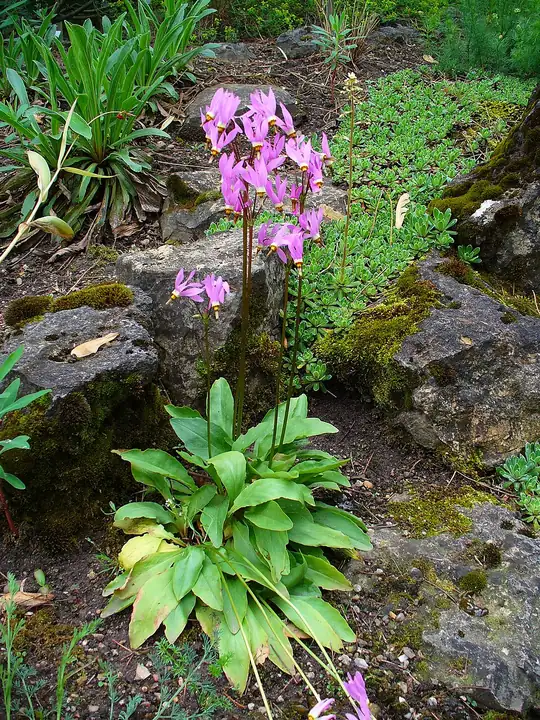
Shooting star
Primula meadia (formerly Dodecatheon meadia) · Primrose family (Primulaceae)
| Hardiness zones | 4 to 8 |
|---|---|
| Sun | part shade |
| Water | moderate |
| Life cycle | perennial |
| Frost | Hardy: takes frost |
About Shooting star
Shooting star is a native spring wildflower with clusters of 8-20 nodding flowers whose petals sweep straight back, so each bloom looks like a tiny falling star (Wisconsin Extension, NC State). It is native to meadows, prairies and open woods of the central and eastern U.S., from southern Wisconsin and western Pennsylvania south to eastern Texas and Georgia. Botanists have moved it from Dodecatheon into the primrose genus Primula, so you'll see both names. The leaves fade and the plant goes dormant by midsummer, so mark the spot. Buy nursery-grown plants rather than digging them from the wild (Missouri Extension).
Hardy in zones 4-8 (NC State, Wisconsin Extension). Native and not invasive; it spreads only slowly as rosettes make offsets.
When to plant
Timing is counted from your average last spring frost (and first fall frost). Sow & Tell works out the actual dates for your ZIP code.
Divide clumps in fall while they're dormant (Wisconsin Extension). Seed is slow and tricky: sow it fresh in summer, or give it about 3 weeks of cold, moist chilling, and press it onto the surface without covering. Seedlings take 3-4 years to bloom, so we give no day count to first flowers.
Soil
Humus-rich, well-drained soil that is moist in spring; it tolerates clay and rocky or sandy soil but not soggy ground, and summer drought doesn't hurt it once it's dormant (Wisconsin Extension, NC State).
Mix in leaf compost or other organic matter for humus-rich, well-drained soil; test the soil first in a new spot (Missouri Extension, Wisconsin Extension).
Feeding
- Late fall or winter, while dormant: a mulch of shredded leaves or leaf compost. Missouri Extension recommends mulch for shooting star; it keeps the soil cooler and more evenly moist. No fertilizer schedule is given.
Too much fertilizer weakens meadow wildflowers like this one (Missouri Extension), and it can't compete with big plants crowding it.
Harvest
Blooms in mid to late spring (about April-May) on leafless stalks up to 18 inches tall (Wisconsin Extension, Missouri Extension). There's no need to deadhead; leave the stalks if you want the seed capsules. Let the leaves yellow and fade on their own by midsummer. The large-flowered 'Goliath' can be cut for small vases.
Varieties (4)
Wisconsin Extension documents 4 named forms; we found no others in extension sources.
| Variety | Type | Days | Notes |
|---|---|---|---|
| Aphrodite | Cultivar | Dark pink flowers with yellow tips, about twice the size of the wild type, on bigger plants. | |
| Goliath | Cultivar | Larger flowers on stalks about 2 ft tall. | |
| Queen Victoria | Cultivar | Free-flowering, with large light pink blooms and a wide yellow-and-white band at the base. | |
| Alba | White form (P. meadia f. album) | Pure white flowers. |
Good neighbors
Bloodroot, Prairie smoke, Trillium, Twinleaf, Prairie dropseed
These are design pairings, not pest-control companions: Wisconsin Extension suggests bloodroot, prairie smoke, trillium and twinleaf for a spring show, and prairie dropseed or groundcovers to hide the fading leaves.
In the kitchen
Safety: None of the extension sources we checked lists it as poisonous, but it is not a food plant and we found no source on its safety to eat, so don't eat it.
Pets: Not listed by the ASPCA (no shooting star or Dodecatheon entry on its plant lists that we could check). The ASPCA's 'Primrose' entry, which is toxic to dogs, cats and horses, is a different species, the English primrose (Primula vulgaris).
Sources
- plants.ces.ncsu.edu
- hort.extension.wisc.edu
- mastergardener.extension.wisc.edu
- extension.missouri.edu
- aspca.org
- aspca.org
- aspca.org
- aspca.org
Photo: Photo: H. Zell, CC BY-SA 3.0, via Wikimedia Commons (CC BY-SA 3.0). Photo resized for the web.

Planting dates and advice are general guidance; check with your local Cooperative Extension office for your area.