
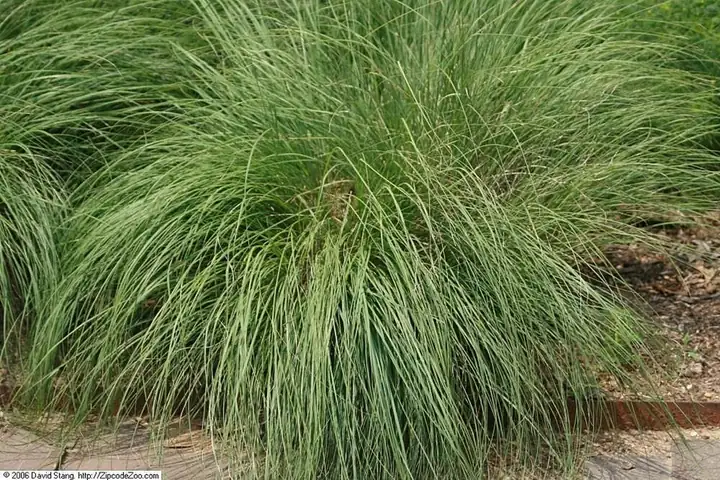
Prairie dropseed
Sporobolus heterolepis · Grass family (Poaceae)
| Hardiness zones | 3 to 9 |
|---|---|
| Sun | full sun |
| Water | low |
| Life cycle | perennial |
| Frost | Hardy: takes frost |
About Prairie dropseed
Prairie dropseed is a fine-textured native bunchgrass that makes a neat, fountain-like mound of thread-thin leaves, with airy pink-and-brown flower heads in late summer that smell like popcorn or coriander to many people (NC State, Wisconsin Extension). It is native mainly to the Great Plains, from Quebec to Saskatchewan and locally south to North Carolina, Kentucky, east Texas and Colorado (Wildflower Center, Wisconsin Extension). Fall color is golden orange fading to copper, it stands up to snow, and sparrows and juncos eat the seeds.
Hardy in zones 3-9 (NC State, Wisconsin Extension). NC State notes it is listed as endangered in seven eastern states, North Carolina among them, where it grows at the edge of its range.
When to plant
Timing is counted from your average last spring frost (and first fall frost). Sow & Tell works out the actual dates for your ZIP code.
Plant nursery plugs or divisions in spring once growth starts, with the crown level with the soil (Wisconsin Extension, Clemson). It is slow: plants take about three seasons to reach full size, and seed-grown plants about four years to bloom (Wildflower Center, Wisconsin Extension). Seed is hard to sprout; sow untreated seed outdoors in fall, or start it indoors 10-12 weeks before the last frost.
Soil
Well-drained soil, best dry and rocky, but it tolerates clay, sand and short wet spells, so it suits the upper edge of a rain garden; it also handles black walnut (NC State, Wisconsin Extension).
No special prep; it prefers lean, well-drained soil. Set the crown even with the soil surface (Wisconsin Extension, Clemson).
Feeding
- Spring, only if a soil test shows a need: fertilizer only as a soil test recommends. Most ornamental grasses need very little fertilizer; extra nitrogen makes weak, floppy stems (Clemson).
Don't expect fast results: it is slow to establish and dense clumps are hard to divide (Wildflower Center, Wisconsin Extension). Cut old leaves down in late winter or early spring before new growth.
Varieties (1)
Generally only the species is sold (Wisconsin Extension); 1 named cultivar is documented.
| Variety | Type | Days | Notes |
|---|---|---|---|
| Tara | Cultivar | A dwarf selection; no height is given in the source. |
Good neighbors
Little bluestem, Purple coneflower (echinacea), Black-eyed Susan, Blazing star (liatris), Coreopsis (tickseed), Goldenrod
Wisconsin Extension suggests it as a filler among prairie plants such as purple coneflower, blazing star, black-eyed Susan, coreopsis, small goldenrods and little bluestem; these are design pairings, not pest-control ones.
In the kitchen
Safety: No toxicity is reported in the sources we checked. Native Americans once ground the seed into flour (NC State, Wisconsin Extension), but that is history, not a suggestion to eat it.
Pets: Not listed by the ASPCA.
Sources
Photo: Photo: David J. Stang / Wikimedia Commons, CC BY-SA 4.0 (CC BY-SA 4.0). Photo resized for the web.

Planting dates and advice are general guidance; check with your local Cooperative Extension office for your area.