
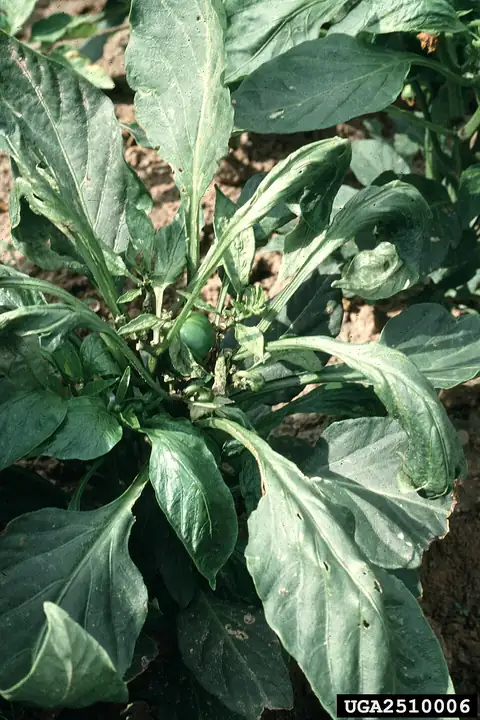
Broad mite
Polyphagotarsonemus latus
| Type | Mite |
|---|---|
| Pressure by region | Moderate: Southeast, South Central, Southwest, California, Hawaii |
About
A mite far smaller than a spider mite, only about 0.2 mm long, so you need strong magnification to see it. It feeds in the newest growth and often arrives on infested transplants.
Spotting it
Damage
New leaves turn narrow, thick and 'strappy,' curl down and become distorted, and growing tips stop growing. Flowers drop, and fruit gets rough, russet-brown or corky skin that may crack. On tomatoes, badly damaged leaves bronze and die.
How to find it early
Suspect broad mites when new growth is twisted and stunted but you see no insects. With a strong hand lens, look on young leaves for the eggs, which are clear ovals covered in rows of white dots (UF/IFAS, CTAHR).
When
Warm weather outdoors; any time of year in greenhouses, high tunnels and warm climates.
Life cycle
It goes from egg to adult in only 4 to 6 days (CTAHR), and males carry the young females to fresh new leaves (UF/IFAS). Broad mites do not survive outdoor winters well, but they carry over in greenhouses and high tunnels and live year-round in warm places (Mississippi State, UMD).
What to do, gentlest first
Start at the top. Sprays are a last step; always read and follow the product label.
Start with clean transplants Prevent
Use clean plants and keep new ones away from infested ones (UF/IFAS). Some whiteflies can carry the mites from plant to plant, so control them too (UF/IFAS).
Pull badly damaged plants By hand
Remove heavily damaged plants so the mites cannot spread to the rest (UF/IFAS).
Predatory mites and natural enemies Natural enemies
Several predatory mites eat broad mites and can be bought. Help wild ones by keeping dust down, managing ants and avoiding broad-spectrum sprays (UF/IFAS).
Horticultural oil, insecticidal soap, neem oil or sulfur Organic spray
Spray when new growth appears, and cover the growing tips and the undersides of leaves well (UF/IFAS). None of these move inside the plant, so repeat as the label allows (Mississippi State). Sulfur can take 2 to 3 weeks to work (CTAHR).
Sulfur and oils can burn plants in hot, humid weather (UMD). Horticultural oil can harm bees it hits for up to about 3 hours (PNW 591), so spray in the evening away from flowers. Read and follow the label and observe the pre-harvest interval.
Bifenthrin Conventional spray
Mississippi State lists bifenthrin among home-garden options for broad mites.
Bifenthrin is highly toxic to bees (PNW 591) and kills the predators that help keep mites down; UF/IFAS prefers mite-specific products for that reason. Never spray when plants are flowering or bees are present. Read and follow the label and observe the pre-harvest interval.
Garden friends that go after it
Predatory mites
Protect these helpers: skip broad sprays when they're around.
Plants it goes after
Chaya (tree spinach), Cucumber, Eggplant, Green beans (snap beans), Pepper (sweet and chili), Tomato, Watermelon
Pressure by region
CTAHR says it is on all the major Hawaiian islands, and UF/IFAS treats it as a pepper problem in Florida gardens. Mississippi State notes it survives winter poorly outdoors, so in colder regions it mostly shows up on greenhouse-grown transplants or in high tunnels. All ratings except Hawaii's are estimates.
| Northeast | Low |
|---|---|
| Southeast | Moderate |
| South Central | Moderate |
| Midwest | Low |
| Great Plains | Low |
| Mountain West | Low |
| Southwest | Moderate |
| Pacific Northwest | Low |
| California | Moderate |
| Alaska | Low |
| Hawaii | Moderate |
Ratings come from extension sources where available; some are estimates, as noted above.
Sources
- extension.msstate.edu
- extension.umd.edu
- blogs.ifas.ufl.edu
- entnemdept.ufl.edu
- journals.flvc.org
- cms.ctahr.hawaii.edu
- s3.wp.wsu.edu
- ask.ifas.ufl.edu
Photo: Photo: David Riley, University of Georgia, Bugwood.org, CC BY 3.0, via Wikimedia Commons (CC BY 3.0). Photo resized for the web.

Planting dates and advice are general guidance; check with your local Cooperative Extension office for your area.