
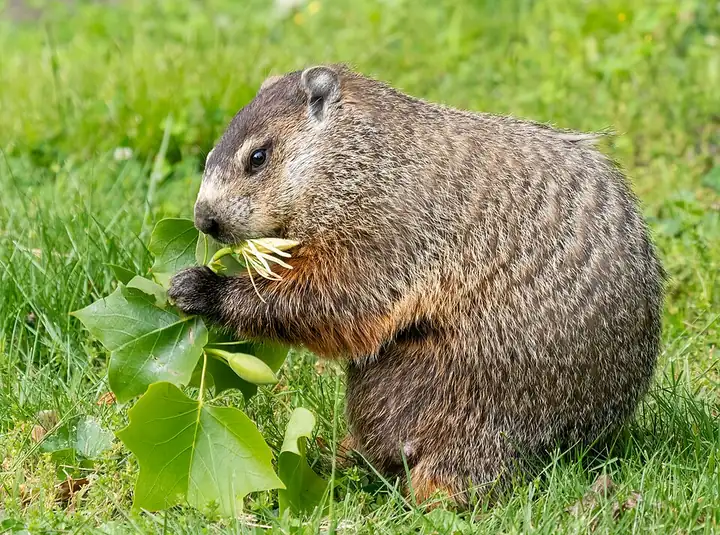
Groundhog (woodchuck)
Marmota monax
| Type | Animal |
|---|---|
| When | Early spring through fall. |
| Pressure by region | Moderate: Northeast, Southeast, Midwest |
About
A heavy-bodied, grizzled brown rodent weighing about 5 to 10 pounds that digs large burrows and eats garden crops, especially beans and peas. Groundhogs are strong diggers and good climbers, so fences need to stop both.
Spotting it
Damage
Plants are eaten down; beans, peas, squash, tomatoes and carrot tops are favorites. The main burrow entrance is 10 to 12 inches across with a big mound of dirt in front, and there are usually one to three hidden back doors.
How to find it early
Look for large burrow holes with fresh dirt mounds near the garden, and watch in early morning and evening, when they feed.
When
Early spring through fall.
Life cycle
Groundhogs hibernate from about late October or November until late February or March, then breed in March and April. A single litter of two to six young (usually four) is born each year.
What to do, gentlest first
Start at the top. Sprays are a last step; always read and follow the product label.
Buried, climb-proof fence Barrier
Build a fence of heavy poultry wire or 2-inch woven mesh standing 3 to 4 feet above ground. Bury it 12 inches deep with the bottom 6 inches bent outward in an L so they cannot dig under.
Groundhogs climb, so add a single electric wire 4 to 5 inches off the ground outside the fence. Keep children and pets clear of electric wires, and use a charger made for fencing.
Live trapping is regulated Trap
Groundhogs are game animals in some states and unprotected in others. A live trap must be at least 10 x 10 x 24 inches, and some states, such as Pennsylvania, do not allow trapped groundhogs to be moved to other properties.
Trapping and relocating wildlife is regulated by state law, and the rules differ from state to state. Check with your state wildlife agency before you set a trap.
Few good options Repellent
No repellents are registered for woodchucks in Pennsylvania. Scarecrows give only brief relief, so move them often.
Plants it goes after
Carrot, Edamame, Green beans (snap beans), Peas, Tomato, Winter squash and pumpkin, Zucchini and summer squash
Pressure by region
Woodchucks live in eastern and central North America, reaching west to northern Idaho, central Nebraska, eastern Kansas and northeastern Oklahoma, south to northern Alabama, and into parts of Alaska (ICWDM). Regions at or beyond the edge of that range are rated low, not absent; all ratings are estimates made without a regional severity source.
| Northeast | Moderate |
|---|---|
| Southeast | Moderate |
| South Central | Low |
| Midwest | Moderate |
| Great Plains | Low |
| Mountain West | Low |
| Southwest | Low |
| Pacific Northwest | Low |
| California | Low |
| Alaska | Low |
| Hawaii | Low |
Ratings come from extension sources where available; some are estimates, as noted above.
Sources
Photo: Photo: Rhododendrites, CC BY-SA 4.0, via Wikimedia Commons (CC BY-SA 4.0). Photo resized for the web.

Planting dates and advice are general guidance; check with your local Cooperative Extension office for your area.