
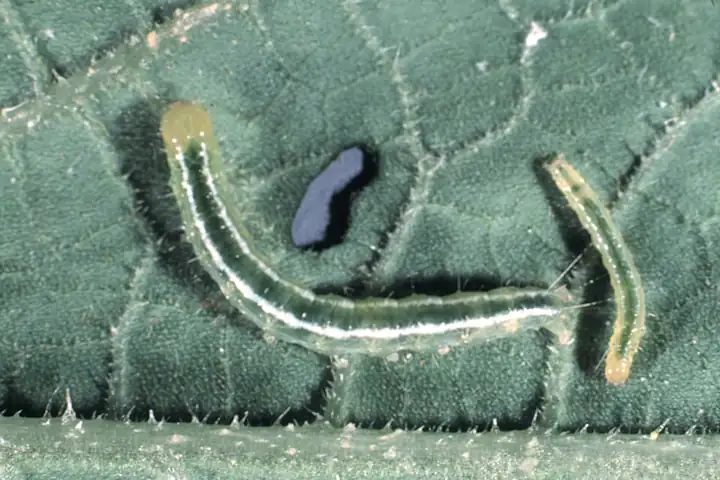
Melonworm
Diaphania hyalinata
| Type | Insect |
|---|---|
| When | Midsummer to fall; much of the year in south Florida. |
| Pressure by region | Moderate: Southeast, South Central |
About
A slender green caterpillar with two white stripes down its back, the young of a moth with pearly white wings edged in dark brown. It is a close cousin of the pickleworm but feeds mostly on leaves, especially squash leaves.
Spotting it
Damage
Caterpillars eat the leaf tissue between the veins, leaving lacy leaves. On less favored plants such as melons they also scar the rind or bore into the fruit.
How to find it early
Check the undersides of squash leaves for green caterpillars with two white stripes, and watch for lacy feeding starting in midsummer.
When
Midsummer to fall; much of the year in south Florida.
Life cycle
It survives winter only in south Florida and perhaps south Texas, then spreads north each summer, reaching the Southeast by July and sometimes New England and the Great Lakes. A generation takes about 30 days, and no more than three usually occur in temperate areas before frost kills the plants.
What to do, gentlest first
Start at the top. Sprays are a last step; always read and follow the product label.
Plant early and clean up Prevent
Early plantings often escape serious damage, and destroying vines after harvest removes pupae.
Row cover Barrier
Row covers keep the moths from laying eggs.
Squash and melons need bees to set fruit, so uncover them when the flowers open.
Natural enemies Natural enemies
Parasitic wasps and flies, predatory beetles and fire ants kill melonworms; parasitism can reach about a quarter of the caterpillars.
Bt (Bacillus thuringiensis) Natural enemies
Bt sprays control melonworm; spray while caterpillars are small.
Bt carries no bee warning on its label.
Pyrethroids Conventional spray
Mississippi State lists permethrin, bifenthrin and zeta-cypermethrin for melonworm in home gardens.
Highly toxic to bees, which squash and melons need for pollination. Spray only in the evening, keep sprays off open flowers, and follow the label and pre-harvest interval.
Plants it goes after
Cantaloupe (muskmelon), Chayote, Watermelon, Winter squash and pumpkin, Zucchini and summer squash
Pressure by region
Mainly a southern pest that arrives later in the season farther north (UF/IFAS). South Central is rated moderate because it may overwinter in south Texas. Other low ratings, including Alaska and Hawaii, are estimates.
| Northeast | Low |
|---|---|
| Southeast | Moderate |
| South Central | Moderate |
| Midwest | Low |
| Great Plains | Low |
| Mountain West | Low |
| Southwest | Low |
| Pacific Northwest | Low |
| California | Low |
| Alaska | Low |
| Hawaii | Low |
Ratings come from extension sources where available; some are estimates, as noted above.
Sources
Photo: Photo: Alton N. Sparks, Jr., Bugwood.org, CC BY 3.0 US, via Wikimedia Commons (CC BY 3.0 US). Photo resized for the web.

Planting dates and advice are general guidance; check with your local Cooperative Extension office for your area.