
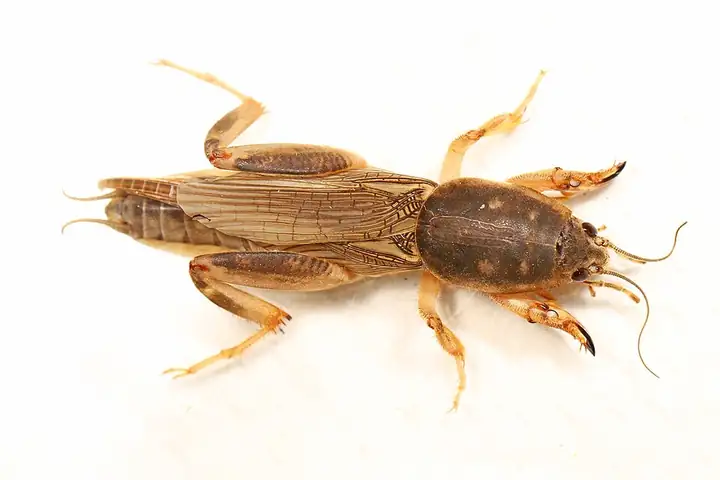
Mole crickets
Tawny (Neoscapteriscus vicinus), southern (N. borellii) and shortwinged (N. abbreviatus) mole crickets, all introduced from South America; the native northern mole cricket (Neocurtilla hexadactyla) is not a pest
| Type | Insect |
|---|---|
| Pressure by region | High pressure: Southeast |
About
Velvety brown insects about 1 to 1 1/4 inches long with shovel-like front legs built for digging. Three species arrived in the Southeast around 1900 and are now among the worst lawn pests on the Gulf Coast, and they also cut down vegetable seedlings (Alabama Extension, UF/IFAS).
Spotting it
Damage
Tunnels push up small mounds of soil and loosen roots, so turf dries out, thins and dies, especially bahiagrass, bermudagrass and zoysia; tawny mole crickets also eat grass roots and shoots (Alabama Extension, NC State). In gardens they cut seedlings off at the soil line, pull them underground or dry them out by tunneling (UF/IFAS). Armadillos and birds digging for them can do more harm than the insects (Alabama Extension).
How to find it early
Mix 2 tablespoons of liquid dish soap in a gallon of water and pour it over 1 to 2 square feet of damaged turf; mole crickets crawl up within minutes. Water afterward so the soap doesn't scald the grass (Alabama Extension).
When
Mating flights in late winter and spring; seedlings at risk in spring; lawn damage worst from late summer into fall as nymphs grow.
Life cycle
Adults fly and mate in late winter and spring (February and March on the Gulf Coast), females lay eggs underground in spring, and nymphs hatch from about May into June and feed through summer. There is usually one generation a year (two in South Florida), and they spend winter as nymphs or adults (Alabama Extension, UF/IFAS).
What to do, gentlest first
Start at the top. Sprays are a last step; always read and follow the product label.
Choose tougher grass Prevent
Coarser bermudagrass types suffer less than fine hybrids, and some zoysia and bermudagrass cultivars tolerate tawny mole crickets; bahiagrass is very susceptible (NC State, Alabama Extension).
Soap flush to find hot spots By hand
Use the soap flush in spring and early summer to find where mole crickets are and when the young have hatched, and pick up the ones that surface (Alabama Extension).
Larra wasps and nematodes Natural enemies
A small wasp, Larra bicolor, now established in Alabama, Georgia, Mississippi and Florida, paralyzes mole crickets and lays eggs on them; nectar flowers such as pentas feed the adult wasps. An insect-killing nematode, Steinernema scapterisci, also attacks mole crickets in moist soil (Alabama Extension, NC State).
Alabama Extension says the main mole cricket nematode product appears to be off the market.
Treat young nymphs in early summer Conventional spray
Treatments work best on small nymphs soon after egg hatch, roughly May through June, rather than on big crickets in fall (Alabama Extension, NC State). Homeowner lawn products include bifenthrin and other pyrethroids, and carbaryl bait.
Pyrethroids and carbaryl are highly toxic to bees (PNW 591), so keep them off blooming clover and weeds. Some guides list neonicotinoids such as imidacloprid; they harm pollinators, so skip them. Never use a lawn product in a vegetable bed unless the label names the crop, and follow the label.
Plants it goes after
Cabbage, Cantaloupe (muskmelon), Carrot, Collards, Eggplant, Lettuce, Onion, Pepper (sweet and chili), Potato, Strawberry, Sweet potato, Tomato
Pressure by region
The pest species live mainly on the southern coastal plain: tawny from North Carolina to Louisiana and all of Florida, southern from North Carolina to Arizona and recently found in California, and shortwinged mostly in South Florida (UF/IFAS, NC State). Ratings outside the Southeast are estimates.
| Northeast | Low |
|---|---|
| Southeast | High pressure |
| South Central | Moderate |
| Midwest | Low |
| Great Plains | Low |
| Mountain West | Low |
| Southwest | Low |
| Pacific Northwest | Low |
| California | Low |
| Alaska | Low |
| Hawaii | Low |
Ratings come from extension sources where available; some are estimates, as noted above.
Sources
Photo: Photo: Judy Gallagher / Wikimedia Commons, CC BY 2.0 (CC BY 2.0). Photo resized for the web.

Planting dates and advice are general guidance; check with your local Cooperative Extension office for your area.