
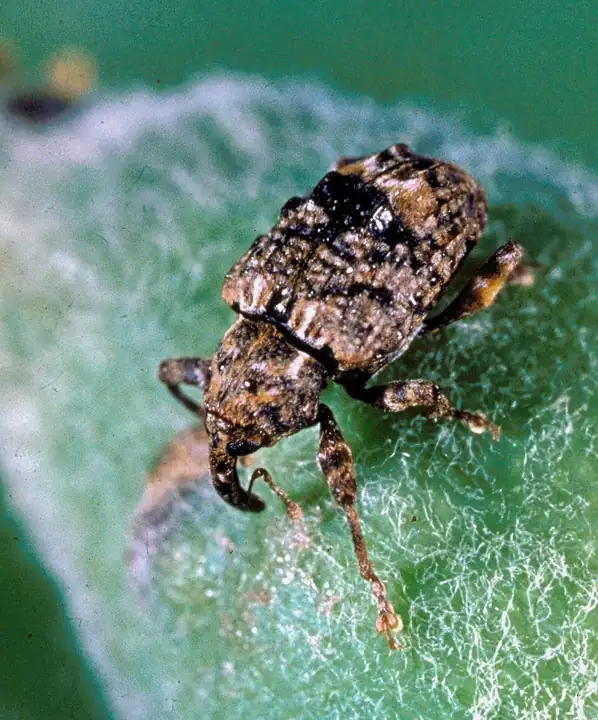
Plum curculio
Conotrachelus nenuphar
| Type | Insect |
|---|---|
| Pressure by region | High pressure: Northeast, Southeast |
About
A quarter-inch, dark brown snout beetle with whitish patches and four humps on its back. It is a native weevil of eastern North America that lays eggs in young apples, pears and stone fruits.
Spotting it
Damage
Females cut a crescent-shaped flap next to each egg they lay, and adults also chew small round feeding holes. Grubs tunnel inside, so fruit becomes lumpy, rots or drops early. Stone fruits suffer more, because in apples and pears the growing fruit often crushes the young grub.
How to find it early
From petal fall on, look for crescent scars on small fruit. Tap branches over a light-colored sheet and look for the small beetles that fall.
When
Spring into early summer. Activity peaks in the first warm spell after petal fall, when highs reach 70°F or more (Penn State).
Life cycle
Adults spend winter in sheltered spots and become active in spring when temperatures pass about 50°F, laying eggs from petal fall for roughly a month. There is one generation a year in Pennsylvania and Utah; in South Carolina a second brood of adults turns up from mid-June into July.
What to do, gentlest first
Start at the top. Sprays are a last step; always read and follow the product label.
Pick up drops and remove wild hosts Prevent
Collect fallen fruit through early summer so grubs cannot finish growing in the soil. Where you can, remove wild plums, abandoned fruit trees and hawthorns nearby, which keep the population going (USU).
Trees next to woods get hit hardest.
Jar the beetles onto a sheet By hand
Spread a sheet under the tree and sharply tap the limbs; destroy the beetles that fall. Repeat every few days after petal fall.
Kaolin clay film or fruit bags Barrier
Penn State says a kaolin clay film on leaves and fruit reduces egg-laying. Clemson suggests fruit bags put on when peaches are thumbnail size, about three weeks after bloom.
Kaolin washes off in rain and must be reapplied to keep fruit coated. Kaolin has no bee warning on its label (PNW 591).
Pyrethrins or neem (azadirachtin) Organic spray
USU lists pyrethrin and azadirachtin products for home use, starting at petal fall and repeating every 7 to 10 days while beetles are active.
Pyrethrins are highly toxic to bees and neem is toxic for a couple of hours (PNW 591), so do not spray until all petals have fallen, and spray in the evening. Follow the label and pre-harvest interval.
Petal-fall sprays of a labeled insecticide Conventional spray
Time the first spray for the first warm days after petal fall and keep intervals short during peak activity (Penn State). Clemson lists malathion, permethrin, esfenvalerate and carbaryl for peaches; USU lists gamma-cyhalothrin.
All of these are highly toxic to bees (PNW 591): never spray during bloom. Clemson notes a 7-day pre-harvest interval for malathion. Carbaryl has been a restricted-use pesticide in California since August 1, 2020 (UC IPM), so California home gardeners cannot buy it without an applicator license. Use only a product whose label lists your fruit, and follow its pre-harvest interval.
Plants it goes after
American plum (wild plum), Apple (backyard tree), Apricot, Beach plum, Cherry (sweet and tart), Cornelian cherry, Mayhaw, Nanking cherry, Peach, Pear, Plum, Quince
Pressure by region
California's quarantine lists every state from the Dakotas, Nebraska, Kansas, Oklahoma and Texas eastward, plus Box Elder and Salt Lake counties in Utah, as infested. USU says the Utah population is the only one west of the Rocky Mountains, so it is rated absent in California and the Pacific Northwest. The Southwest, Alaska and Hawaii are rated low for lack of a source that names them; they are likely free of it, but those ratings are estimates. Midwest, South Central and Great Plains ratings are also estimates.
| Northeast | High pressure |
|---|---|
| Southeast | High pressure |
| South Central | Moderate |
| Midwest | Moderate |
| Great Plains | Moderate |
| Mountain West | Low |
| Southwest | Low |
| Pacific Northwest | Not found here |
| California | Not found here |
| Alaska | Low |
| Hawaii | Low |
Ratings come from extension sources where available; some are estimates, as noted above.
Sources
Photo: Photo: Clemson University - USDA Cooperative Extension Slide Series, CC BY 3.0, via Wikimedia Commons (CC BY 3.0). Photo resized for the web.

Planting dates and advice are general guidance; check with your local Cooperative Extension office for your area.