
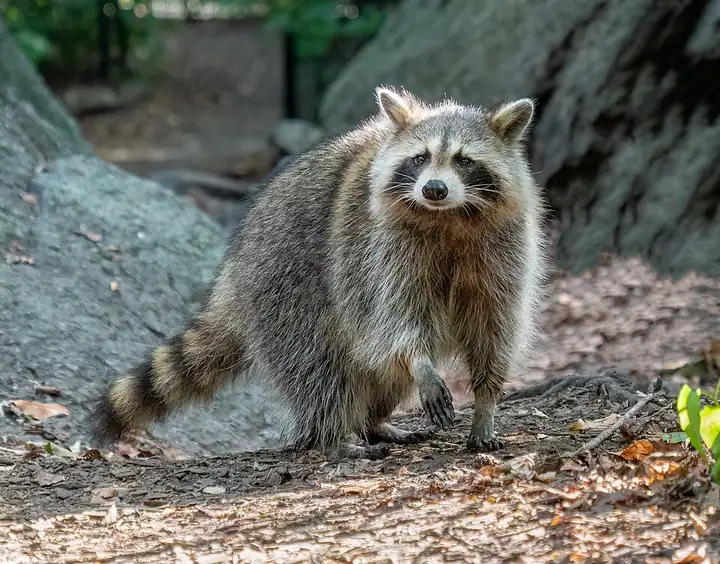
Raccoon
Procyon lotor
| Type | Animal |
|---|---|
| When | Spring through fall; worst as sweet corn, melons, grapes and tree fruit ripen. |
| Pressure by region | Moderate: Northeast, Southeast, South Central, Midwest, Great Plains, Mountain West, Southwest, Pacific Northwest, California |
About
A ring-tailed animal with a black mask, about 2 to 3 feet long and 7 to 30 pounds. Raccoons eat almost anything, and they are notorious for raiding sweet corn, melons, grapes and tree fruit such as peaches, often right before harvest.
Spotting it
Damage
Raccoons climb or pull down cornstalks, then partly husk the ears and eat them, leaving broken stalks and half-eaten ears. They dig a small hole in melons and hollow them out, leave piles of grape skins or peach pits under the plants, and roll back sod or new turf looking for grubs and worms.
How to find it early
Raccoons feed at night, so check in the morning for broken stalks, husked ears, hollowed melons and five-toed tracks (the hind print is about 3 1/4 to 4 1/2 inches long). Sweet corn is most at risk at the milk stage, when the kernels are juicy.
When
Spring through fall; worst as sweet corn, melons, grapes and tree fruit ripen.
Life cycle
Raccoons mate mostly from January to March, and a litter of about 3 to 5 young is born in April or May. The young stay with their mother until late summer or longer, and the family dens in hollow trees, under decks, or in attics and chimneys.
What to do, gentlest first
Start at the top. Sprays are a last step; always read and follow the product label.
Take away food and den sites Prevent
Keep pet food, birdseed and garbage in a garage or shed or in tightly closed cans. Cut back tree limbs that hang over the roof, leaving a gap of about 5 feet, and cap chimneys so raccoons cannot den there.
Watch out for raccoon roundworm Prevent
Raccoon droppings can carry the eggs of raccoon roundworm, which can cause serious illness if people swallow or breathe them in; small children are most at risk. Raccoons use the same toilet spots (latrines) at the base of trees and on logs, woodpiles, decks and roofs, and the droppings look like small dark dog droppings, often with seeds in them. Cover sandboxes and keep children away from droppings.
Do not clean up a latrine bare-handed. Wear disposable gloves and rubber boots, and seal the droppings in heavy-duty plastic bags. Bleach and other household disinfectants do not kill roundworm eggs. For a large or indoor latrine, follow the cleanup steps from your state health or wildlife agency.
Two-wire electric fence Barrier
Ordinary fences do not stop raccoons, which climb. Put up an electric fence with one wire about 6 inches above the ground (Iowa State says 4 to 6 inches) and a second at 12 inches, about 2 weeks before sweet corn reaches the milk stage. It only needs to be on from dusk to dawn.
Use a charger made for electric fencing and follow its directions, and post signs so children and visitors know the fence is live.
Wrap the ears Barrier
In a small corn patch, wrapping ripening ears with filament tape or covering them with bags can slow raccoons down.
Trapping is regulated Trap
Moving raccoons is often illegal. California, where raccoons are classed as furbearers, forbids relocating raccoons without written permission from the Department of Fish and Wildlife, Maryland law forbids relocating a trapped raccoon, and North Carolina requires a trapping license in season or a depredation permit out of season. For a problem animal, call your state wildlife agency or a licensed wildlife control operator.
Raccoons can carry rabies and distemper. Stay away from one that seems sick, aggressive, unsteady or unusually tame, and report it to animal control. Keep pets' rabies shots up to date. Never handle a wild animal, live or dead, with bare hands. Trapping and relocating wildlife is regulated by state law, and the rules differ from state to state. Check with your state wildlife agency or your county Extension office before you set a trap.
Skip repellents Repellent
UC IPM reports that no commercial repellent has worked against raccoons, and home remedies fail because raccoons adapt quickly.
Plants it goes after
Cantaloupe (muskmelon), Grape, Peach, Pineapple, Starfruit (carambola), Sweet corn, Watermelon
Pressure by region
Raccoons live throughout most of the lower 48 states; no regional severity source was found, so those moderate ratings are estimates. Alaska: raccoons are not native, and the island populations once introduced there are gone (Alaska Department of Fish and Game). Hawaii: raccoons are illegal there and treated as an invasive species; no source found describes a population, so the low rating is an estimate. Report any sighting to the state Pest Hotline at 808-643-PEST (7378).
| Northeast | Moderate |
|---|---|
| Southeast | Moderate |
| South Central | Moderate |
| Midwest | Moderate |
| Great Plains | Moderate |
| Mountain West | Moderate |
| Southwest | Moderate |
| Pacific Northwest | Moderate |
| California | Moderate |
| Alaska | Not found here |
| Hawaii | Low |
Ratings come from extension sources where available; some are estimates, as noted above.
Sources
- ipm.ucanr.edu
- ipm.ucanr.edu
- yardandgarden.extension.iastate.edu
- naturalresources.extension.iastate.edu
- extension.umd.edu
- extension.missouri.edu
- extension.usu.edu
- fruitscout.mgcafe.uky.edu
- fruitscout.mgcafe.uky.edu
- byf.unl.edu
- content.ces.ncsu.edu
- umass.edu
- nrm.dfg.ca.gov
- adfg.alaska.gov
- dab.hawaii.gov
Photo: Photo: Rhododendrites, CC BY-SA 4.0, via Wikimedia Commons (CC BY-SA 4.0). Photo resized for the web.

Planting dates and advice are general guidance; check with your local Cooperative Extension office for your area.