
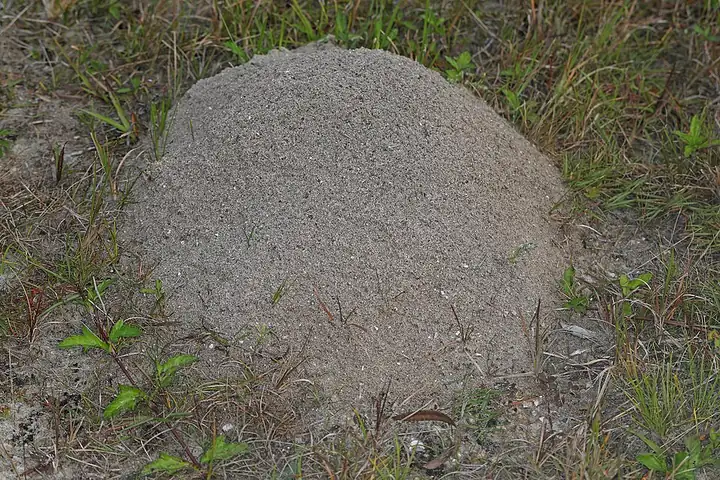
Red imported fire ant
Solenopsis invicta
| Type | Insect |
|---|---|
| Pressure by region | High pressure: Southeast, South Central |
About
A reddish-brown ant with a darker abdomen, 1/16 to 1/5 inch long, native to South America (UC IPM, UF, Hawaii Invasive Species Council). It builds dome-shaped mounds of loose soil and swarms out to sting anything that disturbs the mound.
Spotting it
Damage
Fire ants tunnel into potatoes and feed on okra buds and pods, and in dry weather they chew the stems of tender seedlings and transplants (Clemson, Texas A&M). They also feed on young growth and fruit and attack roots, which can thin out a planting (UF). Their stings burn and itch, then form white pustules that can take weeks to go away (UC IPM).
How to find it early
Look for dome-shaped mounds of loose soil up to about a foot high; in irrigated California yards they can look like gopher mounds. To check whether ants are foraging, put out a potato chip or other greasy food and look at it after about 30 minutes (UC IPM).
When
Active much of the year where it lives. UC IPM says baits work best at 70 to 90°F, when ants are out foraging; in hot weather, bait in the evening.
Life cycle
Ants grow from egg to adult in about 22 to 38 days, all inside the nest. A mature queen can lay 1,500 to 2,000 eggs a day, big colonies can hold up to 500,000 workers, and winged queens and males leave on mating flights to start new colonies.
What to do, gentlest first
Start at the top. Sprays are a last step; always read and follow the product label.
Look before you kneel Prevent
Check for mounds before you weed or harvest, since workers swarm up and sting anything touching the mound or their food (UC IPM).
Fire ant stings can be dangerous. NC State says about 2% of stings cause a whole-body allergic reaction, and a person's reaction can get worse with later stings. Get emergency help right away if someone who is stung has chest pain, nausea, dizziness, sweating, swelling of the face or throat, trouble breathing, slurred speech or signs of shock (UC IPM, UH CTAHR). Keep pustules clean, since they can get infected (UC IPM).
Shovel out or scald mounds By hand
Mounds inside the garden can be shoveled out or drenched with very hot water (Texas A&M).
Keep the hot water off your plants, and take care not to scald yourself. Expect stings when you disturb a mound.
Spinosad fire ant bait Organic spray
Clemson lists spinosad baits as labeled for vegetable gardens. Spread bait when the ground is dry and no rain is expected for a day or two; for a single mound, sprinkle it gently in a 4-foot circle over and around it. Baits are slow: results take two to three weeks (Clemson).
Most fire ant baits are not labeled for use inside vegetable gardens, so use only one that is, or bait around the garden edge (Texas A&M). Spinosad is toxic to bees for about 3 hours to a day (PNW 591). Read and follow the label and its pre-harvest interval; for spinosad products Clemson found intervals from 0 to 60 days, depending on the crop.
Permethrin or bifenthrin mound drench Conventional spray
Clemson lists permethrin and bifenthrin products labeled for vegetable gardens. A liquid drench works within a few hours: pour about a tenth of the mix in a ring a foot out from the mound and the rest right on top.
Both are highly toxic to bees (PNW 591). UC IPM says pyrethroid mound treatments mostly kill only the workers outside, so they do not give lasting control; baits work better. Never use acephate fire ant products in a vegetable garden; they are labeled for lawns only (Clemson). Read and follow the label and the pre-harvest interval (Clemson found 0 to 22 days for permethrin and 1 to 7 days for bifenthrin).
Plants it goes after
Cabbage, Cucumber, Eggplant, Green beans (snap beans), Okra, Potato, Sweet corn, Sweet potato
Pressure by region
USDA APHIS has fire ant quarantines in Alabama, Arkansas, California, Florida, Georgia, Louisiana, Mississippi, North Carolina, Oklahoma, South Carolina, Tennessee, Texas and Virginia; mainland regions and Alaska with no state on that map are rated absent. Hawaii's Invasive Species Council says it is not established in Hawaii (report suspicious ants at 643pest.org). In California it is in Orange, Los Angeles, Riverside, San Bernardino and San Diego counties. UF says it has reached New Mexico and Arizona, so the Southwest rating is an estimate. It is still spreading: report new finds to your state department of agriculture (in California, call 1-888-434-7326).
| Northeast | Not found here |
|---|---|
| Southeast | High pressure |
| South Central | High pressure |
| Midwest | Not found here |
| Great Plains | Not found here |
| Mountain West | Not found here |
| Southwest | Low |
| Pacific Northwest | Not found here |
| California | Moderate |
| Alaska | Not found here |
| Hawaii | Not found here |
Ratings come from extension sources where available; some are estimates, as noted above.
Sources
- hgic.clemson.edu
- entnemdept.ufl.edu
- aphis.usda.gov
- content.ces.ncsu.edu
- ipm.ucanr.edu
- fireant.tamu.edu
- s3.wp.wsu.edu
- dlnr.hawaii.gov
- ctahr.hawaii.edu
Photo: Photo: Judy Gallagher, CC BY 2.0, via Wikimedia Commons (CC BY 2.0). Photo resized for the web.

Planting dates and advice are general guidance; check with your local Cooperative Extension office for your area.