
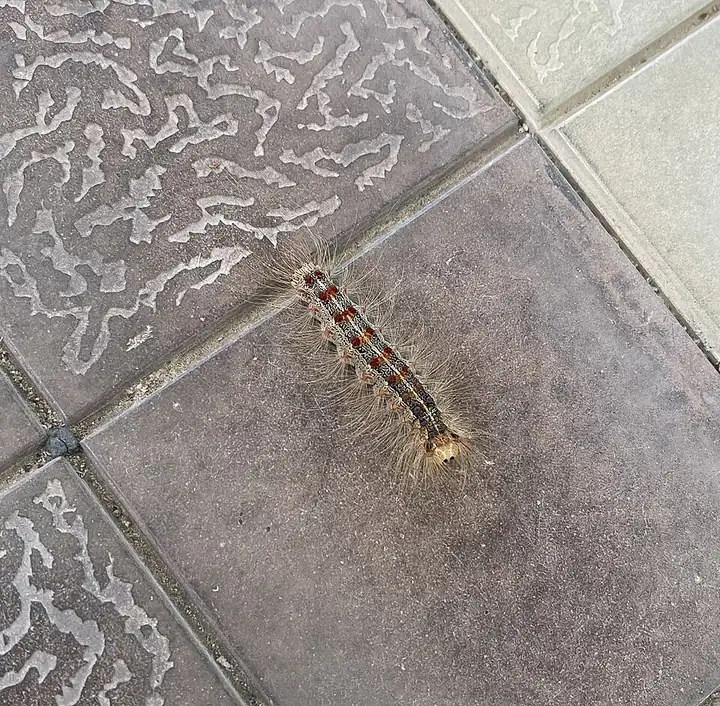
Spongy moth (formerly gypsy moth)
Lymantria dispar
| Type | Insect |
|---|---|
| Pressure by region | High pressure: Northeast, Midwest |
About
An invasive moth from Europe that escaped in Massachusetts in the late 1860s and used to be called the gypsy moth. Its hairy caterpillars eat the leaves of at least 500 kinds of trees, shrubs and vines, and fruit trees such as apple and cherry are among them.
Spotting it
Damage
Young caterpillars chew small holes in leaves. Older ones eat whole leaves down to the big veins and can strip a tree overnight, leaving brown frass pellets and leaf bits underneath. A healthy tree usually survives one year of total leaf loss, but several years in a row can cause branch dieback or kill the tree.
How to find it early
From August to April, look for tan, fuzzy egg masses about 1 inch long and 1/2 inch wide on trunks, branches, firewood, patio furniture and trailers. In spring, look for hairy caterpillars with five pairs of blue dots and then six pairs of red dots down the back.
When
Caterpillars feed late April through early July; egg masses are on view August through April
Life cycle
There is one generation a year. Winter is spent as tan, fuzzy egg masses of 500 or more eggs on bark and outdoor objects; they hatch from late April into May, the caterpillars feed for about six weeks, pupate in June, and the moths appear about 10 to 14 days later, in late June and July (females of this strain cannot fly).
What to do, gentlest first
Start at the top. Sprays are a last step; always read and follow the product label.
Check what you move; buy local firewood Prevent
Before moving out of an infested area, check outdoor items such as patio furniture, grills and trailers for egg masses. Buy firewood where you will burn it and don't carry it to new places.
Moving outdoor items out of a quarantine area may require inspection. Check APHIS's quarantine map for your county.
Scrape off egg masses By hand
Between August and late April, scrape egg masses off bark and other surfaces with a putty knife into a container of hot, soapy water. Scraping is slow work but cuts down next spring's caterpillars.
The caterpillars' hairs can irritate skin, and some people have allergy-type reactions, so wear gloves and don't handle caterpillars bare-handed.
Burlap bands Barrier
In mid- to late May, tie a burlap strip at least 18 inches wide around the trunk and fold the top half down to make a flap. Caterpillars hide under it by day; check daily, drop them into soapy water, and take the band off in late July.
Rutgers does not recommend sticky bands because they trap beneficial insects too. Bands won't stop tiny caterpillars that blow in on silk threads.
Let natural enemies work Natural enemies
In wet springs, a fungus (Entomophaga maimaiga) and a virus often crash outbreaks; caterpillars killed by the fungus hang head-down on trunks. Parasitic wasps and flies, ground beetles, ants and mice also eat caterpillars and pupae.
Bt (Bacillus thuringiensis kurstaki) on young caterpillars Natural enemies
Spray leaves when caterpillars are small and feeding in May. Bt works best on caterpillars under about 3/4 inch long that still have all-black heads.
Bt loses its punch on older caterpillars. Bee-hazard guides list no bee warning for Bt. Read and follow the label, including its pre-harvest interval on fruit trees.
Spinosad for older caterpillars Organic spray
Once caterpillars are too big for Bt, UMass lists spinosad as an option.
Spinosad is toxic to bees for about 3 hours to a day after spraying, so apply after bloom and only when bees are not flying. Read and follow the label, including the pre-harvest interval on fruit trees.
Hire a licensed applicator for big trees Conventional spray
Tall trees need power spray equipment, so Rutgers advises hiring a licensed professional. Several of the insecticides labeled for this pest are for certified applicators only.
Pyrethroids such as permethrin and bifenthrin are highly toxic to bees; spray after bloom and when bees are not active. Some guides also list neonicotinoids; skip them, because they are highly toxic to bees and turn up in pollen and nectar. Read and follow the label and the pre-harvest interval on fruit trees.
Garden friends that go after it
Trichogramma wasps
Protect these helpers: skip broad sprays when they're around.
Plants it goes after
Apple (backyard tree), Cherry (sweet and tart), Eastern hemlock, Hop-hornbeam (ironwood), Oaks (white, red and pin oak)
Pressure by region
USDA APHIS lists it as established in Connecticut, Delaware, the District of Columbia, Illinois, Indiana, Maine, Maryland, Massachusetts, Michigan, Minnesota, New Hampshire, New Jersey, New York, North Carolina, Ohio, Pennsylvania, Rhode Island, Vermont, Virginia, West Virginia and Wisconsin. It is still spreading, and APHIS says every state is at risk because egg masses ride along on firewood, outdoor furniture, grills and trailers. Regions with no established population are rated low, not absent, for that reason; the Midwest and Southeast ratings are estimates. Report new finds to your state department of agriculture (your state plant regulatory official) or county Extension office.
| Northeast | High pressure |
|---|---|
| Southeast | Moderate |
| South Central | Low |
| Midwest | High pressure |
| Great Plains | Low |
| Mountain West | Low |
| Southwest | Low |
| Pacific Northwest | Low |
| California | Low |
| Alaska | Low |
| Hawaii | Low |
Ratings come from extension sources where available; some are estimates, as noted above.
Sources
Photo: Photo: Diwikiped, CC0, via Wikimedia Commons (CC0). Photo resized for the web.

Planting dates and advice are general guidance; check with your local Cooperative Extension office for your area.