
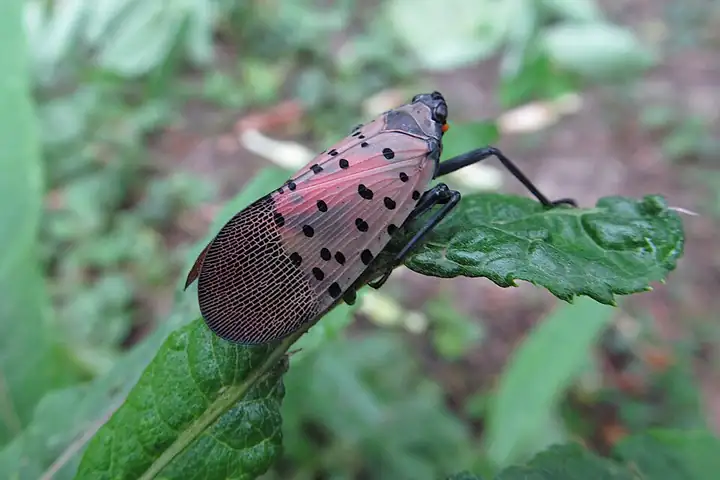
Spotted lanternfly
Lycorma delicatula
| Type | Insect |
|---|---|
| Pressure by region | High pressure: Northeast |
About
An invasive planthopper from Asia, first found in the U.S. in Pennsylvania in 2014. Adults are about an inch long with light brown, black-spotted forewings and a pinkish-brown look at rest; young nymphs are black with white spots and turn red with white spots before becoming adults.
Spotting it
Damage
Large numbers suck sap from vines and trees and drip honeydew that grows black sooty mold. Penn State says heavy feeding has contributed to the death of grapevines, tree-of-heaven and black walnut saplings, but it is not known to directly kill other plants.
How to find it early
Look for gray, mud-like egg masses on tree bark (especially tree-of-heaven), bricks, stones, other smooth surfaces and vehicles in fall and winter, and for nymphs and adults on grapevines and trees in summer. If you find one where it is not known to live, take a photo, collect it if you can, and report it to your state department of agriculture or Extension office; in California call the CDFA pest hotline, 1-800-491-1899.
When
Nymphs late April to July; adults July until hard freeze; eggs fall through spring.
Life cycle
There is one generation a year. Eggs spend winter in mud-like masses averaging about 35 eggs and hatch from late April to June; adults appear in July, feed until hard freezes, and lay eggs from September to December.
What to do, gentlest first
Start at the top. Sprays are a last step; always read and follow the product label.
Follow quarantine rules and do not move it Prevent
Several states have quarantine areas (APHIS); Pennsylvania's bans moving any life stage and regulates items such as firewood, nursery stock and outdoor household goods, and businesses working there need a permit. Before leaving an infested area, check your car's doors, bumpers, wheel wells, grill and roof, and outdoor items you are moving, for eggs and insects (APHIS).
Outside known quarantine areas, report any suspected sighting to your local Extension office or your State Plant Regulatory Official (APHIS); take a photo and, if you can, capture the insect.
Remove tree-of-heaven Prevent
Tree-of-heaven (Ailanthus) is its favorite host, and Penn State recommends removing it from your property.
Penn State notes more research is needed on how much removal lowers lanternfly numbers.
Scrape eggs and squash the insects By hand
From fall through spring, scrape egg masses into a zip-top bag of rubbing alcohol or hand sanitizer (APHIS); each mass destroyed removes about 35 of next year's insects (Penn State). Squash nymphs and adults when you can.
Circle traps, not bare sticky bands Trap
Circle traps are funnel traps wrapped around a trunk that catch nymphs and adults as they climb, without chemicals (Penn State).
Penn State says never use sticky bands without a wildlife barrier such as window screening over them, and check them daily; bare bands catch birds and other wildlife.
Contact sprays: insecticidal soap, oil, neem or pyrethrins Organic spray
These kill only the insects the spray actually hits, so wet them thoroughly (Penn State).
Pyrethrins are highly toxic to bees and oil and neem are toxic for a few hours (PNW 591); spray when bees are not foraging and keep spray off open flowers. On grapes and fruit trees use products labeled for that crop and follow the pre-harvest interval.
Systemic dinotefuran or imidacloprid, mainly for large shade trees Conventional spray
Penn State lists these for trees with heavy feeding, applied as bark sprays, soil treatments or trunk injections.
Both are highly toxic to bees and move into pollen and nectar (PNW 591). Penn State says never apply them to blooming plants and only after bloom is finished. Do not use systemic neonicotinoids on grapes or fruit trees unless the label names that crop, and follow the label.
Plants it goes after
Apple (backyard tree), Cherry (sweet and tart), Grape, Hops, Peach, Plum
Pressure by region
Invasive and spreading. APHIS's spotted lanternfly page (last updated August 2025) lists it in 19 states and Washington, DC: CT, DE, GA, IL, IN, KY, MD, MA, MI, NJ, NY, NC, OH, PA, RI, SC, TN, VA and WV; Michigan confirmed its eighth infested county in September 2026. 'Absent' here means not on APHIS's list of states with spotted lanternfly; CDFA says it has not been found in California (though it has been intercepted on airplanes from the East), ODA says it is not considered present in Oregon, and WSDA's June 2025 update reported no confirmed detections in Washington. Because it spreads by hitchhiking, check your state department of agriculture's map for the latest.
| Northeast | High pressure |
|---|---|
| Southeast | Moderate |
| South Central | Not found here |
| Midwest | Moderate |
| Great Plains | Not found here |
| Mountain West | Not found here |
| Southwest | Not found here |
| Pacific Northwest | Not found here |
| California | Not found here |
| Alaska | Not found here |
| Hawaii | Not found here |
Ratings come from extension sources where available; some are estimates, as noted above.
Sources
- aphis.usda.gov
- aphis.usda.gov
- extension.psu.edu
- pa.gov
- cdfa.ca.gov
- oregon.gov
- content.govdelivery.com
- michigan.gov
- s3.wp.wsu.edu
Photo: Photo: Cbaile19, CC0, via Wikimedia Commons (CC0). Photo resized for the web.

Planting dates and advice are general guidance; check with your local Cooperative Extension office for your area.