
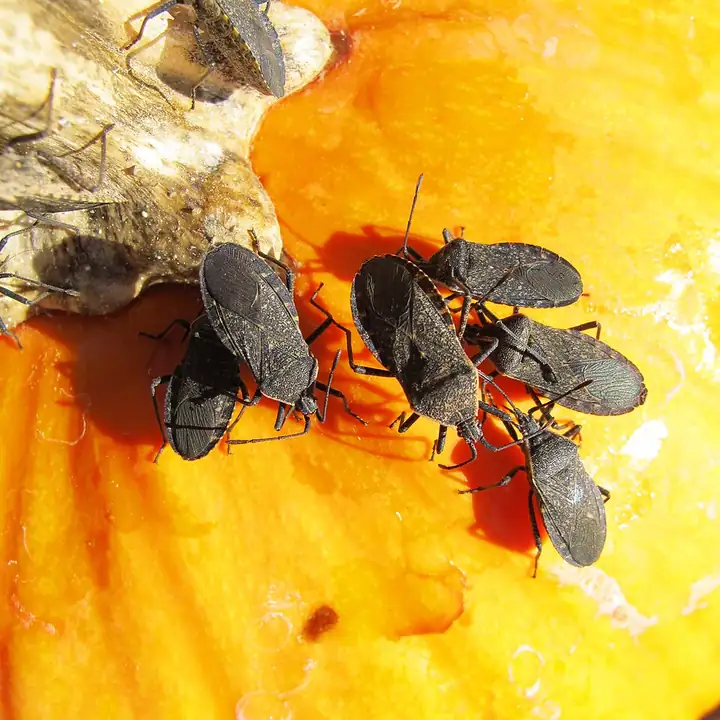
Squash bug
Anasa tristis
| Type | Insect |
|---|---|
| When | Early summer through fall. |
| Pressure by region | Moderate: Northeast, Southeast, South Central, Midwest, Great Plains, Mountain West, Southwest, Pacific Northwest, California |
About
A flat, gray-brown true bug about five-eighths of an inch long with orange-brown stripes along its edges, and a sharp smell when crushed. It is common throughout the U.S.
Spotting it
Damage
Bugs suck sap and inject toxic saliva, so leaves get yellow specks that turn brown, then blacken and dry. Young plants can die, and whole vines may wilt.
How to find it early
Turn leaves every few days and look for neat clusters of shiny bronze eggs in the angles between veins, and for gray nymphs at the base of plants. One egg cluster per plant on average is the point to act.
When
Early summer through fall.
Life cycle
Unmated adults overwinter under debris, compost piles and foundations, and females lay bronze egg clusters on leaf undersides from early June that hatch in 10 to 14 days. Nymphs mature in four to six weeks; there is one generation a year in the North, sometimes a partial second.
What to do, gentlest first
Start at the top. Sprays are a last step; always read and follow the product label.
Clean up, rotate and plant early Prevent
Remove crop debris right after harvest, rotate away from squash in alternate years, and plant early so vines are established before bugs build up.
Boards and egg crushing By hand
Lay boards or cardboard in the patch overnight and destroy the bugs hiding under them each morning. Crush egg masses and pick nymphs and adults every two to three days.
Floating row cover Barrier
Cover plants before adults arrive and remove the cover at flowering for pollinators.
Feather-legged fly Natural enemies
This native parasitic fly lays white eggs on squash bugs and its maggot kills them, so avoid broad-spectrum sprays that kill it.
Target young nymphs Conventional spray
If you spray, aim at freshly hatched nymphs; adults are hard to kill. Rotate insecticide groups.
Spray late in the day when squash flowers are closed to protect pollinators. Follow the label and pre-harvest interval.
Garden friends that go after it
Tachinid flies
Protect these helpers: skip broad sprays when they're around.
Plants it goes after
Cantaloupe (muskmelon), Cucumber, Luffa (loofah gourd), Watermelon, Winter squash and pumpkin, Zucchini and summer squash
Pressure by region
Common throughout the lower 48 (Utah State). It favors pumpkins, Hubbard and yellow crookneck and straightneck squash over cucumbers and melons. Not listed as a Hawaii home-garden pest (CTAHR) and no Alaska source was found, so both low ratings are estimates.
| Northeast | Moderate |
|---|---|
| Southeast | Moderate |
| South Central | Moderate |
| Midwest | Moderate |
| Great Plains | Moderate |
| Mountain West | Moderate |
| Southwest | Moderate |
| Pacific Northwest | Moderate |
| California | Moderate |
| Alaska | Low |
| Hawaii | Low |
Ratings come from extension sources where available; some are estimates, as noted above.
Sources
Photo: Photo: Ilona Loser, CC BY-SA 4.0, via Wikimedia Commons (CC BY-SA 4.0). Photo resized for the web.

Planting dates and advice are general guidance; check with your local Cooperative Extension office for your area.