
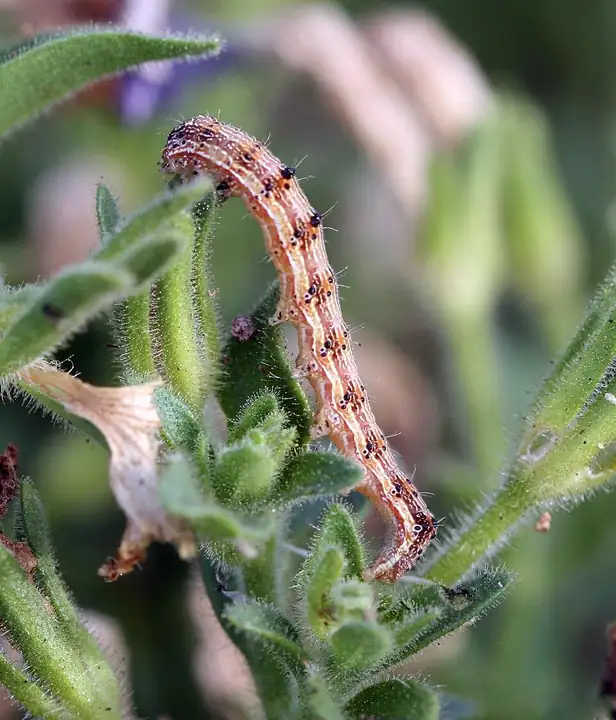
Tobacco budworm (geranium or petunia budworm)
Chloridea virescens (formerly Heliothis virescens)
| Type | Insect |
|---|---|
| Pressure by region | High pressure: Southeast, South Central |
About
A moth caterpillar that bores into flower buds, especially on geraniums and petunias. Caterpillars range from green to red to nearly black, often striped, and grow to about 1 1/2 inches (Iowa State); the moth is light green with gray or brown overtones and a 1 1/2-inch wingspan (Colorado State).
Spotting it
Damage
Caterpillars chew into buds before they open, so many never bloom, and flowers that do open have chewed petals. Small holes in buds are the usual clue (K-State, Colorado State).
How to find it early
Check buds for small holes. Look for caterpillars at dusk, when they climb up from their daytime hiding places at the base of the plant (Colorado State, K-State).
When
Summer; damage peaks in late summer and fall as the second generation builds (K-State, Iowa State).
Life cycle
Caterpillars feed for about a month and then pupate in the soil, where they spend winter. There are usually two generations a year in Colorado and four or five in the Deep South (Colorado State, UF). Pupae are generally killed below 20°F, so it survives winter mainly in southern states; farther north, survival depends on how mild the winter was (Colorado State, UF).
What to do, gentlest first
Start at the top. Sprays are a last step; always read and follow the product label.
Grow less-favored types Prevent
Smooth-leaved ivy geraniums are much less often damaged than zonal geraniums, and petunia varieties differ in how much they are attacked (Colorado State).
Hand-pick at dusk By hand
On small plantings, pick off caterpillars at dusk, when they climb onto the plants (Colorado State, K-State, Iowa State).
Spinosad Organic spray
Colorado State and K-State say spinosad works. Spray late in the day, preferably at dusk.
Spinosad is toxic to bees for 3 hours to a day after spraying (PNW 591), so never spray open flowers or plants where bees are working. Bt usually fails on geraniums because the caterpillars feed hidden inside buds (Colorado State, Iowa State). Read and follow the label, including its pre-harvest interval if you eat any part of the plant.
Pyrethroid sprays Conventional spray
For larger plantings, K-State lists permethrin, esfenvalerate, bifenthrin or gamma-cyhalothrin. Spray at dusk.
These are highly toxic to bees for half a day to more than a day (PNW 591), and Colorado State advises against pyrethroids on flowers that attract bees. Iowa State notes budworms often resist pyrethroids. Read and follow the label, including its pre-harvest interval if you eat any part of the plant.
Garden friends that go after it
Trichogramma wasps
Protect these helpers: skip broad sprays when they're around.
Plants it goes after
Chrysanthemum (garden mum), Gardenia (cape jasmine), Geranium (annual, Pelargonium), Marigold, Petunia, Rose (garden and landscape roses), Snapdragon, Verbena (garden verbena), Zinnia
Pressure by region
UF says it lives through the eastern and southwestern US and is also known from California. It survives winter only in southern states and spreads north each year, reaching New England by late summer, where it is not considered a pest. Colorado State says problems there are worse after mild winters. Ratings for the Pacific Northwest, California, Alaska and Hawaii are estimates.
| Northeast | Low |
|---|---|
| Southeast | High pressure |
| South Central | High pressure |
| Midwest | Moderate |
| Great Plains | Moderate |
| Mountain West | Moderate |
| Southwest | Moderate |
| Pacific Northwest | Low |
| California | Low |
| Alaska | Low |
| Hawaii | Low |
Ratings come from extension sources where available; some are estimates, as noted above.
Sources
- extension.colostate.edu
- yardandgarden.extension.iastate.edu
- ksre.k-state.edu
- ask.ifas.ufl.edu
- s3.wp.wsu.edu
Photo: Photo: Whitney Cranshaw, Colorado State University, Bugwood.org, CC BY 3.0 US, via Wikimedia Commons (CC BY 3.0 US). Photo resized for the web.

Planting dates and advice are general guidance; check with your local Cooperative Extension office for your area.