
Winter moth
Operophtera brumata
| Type | Insect |
|---|---|
| When | Caterpillars late March to early June; moths November to January. |
| Pressure by region | High pressure: Northeast |
About
A European inchworm moth that has been a major pest of shade trees, apples and blueberries in eastern and coastal Massachusetts and other parts of New England (UMass). Its tiny caterpillars crawl into swelling buds in early spring, and the moths fly in late fall and early winter.
Spotting it
Damage
Newly hatched caterpillars feed inside opening leaf and flower buds, so leaves come out ragged and full of holes and apple and blueberry crops can shrink. Older caterpillars eat the expanding leaves and can strip trees when numbers are high; cool springs that slow bud opening make damage worse (UMass).
How to find it early
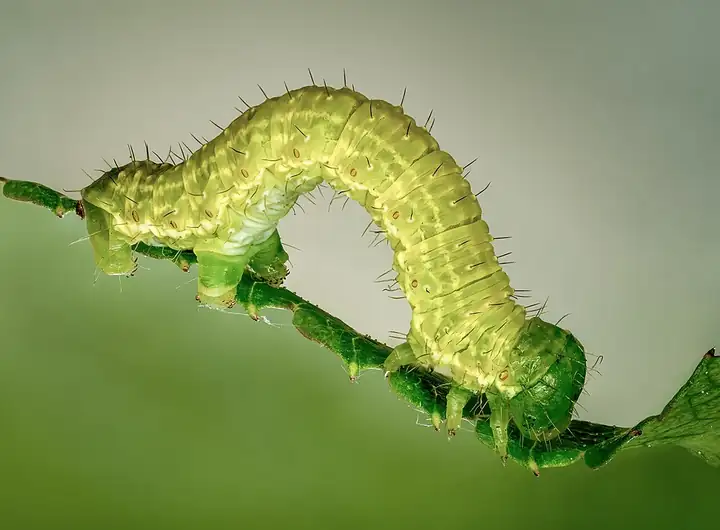
In late fall, swarms of tan moths at porch lights are a clue. In spring, look for ragged new leaves and pale green inchworms with a faint white stripe on each side and two pairs of hind legs; fall cankerworm has an extra short pair, and the native Bruce spanworm looks almost the same but is rarely a problem (UMass).
When
Caterpillars late March to early June; moths November to January.
Life cycle
One generation a year. Moths come out of the soil in mid to late November and can stay active into January; the nearly wingless females climb trunks and lay 150 to 350 eggs in bark cracks, which hatch from late March to mid-April about when buds open, and the caterpillars drop to the soil to pupate in late May or early June (UMass).
What to do, gentlest first
Start at the top. Sprays are a last step; always read and follow the product label.
Watch before you treat Prevent
UMass advises against treating unless you can see caterpillars actively stripping your trees, especially outside eastern and coastal Massachusetts.
Sticky bands to time the hatch Trap
Sticky bands put on trunks in late October catch climbing females, and checking the eggs near them in late March to mid-April shows when hatch is near: eggs turn from orange-red to blue just before they hatch (UMass).
Field observations show bands do not bring down heavy infestations, so use them for monitoring, not control (UMass).
Let the parasitic fly work Natural enemies
A tachinid fly, Cyzenis albicans, that attacks only winter moth was released in Massachusetts, and populations have dropped below outbreak levels across much of eastern Massachusetts. Shrews and ground and rove beetles eat the pupae in the soil (UMass).
Bt or spinosad on young caterpillars Organic spray
If trees are being defoliated, Bacillus thuringiensis (Bt) or spinosad can be sprayed on young caterpillars; for apples and blueberries, sprays are usually timed before caterpillars get inside the flower buds (UMass).
Caterpillars inside buds are protected. Spinosad is toxic to bees (PNW 591), so spray after bloom when bees are not flying (UMass). Bt carries no bee warning. Follow the label.
Plants it goes after
Apple (backyard tree), Blueberry, Cherry (sweet and tart), Flowering crabapple, Oaks (white, red and pin oak), Red maple, River birch, Rose (garden and landscape roses), Sugar maple
Pressure by region
Sourced for New England, where it is worst in eastern and coastal Massachusetts and has not reached outbreak levels in central and western Massachusetts (UMass). Ratings elsewhere are estimates.
| Northeast | High pressure |
|---|---|
| Southeast | Low |
| South Central | Low |
| Midwest | Low |
| Great Plains | Low |
| Mountain West | Low |
| Southwest | Low |
| Pacific Northwest | Low |
| California | Low |
| Alaska | Low |
| Hawaii | Not found here |
Ratings come from extension sources where available; some are estimates, as noted above.
Sources
Photo: Photo: Ermell / Wikimedia Commons, CC BY-SA 4.0 (CC BY-SA 4.0). Photo resized for the web.

Planting dates and advice are general guidance; check with your local Cooperative Extension office for your area.