
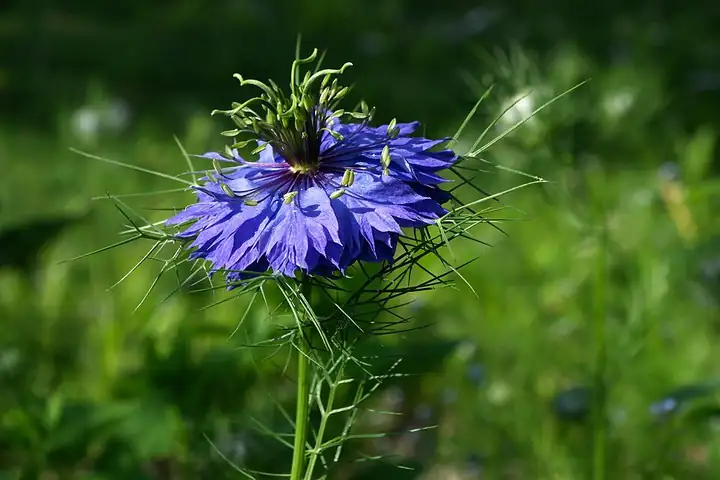
Nigella (love-in-a-mist)
Nigella damascena · Buttercup family (Ranunculaceae)
| Hardiness zones | 2 to 11 |
|---|---|
| Sun | full sun |
| Water | moderate |
| Life cycle | annual |
| Frost | Hardy: takes frost |
| Soil pH | 6.0–8.0 |
| Spacing | 8 to 10 inches |
| Days to harvest | 90 days |
About Nigella (love-in-a-mist)
Love-in-a-mist is an easy, old-fashioned annual with blue, white, pink or lavender flowers sitting in a lacy collar of thread-like bracts above fennel-like leaves. After the flowers come puffy, striped seed pods that are just as pretty fresh or dried. The black seeds sold for cooking as nigella or black cumin come from a cousin, Nigella sativa, not this garden flower (Wisconsin).
Grown from seed as a cool-season annual in every zone (NC State lists 2-11). It takes frost but fades in hot weather, so sow in fall where winters are mild and in early spring elsewhere (Wisconsin, NC State).
When to plant
Timing is counted from your average last spring frost (and first fall frost). Sow & Tell works out the actual dates for your ZIP code.
Sow seed about 1/8 inch deep right where it will grow as soon as the soil can be worked in spring, or in fall (NC State prefers fall). It sprouts in 2-3 weeks and starts blooming about three months after sowing, so days to harvest count from seeding. A long taproot makes it a poor transplant; if you start it indoors, use plantable pots 4-6 weeks ahead. Sow again every 3 weeks for flowers all season, and thin seedlings to 8-10 inches (Wisconsin).
Soil
Fertile, well-drained soil kept evenly moist; it handles clay, loam or sand (Wisconsin, NC State).
Give it fertile, well-drained soil; no extra fertilizer schedule is given by the sources we found, so follow a soil test.
Feeding
Don't try to transplant big seedlings; the long taproot sulks when moved. Spring sowings in hot-summer areas give small plants that fade fast in heat.
Harvest
Blooms from late spring into midsummer for about one to two months (NC State, Wisconsin). Deadheading stretches the bloom but you lose the pods; for drying, cut pods while the stripes still show, or once they feel firm and papery, and hang them upside down somewhere dry, dark and airy (Wisconsin, Iowa State).
Varieties (11)
Extension sources document 11 named varieties and series; few give sizes.
| Variety | Type | Days | Notes |
|---|---|---|---|
| Albion Black Pod | Albion series (cut flower) | About 2 ft tall; double white flowers with green centers and dark purple pods. | |
| Albion Green Pod | Albion series (cut flower) | About 2 ft tall; double white flowers and green pods. | |
| Dwarf Moody Blue | Dwarf | Only about 6 in tall. | |
| Miss Jekyll | Miss Jekyll series | About 20 in tall; semi-double flowers in dark blue, light blue or white. | |
| Miss Jekyll Alba | Miss Jekyll series | Double white flowers. | |
| Delft Blue | Nigella damascena | 2-3 ft tall; purple flowers splashed with blue-gray. | |
| Moody Blues | Nigella damascena | About 30 in tall; double flowers in many shades of blue; good for cutting and mass planting. | |
| Mulberry Rose | Persian series | Pale to rosy pink flowers; NC State notes it draws pollinators. | |
| Oxford Blue | Persian series | Deep blue flowers. | |
| Persian Jewels | Persian series | About 18 in tall; semi-double flowers in white, pink, lavender and blue, with striped pods. | |
| Persian Rose | Persian series | Pale pink flowers. |
Good neighbors
Lamb's ear, Dusty miller, Strawflower, Bachelor's button (cornflower), Gomphrena (globe amaranth)
Wisconsin suggests these for looks: silver leaves set off the blue flowers, and other everlastings dry well alongside it. No one has tested it for pest control.
In the kitchen
Pets: Not listed by the ASPCA (we found no love-in-a-mist or Nigella entry), so we can't call it pet-safe; discourage pets from chewing it.
Sources
- hort.extension.wisc.edu
- plants.ces.ncsu.edu
- extension.illinois.edu
- rhs.org.uk
- extension.iastate.edu
- aspca.org
- aspca.org
Photo: Photo: JLPC / Wikimedia Commons, CC BY-SA 3.0 (CC BY-SA 3.0). Photo resized for the web.

Planting dates and advice are general guidance; check with your local Cooperative Extension office for your area.