
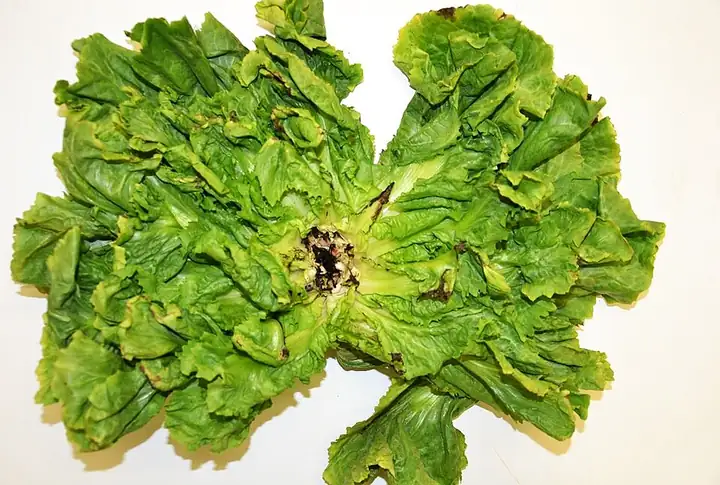
Boron deficiency
Not an infection: the plant is short of boron, a trace nutrient that growing tips, stems and roots need
| Type | Not an infection |
|---|---|
| Cause | Not an infection: the plant is short of boron, a trace nutrient that growing tips, stems and roots need |
| When | Mid to late season, as heads, stalks and roots fill out. |
About
Plants need only a trace of boron, but a shortage causes hollow, browned broccoli stems, cracked celery stalks and dark, corky spots inside beets and turnips. Too much boron is also toxic, so add it only when a soil test calls for it.
Also called boron shortage, lack of boron, cracked stem of celery, brown checking, brown heart, black heart of beet, hollow stem from boron
How to recognize it
Symptoms
Broccoli and cauliflower stems show brown areas inside, and in bad cases the stem is fully hollow. Celery stalks crack crosswise, and the cracks turn brownish black. Beets and turnips get dark spots, glassy or water-soaked areas, or punky brown to black tissue inside the root, with rough skin and twisted young leaves that may die.
Often confused with
Broccoli and cabbage can also go hollow from very fast growth in heat with lots of nitrogen; boron shortage leaves the inside of the hollow darkened. Boron problems show inside stems and roots and on the newest growth, unlike the old-leaf yellowing of nitrogen, potassium or magnesium shortage or the yellow-between-green-veins new leaves of iron chlorosis. A soil test (or tissue test) confirms it.
Worse when
Sandy soil and alkaline soil.
How it spreads
It does not spread from plant to plant.
When
Mid to late season, as heads, stalks and roots fill out.
What to do, gentlest first
This is not an infection, so sprays for diseases won't help. Fix the cause below.
Test soil for boron Prevent
Have your soil tested for boron and follow the lab's advice for adding it. Your county Extension office can recommend a lab.
Too much boron injures plants (look for burned leaf edges). Never add borax or other boron products by guesswork; follow the soil test and the label.
Keep broccoli growing steadily Prevent
Feed nitrogen at recommended rates, not more, so cole crops don't grow too fast and split inside.
Cut open a sample By hand
Slice a broccoli stem, beet or turnip lengthwise to check the inside, and note which beds are affected so you can test there.
Plants it affects
Sources
- veggiescout.mgcafe.uky.edu
- ipm.ucanr.edu
- pnwhandbooks.org
- apps.extension.umn.edu
- hortsense.cahnrs.wsu.edu
Photo: Photo: Jan Hinrichs-Berger, LTZ Augustenberg / Wikimedia Commons, CC BY 4.0 (CC BY 4.0). Photo resized for the web.

Planting dates and advice are general guidance; check with your local Cooperative Extension office for your area.