
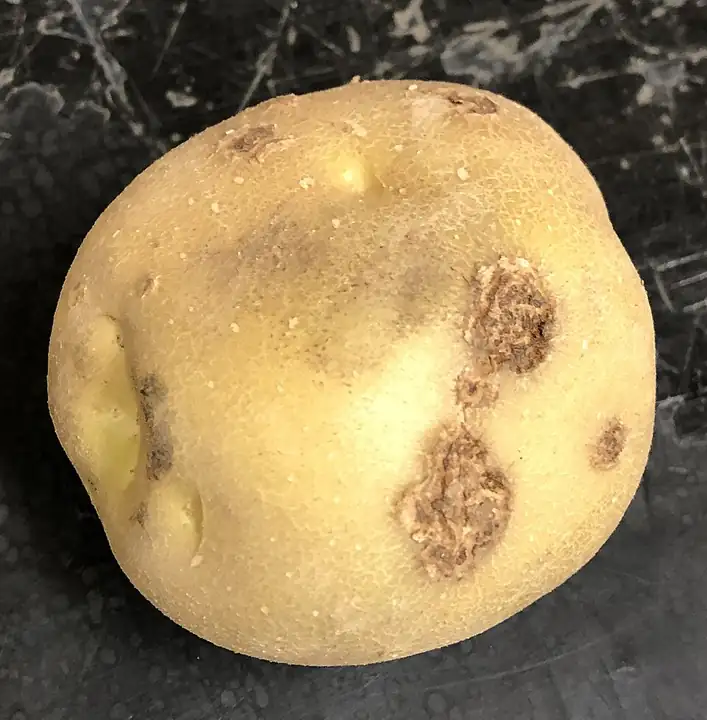
Common scab
Soil bacteria (Streptomyces scabies and related species)
| Type | Bacteria |
|---|---|
| Cause | Soil bacteria (Streptomyces scabies and related species) |
| When | Develops while tubers and roots are forming; found at harvest. |
About
Common scab makes rough, corky patches on the skins of potatoes and other root crops. The bacteria live naturally in many soils, so managing soil pH and moisture is the main defense.
Also called common scab, potato scab, scab
How to recognize it
Symptoms
Tubers and roots get tan to dark brown, rough, corky patches that may be shallow, raised or pitted; under severe stress pits can be deep.
Worse when
Neutral to alkaline soil, dry soil while tubers are forming, warm dry seasons, and light sandy or gravelly soils.
How it spreads
The bacteria live naturally in many soils and also arrive on infected seed potatoes.
When
Develops while tubers and roots are forming; found at harvest.
What to do, gentlest first
Prevention works best; most sprays only protect healthy leaves and can't cure infected ones. Always read and follow the product label.
Clean seed potatoes and resistant varieties Prevent
Plant certified scab-free seed potatoes and resistant varieties such as 'Norland', 'Russet Burbank' and 'Superior'.
UMass notes no potato variety is immune.
Keep soil evenly moist Prevent
Water steadily while tubers are forming and just after, and add organic matter to help soil hold water.
Do not raise soil pH Prevent
Scab rarely develops below pH 5.2, so avoid lime, calcium or potassium nitrate and fresh manure in potato beds.
Rotate Prevent
Grow potatoes and other root crops in a new spot for three to four years.
Plants it affects
Avocado, Beet, Carrot, Loquat, Parsnip, Potato, Radish, Turnip, White sapote
Sources
Photo: Photo: JasonG1313, CC BY-SA 4.0, via Wikimedia Commons (CC BY-SA 4.0). Photo resized for the web.

Planting dates and advice are general guidance; check with your local Cooperative Extension office for your area.