
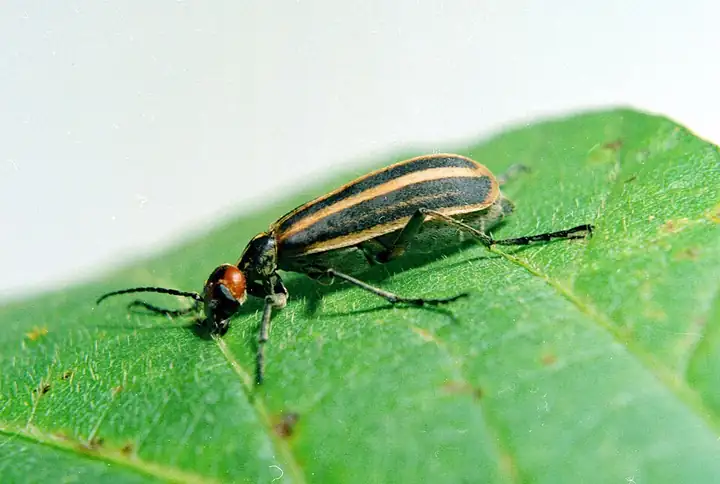
Blister beetles
Many species (family Meloidae), such as Epicauta species
| Type | Insect |
|---|---|
| Pressure by region | Moderate: South Central, Great Plains, Mountain West, Southwest |
About
Long, narrow, soft-bodied beetles about half an inch to three-quarters of an inch long, with a distinct 'neck' behind the head; they may be gray, black, striped or metallic. They make cantharidin, a chemical that blisters skin and is poisonous to horses and other animals, even from dead beetles in hay.
Spotting it
Damage
Adults often arrive in groups and eat leaves and flowers.
How to find it early
Watch for sudden groups of slim beetles on tomato, potato, chard or bean leaves and flowers, especially in early to mid summer.
When
Early summer through late summer; swarms reported from May to October in New Mexico.
Life cycle
There is one generation a year. Larvae spend the winter in the soil, pupate in spring and emerge as adults from about May into summer; young larvae eat grasshopper eggs or the food in ground-nesting bees' nests.
What to do, gentlest first
Start at the top. Sprays are a last step; always read and follow the product label.
Tolerate a few Prevent
The larvae eat grasshopper eggs, so blister beetles do some good (Mississippi State). Act only when a group is damaging plants.
Horse owners: choose hay carefully Prevent
Beetles crushed during hay-making stay poisonous in the bale. Earlier cuttings of alfalfa usually carry few beetles, and hay cut at under 10 percent bloom has fewer.
As little as 4 to 6 grams of dried beetles can kill a horse (Merck Veterinary Manual). Call your veterinarian right away if you suspect poisoning.
Knock them off, wearing gloves By hand
Wearing gloves, knock the beetles into a bucket of soapy water. Mississippi State also suggests shaking them off and stepping on them.
Never handle or crush them with bare hands: their fluid raises painful blisters on skin. Wash up afterward, and keep children and pets away from them.
Pyrethroids Conventional spray
Mississippi State lists permethrin, bifenthrin and zeta-cypermethrin for blister beetles in home gardens.
Highly toxic to bees and it also kills the natural enemies. Keep sprays off open flowers, and follow the label and pre-harvest interval.
Plants it goes after
Aronia (black chokeberry), Baptisia (false indigo), Beet, Cantaloupe (muskmelon), Edamame, Green beans (snap beans), Potato, Radish, Sweet corn, Swiss chard, Tomato, Turnip
Pressure by region
New Mexico alone has at least 28 species. No source rated garden damage by region, so all ratings are estimates; outbreaks are sporadic everywhere.
| Northeast | Low |
|---|---|
| Southeast | Low |
| South Central | Moderate |
| Midwest | Low |
| Great Plains | Moderate |
| Mountain West | Moderate |
| Southwest | Moderate |
| Pacific Northwest | Low |
| California | Low |
| Alaska | Low |
| Hawaii | Low |
Ratings come from extension sources where available; some are estimates, as noted above.
Sources
Photo: Photo: Clemson University - USDA Cooperative Extension Slide Series, Bugwood.org, CC BY 3.0, via Wikimedia Commons (CC BY 3.0). Photo resized for the web.

Planting dates and advice are general guidance; check with your local Cooperative Extension office for your area.