
Foliar nematodes
Aphelenchoides species, mainly A. fragariae, A. ritzemabosi and A. besseyi
| Type | Nematode (microscopic worm) |
|---|---|
| When | Symptoms mostly mid to late summer. |
| Pressure by region | Moderate: Northeast, Southeast, Midwest, Pacific Northwest |
About
Microscopic roundworms that live in leaves and stems instead of roots; they can infect more than 450 kinds of plants and are most common on hostas (Wisconsin). The damage is usually cosmetic, but it makes plants look ragged.
Spotting it
Damage
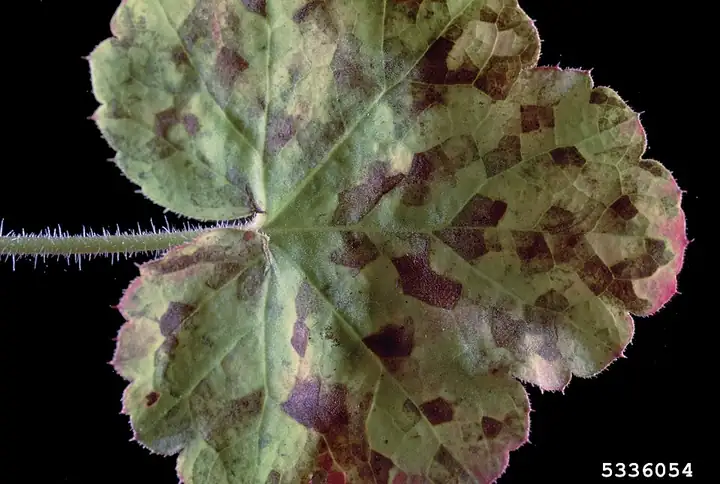
On mature plants, discolored blotches with straight edges form between the leaf veins, turn brown and dry, and may fall out, leaving holes, often not until late summer, around August (Wisconsin). New growth on young plants may twist and stay stunted (Wisconsin, Penn State).
How to find it early
In late summer, look for vein-bounded brown streaks or patches, often on several plants in a clump. To check, tear a piece of leaf into a drop of water, wait a few minutes, and look at it with a 10x lens against a dark background for wriggling worms, or send a sample to your extension plant clinic (Penn State).
When
Symptoms mostly mid to late summer.
Life cycle
They swim in films of water on wet leaves and stems and get into the leaf tissue, where females lay eggs; they do best around 70 to 75°F (Penn State). They survive winter in dry leaves, dormant buds and soil, tolerate drying and freezing, and spread by splashing water, infested plants and cuttings (Wisconsin).
What to do, gentlest first
Start at the top. Sprays are a last step; always read and follow the product label.
Start clean and keep leaves dry Prevent
Inspect plants before you buy, though early-season plants may not show symptoms yet. Use drip or soaker hoses instead of sprinklers, space plants apart, stay out of wet beds, and never take divisions or cuttings from suspect plants (Wisconsin, Penn State).
Remove infected plants By hand
Dig up, bag and throw out infected plants as soon as you see symptoms. Wash your hands, disinfect tools and pots for 30 seconds with 70% alcohol or 10% bleach, and don't replant susceptible plants in that spot, since the soil is nearly impossible to clean (Wisconsin).
There are no chemical controls for home gardens, and hot water dips are not recommended at home because they easily kill the plant or fail (Wisconsin).
Plants it goes after
Anemone (windflower), Azalea, Bird's nest fern, Chrysanthemum (garden mum), Columbine, Dahlia, Garden ferns (ostrich, Christmas, lady, Japanese painted), Hosta (plantain lily), Iris, Strawberry, Veronica (speedwell)
Pressure by region
Ratings are estimates; problems follow infested plants and wet foliage more than climate.
| Northeast | Moderate |
|---|---|
| Southeast | Moderate |
| South Central | Low |
| Midwest | Moderate |
| Great Plains | Low |
| Mountain West | Low |
| Southwest | Low |
| Pacific Northwest | Moderate |
| California | Low |
| Alaska | Low |
| Hawaii | Low |
Ratings come from extension sources where available; some are estimates, as noted above.
Sources
Photo: Photo: Jonathan D. Eisenback / Wikimedia Commons, CC BY 3.0 US (CC BY 3.0 US). Photo resized for the web.

Planting dates and advice are general guidance; check with your local Cooperative Extension office for your area.