
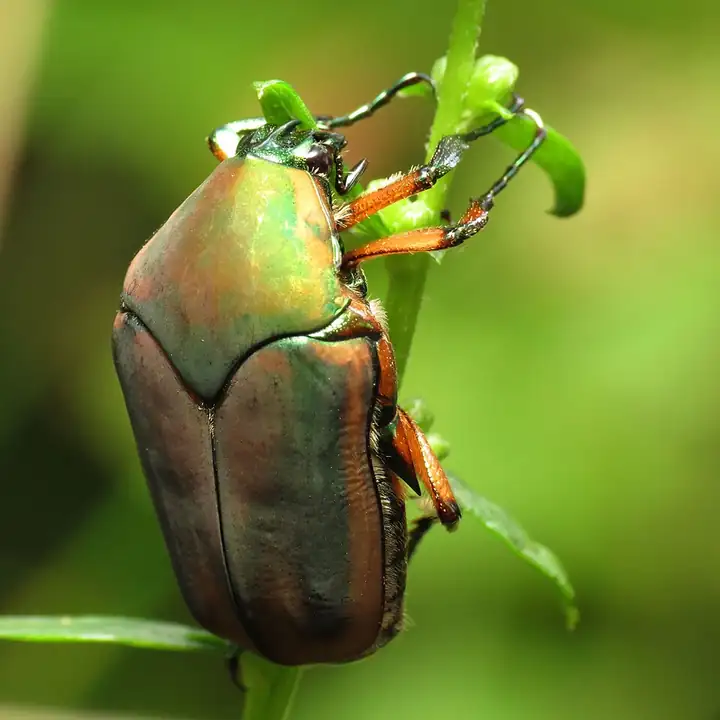
Green June beetle (fig-eater)
Cotinis nitida
| Type | Insect |
|---|---|
| When | July and August. |
| Pressure by region | Moderate: Northeast, Southeast, South Central |
About
A big, native beetle, three-quarters to one inch long, velvety green with tan-orange edges and a shiny green-gold underside. Adults dig into ripe fruit, which is why it is also called the fig-eater.
Spotting it
Damage
Adults use a horn on the head to break into soft, ripening fruit and several can bury themselves in a single peach; their odor and droppings spoil fruit even when feeding is light. Grubs, which crawl on their backs, leave small mounds and burrows in lawns.
How to find it early
Watch ripening peaches, grapes, figs and berries in midsummer; beetles are strong fliers and show up suddenly.
When
July and August.
Life cycle
Grubs spend winter in soil rich in organic matter, pupate in May and June, and adults fly in July and August. There is one generation a year.
What to do, gentlest first
Start at the top. Sprays are a last step; always read and follow the product label.
Harvest promptly Prevent
Beetles are drawn to fruit as it softens and sweetens (UK), so pick as soon as fruit is ripe and remove split or overripe fruit.
Netting Barrier
In small plantings, netting with holes small enough to keep the beetles out protects ripening grapes (UK).
Nematodes and a native wasp for the grubs Natural enemies
Insect-parasitic nematodes (Steinernema or Heterorhabditis) can be used on lawn grubs, and the native digger wasp Scolia dubia lays its eggs on them (Penn State).
Hard to use on ripening fruit Conventional spray
UK notes the more effective fruit insecticides have long pre-harvest intervals, so they cannot be used when the beetles are feeding near harvest. Lawn grubs can be treated in late summer (Penn State, NC State).
Use a lawn product only on lawns, not on fruit or vegetables unless the label lists them. Many grub and fruit insecticides are toxic to bees (PNW 591); keep them off flowering weeds. Follow the label.
Plants it goes after
Apple (backyard tree), Apricot, Blackberry, Blue grama, Fig, Grape, Peach, Pear, Plum, Raspberry, Sweet corn
Pressure by region
Penn State gives its range as Connecticut and southeastern New York south to Florida and west into Texas, Oklahoma and Kansas; numbers swing from year to year (UK, Alabama). Regions outside that range are rated low for lack of a source; those ratings are estimates.
| Northeast | Moderate |
|---|---|
| Southeast | Moderate |
| South Central | Moderate |
| Midwest | Low |
| Great Plains | Low |
| Mountain West | Low |
| Southwest | Low |
| Pacific Northwest | Low |
| California | Low |
| Alaska | Low |
| Hawaii | Low |
Ratings come from extension sources where available; some are estimates, as noted above.
Sources
- extension.psu.edu
- extension.okstate.edu
- aces.edu
- entomology.mgcafe.uky.edu
- content.ces.ncsu.edu
- s3.wp.wsu.edu
Photo: Photo: Katja Schulz, CC BY 2.0, via Wikimedia Commons (CC BY 2.0). Photo resized for the web.

Planting dates and advice are general guidance; check with your local Cooperative Extension office for your area.