
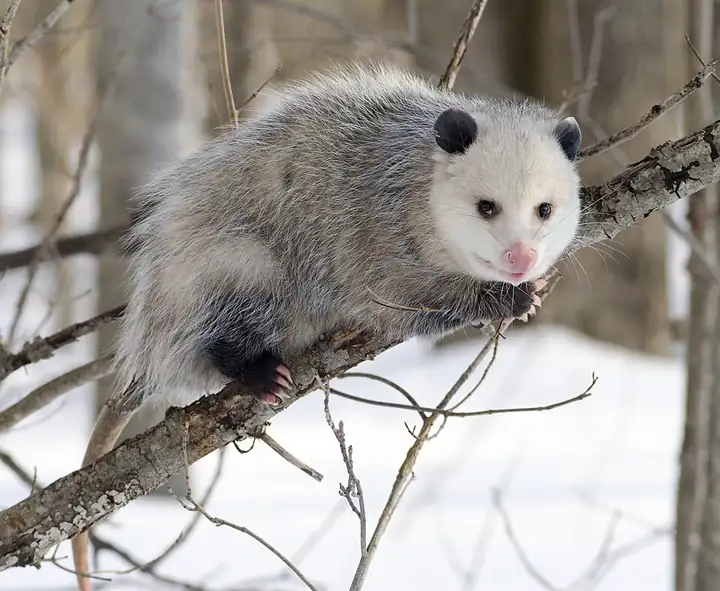
Opossum
Virginia opossum (Didelphis virginiana)
| Type | Animal |
|---|---|
| When | Year-round; worst as grapes, berries and tree fruit ripen. |
| Pressure by region | Moderate: Northeast, Southeast, South Central, Midwest, Pacific Northwest, California |
About
North America's only marsupial, about the size of a house cat, with coarse grayish fur, a pointed face, bare rounded ears and a long bare tail. It eats almost anything, from fallen fruit, berries, grapes, pet food and garbage to insects, snails and carrion (UC IPM, UNL).
Spotting it
Damage
Opossums eat ripening grapes, berries and tree fruit at night, and can damage vines reaching it (UC IPM, Kentucky). They're messy and leave droppings on paths and patios, but they rarely dig up lawns; that is usually raccoons (UC IPM, UNL).
How to find it early
Check in the morning for nibbled fruit, cat-size droppings, and tracks with a thumb-like toe on the hind foot; look for climbing scratches or smudges on trees and buildings (UNL, Kentucky).
When
Year-round; worst as grapes, berries and tree fruit ripen.
Life cycle
Young are born after only about 13 days, about 7 to a litter, and ride in the mother's pouch for about 8 weeks; in California there are usually two breeding seasons a year. Most die before their first birthday, and few live past three (UC IPM).
What to do, gentlest first
Start at the top. Sprays are a last step; always read and follow the product label.
Take away food and shelter Prevent
Pick up fallen fruit, bring pet food in by nightfall, use lidded garbage cans, keep food scraps out of the compost, and trim shrubs and limbs back at least 5 feet from the roof (UC IPM).
Seal decks and sheds Barrier
Close openings under decks and sheds with 1/4-inch hardware cloth buried 6 inches deep. First make sure no animal is inside: sprinkle flour at the opening and look for tracks heading out (UC IPM).
Fence or electric wire Barrier
A 4-foot poultry-wire fence with the top 12 to 18 inches left loose and bent outward keeps opossums out, or add an electric wire about 3 inches out from the top of a wire fence (UC IPM). Around grapes, an electric wire at nose height, 4 to 6 inches up, stops both opossums and raccoons (Kentucky).
Use a charger made for electric fencing, follow its directions, and post signs so children and visitors know the fence is live.
Trapping is regulated Trap
Rules differ: California requires written permission from the Department of Fish and Wildlife to relocate an opossum, and Nebraska requires a trapped opossum to be released within 100 yards of where it was caught unless you have a permit (UC IPM, UNL). A licensed wildlife control operator can handle a problem animal.
Check traps at least twice a day (UNL). Don't handle opossums: they bite when cornered and can carry diseases and fleas, including murine typhus (UC IPM, Texas A&M). This guide does not recommend poisons; none are registered for opossums, and rodent baits must never be used on them (UC IPM). Trapping and relocating wildlife is regulated by state law, and the rules differ from state to state. Check with your state wildlife agency or your county Extension office before you set a trap.
Skip repellents Repellent
No repellents are registered for opossums (UNL), and mothballs and ammonia don't work and aren't recommended (UC IPM). Motion-activated sprinklers may scare them off for a while (UC IPM).
Keep children and pets away from any product you do use, and follow its label.
Plants it goes after
Apple (backyard tree), Blackberry, Grape, Peach, Pineapple, Raspberry, Starfruit (carambola), Strawberry
Pressure by region
Opossums are native to the eastern US and were brought to San Jose, California, in 1910; they are now well established across much of that state (UC IPM). In Nebraska they are common in the east but stay along rivers in the Sandhills and Panhandle (UNL), and they are still spreading north into the Upper Midwest, New England and North Dakota (Prairie Naturalist). No source rated damage by region, and none reported opossums in Alaska or Hawaii, so all ratings are estimates.
| Northeast | Moderate |
|---|---|
| Southeast | Moderate |
| South Central | Moderate |
| Midwest | Moderate |
| Great Plains | Low |
| Mountain West | Low |
| Southwest | Low |
| Pacific Northwest | Moderate |
| California | Moderate |
| Alaska | Low |
| Hawaii | Low |
Ratings come from extension sources where available; some are estimates, as noted above.
Sources
- ipm.ucanr.edu
- extensionpubs.unl.edu
- fruitscout.mgcafe.uky.edu
- digitalcommons.unl.edu
- agrilifeextension.tamu.edu
Photo: Photo: Cody Pope / Wikimedia Commons, CC BY-SA 2.5 (CC BY-SA 2.5). Photo resized for the web.

Planting dates and advice are general guidance; check with your local Cooperative Extension office for your area.