
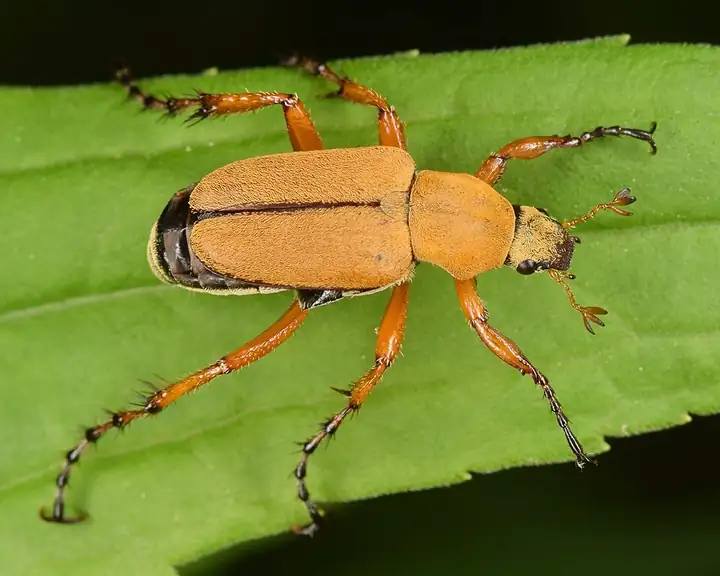
Rose chafer
Macrodactylus subspinosus
| Type | Insect |
|---|---|
| When | Late May through June. |
| Pressure by region | Moderate: Northeast, Midwest |
About
A slender, tan to pale green beetle about a third to half an inch long with long, spiny, orange-brown legs. Adults appear in late spring, usually before Japanese beetles.
Spotting it
Damage
Adults chew large, ragged holes in flowers and skeletonize leaves, eating everything but the veins, and feed on young fruit. The grubs eat grass and weed roots but do not harm home lawns (UMaine).
How to find it early
Watch roses, grapes and berries from late May; populations are highest near sandy soils.
When
Late May through June.
Life cycle
Grubs spend winter deep in the soil, pupate in spring and emerge as adults in late May and early June. Adults feed for three to four weeks, lay eggs in the soil, and there is one generation a year.
What to do, gentlest first
Start at the top. Sprays are a last step; always read and follow the product label.
Pick into soapy water By hand
Knock or pick beetles into a bucket of soapy water. New beetles keep flying in from surrounding areas, so repeat often.
Rose chafers contain a toxin that can kill chickens, other birds and small animals that eat them (UMN, UMaine); keep poultry out of heavily infested areas and do not feed collected beetles to them.
Cheesecloth or row cover Barrier
Cover prized plants when beetles first appear and remove the cover after June; bag individual show flowers.
Uncover fruit crops in bloom that need bees to pollinate.
Labeled insecticides for heavy swarms Conventional spray
UMN lists bifenthrin, esfenvalerate, cyfluthrin, permethrin and carbaryl.
All are highly toxic to bees (PNW 591); do not spray open flowers or when bees are working. UMN also lists imidacloprid, but do not use systemic neonicotinoids on fruit or vegetable crops. Carbaryl has been a restricted-use pesticide in California since August 1, 2020 (UC IPM), so California home gardeners cannot buy it without an applicator license. Make sure your plant is on the label and follow the pre-harvest interval.
Plants it goes after
Apothecary rose, Apple (backyard tree), Blueberry, Cherry (sweet and tart), Grape, Green beans (snap beans), Hydrangea, Peach, Pepper (sweet and chili), Raspberry, Rose (garden and landscape roses), Strawberry, Sweet corn
Pressure by region
Sourced for Maine (northeastern North America) and Minnesota; it is worst where soils are sandy. Other regions are rated low for lack of a source; those ratings are estimates.
| Northeast | Moderate |
|---|---|
| Southeast | Low |
| South Central | Low |
| Midwest | Moderate |
| Great Plains | Low |
| Mountain West | Low |
| Southwest | Low |
| Pacific Northwest | Low |
| California | Low |
| Alaska | Low |
| Hawaii | Low |
Ratings come from extension sources where available; some are estimates, as noted above.
Sources
Photo: Photo: Christina Butler, CC BY 2.0, via Wikimedia Commons (CC BY 2.0). Photo resized for the web.

Planting dates and advice are general guidance; check with your local Cooperative Extension office for your area.