
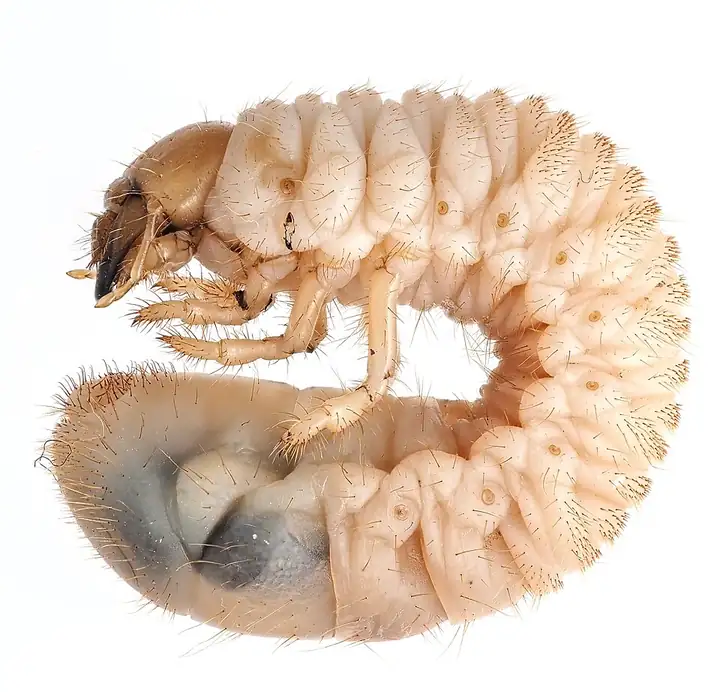
White grubs
Larvae of scarab beetles (Scarabaeidae), including May or June beetles (Phyllophaga species), masked chafers (Cyclocephala species) and the Japanese beetle
| Type | Insect |
|---|---|
| When | Late summer through fall, and again in spring. |
| Pressure by region | Moderate: Northeast, Midwest |
About
Fat, dirty-white, C-shaped larvae with a brown head and six small legs, an inch or more long when grown. They live in the soil eating roots.
Spotting it
Damage
Roots are eaten, so plants wilt and yellow and lawn patches brown and pull up like a rug. Skunks, raccoons and crows tearing up turf are a sign of grubs.
How to find it early
Cut and lift a square foot of sod 2 to 4 inches deep in late summer and count the grubs; five to ten per square foot is the usual point to treat.
When
Late summer through fall, and again in spring.
Life cycle
Most kinds take one year: eggs laid in July and August hatch in two to three weeks, grubs feed through fall, burrow 2 to 8 inches down for winter, then feed a little in spring and pupate. May or June beetle grubs can take two to three years.
What to do, gentlest first
Start at the top. Sprays are a last step; always read and follow the product label.
Healthy, higher-cut lawn Prevent
Mow higher to keep a deep root mass, and let the soil surface dry in July and August when beetles lay eggs.
Dig and count By hand
Check a square foot of turf or bed soil and pick out grubs you find when preparing new beds from lawn.
Beneficial nematodes Natural enemies
Water in Heterorhabditis nematodes, which outperform Steinernema against grubs. Check the expiration date and follow the watering directions.
Milky spore controls only Japanese beetle grubs, takes three to five years, and has little value against other grubs.
Preventive or curative grub insecticides Conventional spray
Preventive products go down mid-June to mid-July before eggs hatch; curative ones work in August to mid-September while grubs are small. Spring treatments work less well.
Use a grub product only on the sites its label lists; do not use a lawn product in vegetable or strawberry beds unless the label names that crop. Some preventive products contain neonicotinoids such as imidacloprid, which are highly toxic to bees (PNW 591), so keep them off flowering weeds that bees visit.
Garden friends that go after it
Ichneumon wasps, Robber flies
Protect these helpers: skip broad sprays when they're around.
Plants it goes after
Blue grama, Buffalograss, Chayote, Pineapple, Potato, Strawberry, Surinam cherry, Sweet corn
Pressure by region
The sources found (Penn State, Ohio State) cover the Northeast and Midwest; other regions are rated low for lack of a source; those ratings are estimates, not proof grubs are rare there.
| Northeast | Moderate |
|---|---|
| Southeast | Low |
| South Central | Low |
| Midwest | Moderate |
| Great Plains | Low |
| Mountain West | Low |
| Southwest | Low |
| Pacific Northwest | Low |
| California | Low |
| Alaska | Low |
| Hawaii | Low |
Ratings come from extension sources where available; some are estimates, as noted above.
Sources
Photo: Photo: Gilles San Martin, CC BY-SA 2.0, via Wikimedia Commons (CC BY-SA 2.0). Photo resized for the web.

Planting dates and advice are general guidance; check with your local Cooperative Extension office for your area.