
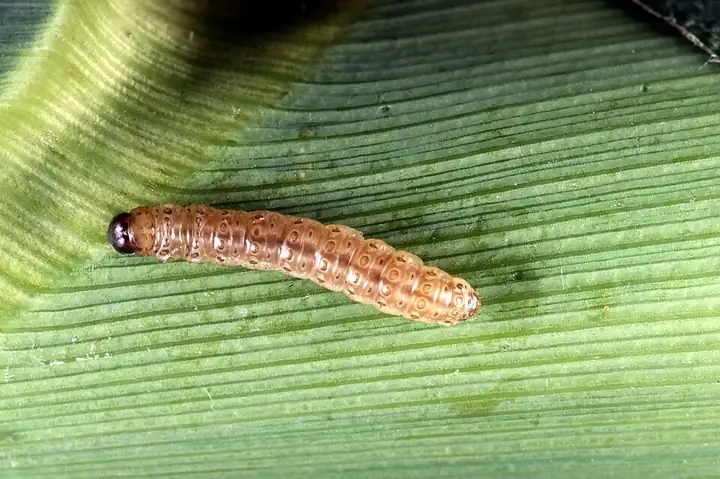
European corn borer
Ostrinia nubilalis
| Type | Insect |
|---|---|
| Pressure by region | Moderate: Northeast, Midwest, Great Plains |
About
A pale pinkish or grayish caterpillar up to about an inch long, with a dark brown head and small round spots on each segment, that tunnels into corn and peppers. It reached Massachusetts in 1917 and spread across most of the eastern U.S. to the Rocky Mountains, though widespread Bt field corn has made it much scarcer.
Spotting it
Damage
In sweet corn the older caterpillars bore into stalks and ears and chew the tips and kernels; tunneled stalks can break or fall over. In peppers they enter near the stem and feed on the seed core, and pinhole entrances with sawdust-like droppings are a telltale sign.
How to find it early
Scout corn weekly from the whorl stage for shot-hole feeding on the leaves, and check peppers for small holes near the cap with frass pushed out.
When
Late spring through summer; moths of the one-generation strain fly in July in New York.
Life cycle
Full-grown caterpillars spend the winter inside old stalks and stems and pupate in spring. There are usually two or three generations a year, but some northern populations have only one.
What to do, gentlest first
Start at the top. Sprays are a last step; always read and follow the product label.
Clean up stalks Prevent
After harvest, cut corn stalks close to the ground and till them under, shred them or remove them, since caterpillars spend the winter inside.
Split and destroy By hand
Slit infested stalks and destroy the borers inside, and remove bored peppers.
Trichogramma wasps Natural enemies
Tiny Trichogramma wasps parasitize corn borer eggs and are used for biological control (Cornell).
Bt (Bacillus thuringiensis) Natural enemies
Spray Bt when larvae first appear, before they bore inside where sprays cannot reach them.
Bt carries no bee warning on its label.
Garden friends that go after it
Minute pirate bugs, Spined soldier bug, Syrphid flies (hover flies, flower flies), Tachinid flies, Trichogramma wasps
Protect these helpers: skip broad sprays when they're around.
Plants it goes after
Celery, Dahlia, Green beans (snap beans), Hops, Pepper (sweet and chili), Potato, Rhubarb, Southern peas, Spinach, Sweet corn, Tomato
Pressure by region
Found across most of the eastern U.S. to the Rocky Mountains (Cornell). In Delaware, Maryland and New Jersey, moth catches fell 72 percent after Bt field corn arrived in 1996, and damage fell about 70 percent in sweet corn and 78 percent in peppers, so it is rated moderate, not high, even in its core range. NC State still lists it as a pepper pest in North Carolina. Southern, western, Alaska and Hawaii low ratings are estimates.
| Northeast | Moderate |
|---|---|
| Southeast | Low |
| South Central | Low |
| Midwest | Moderate |
| Great Plains | Moderate |
| Mountain West | Low |
| Southwest | Low |
| Pacific Northwest | Low |
| California | Low |
| Alaska | Low |
| Hawaii | Low |
Ratings come from extension sources where available; some are estimates, as noted above.
Sources
- extension.umd.edu
- cals.cornell.edu
- extension.illinois.edu
- pmc.ncbi.nlm.nih.gov
- content.ces.ncsu.edu
- s3.wp.wsu.edu
Photo: Photo: Keith Weller, USDA ARS, Public domain (USDA ARS), via Wikimedia Commons. Photo resized for the web.

Planting dates and advice are general guidance; check with your local Cooperative Extension office for your area.