
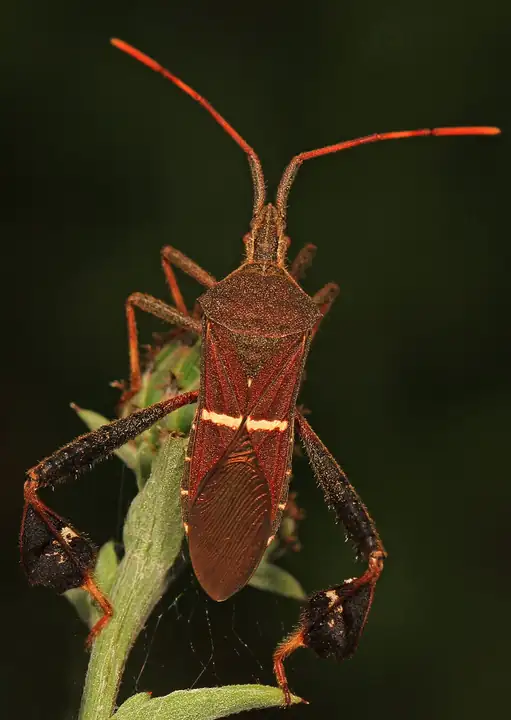
Leaffooted bugs
Several Leptoglossus species, such as the eastern leaffooted bug (L. phyllopus) and, in California, L. zonatus
| Type | Insect |
|---|---|
| When | Spring through fall. |
| Pressure by region | Moderate: Southeast, California |
About
Narrow brown bugs about 3/4 to 1 inch long, named for the flat, leaf-like flare on their hind legs; the eastern species has a white bar across its back. They suck juice from ripening fruit, seeds and nuts, and in California they are a garden pest of tomatoes and pomegranates.
Spotting it
Damage
Feeding leaves dimples or discolored spots on fruit and can lead to rot. They also kill back rose tips and ruin sunflower seeds.
How to find it early
Look for chains of brown, barrel-shaped eggs laid end to end along stems or leaf veins, and for orange to reddish nymphs with dark legs clustered on fruit.
When
Spring through fall.
Life cycle
Adults spend the winter in groups in sheltered spots such as woodpiles, sheds, palm fronds or under loose bark, and become active as it warms up. There are two to three generations a year in California and several in North Carolina.
What to do, gentlest first
Start at the top. Sprays are a last step; always read and follow the product label.
Mow weeds Prevent
Keep weedy areas mowed, since weeds feed the bugs in winter and spring (UC IPM).
Hand-pick and destroy eggs By hand
Knock bugs into a jar of soapy water or catch them with a handheld vacuum kept just for bugs, and crush egg chains when you find them.
Row cover Barrier
Row covers keep flying adults off plants so they cannot lay eggs.
Sunflower trap crop Trap
Mississippi State suggests sunflowers as a trap crop; check them often and remove the bugs that gather there.
Natural enemies Natural enemies
Native parasitic wasps and flies, assassin bugs, spiders and birds all eat leaffooted bugs.
Insecticidal soap, neem or pyrethrins Organic spray
UC IPM says these may give some control of young nymphs only.
Neem and pyrethrins are toxic to bees; spray in the evening and keep them off open flowers. Follow the label.
Pyrethroids such as permethrin Conventional spray
UC IPM says broad-spectrum pyrethroids work best, but treat them as a last resort.
Highly toxic to bees and it also kills the natural enemies. Keep sprays off open flowers, and follow the label and pre-harvest interval.
Garden friends that go after it
Tachinid flies
Protect these helpers: skip broad sprays when they're around.
Plants it goes after
Apple (backyard tree), Dragon fruit (pitaya), Green beans (snap beans), Okra, Peach, Pepper (sweet and chili), Plum, Pomegranate, Southern peas, Starfruit (carambola), Sunflower, Tomato
Pressure by region
Florida has at least nine Leptoglossus species (UF/IFAS), NC State reports several generations a year in North Carolina, and UC IPM covers them as a garden pest in California. No regional severity source was found, so these ratings are estimates.
| Northeast | Low |
|---|---|
| Southeast | Moderate |
| South Central | Low |
| Midwest | Low |
| Great Plains | Low |
| Mountain West | Low |
| Southwest | Low |
| Pacific Northwest | Low |
| California | Moderate |
| Alaska | Low |
| Hawaii | Low |
Ratings come from extension sources where available; some are estimates, as noted above.
Sources
- ipm.ucanr.edu
- ipm.ucanr.edu
- content.ces.ncsu.edu
- gardeningsolutions.ifas.ufl.edu
- extension.msstate.edu
- s3.wp.wsu.edu
Photo: Photo: Judy Gallagher, CC BY 2.0, via Wikimedia Commons (CC BY 2.0). Photo resized for the web.

Planting dates and advice are general guidance; check with your local Cooperative Extension office for your area.