
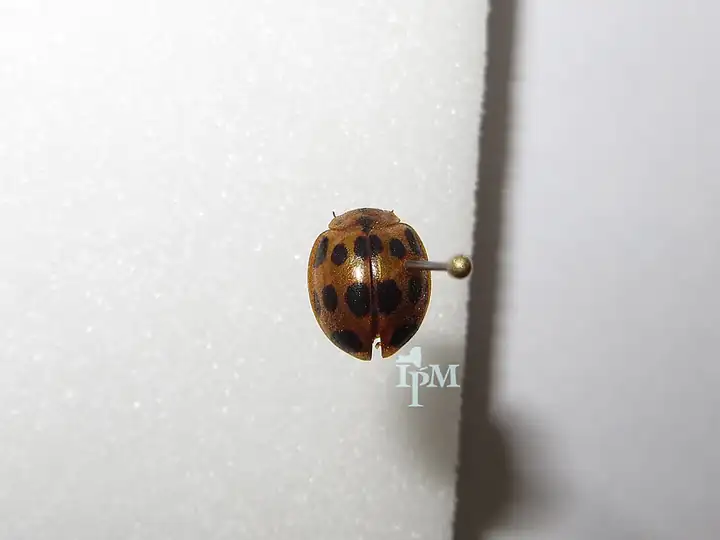
Squash beetle
Epilachna borealis (squash lady beetle)
| Type | Insect |
|---|---|
| When | Early summer through early fall. |
| Pressure by region | Moderate: Northeast, Southeast, Midwest |
About
A big, plant-eating lady beetle, about twice the size of the lady beetles that eat aphids, yellow-orange with seven large black spots on each wing cover and four small ones behind the head. It's native to the eastern US and feeds on squash, pumpkins and other cucurbits (UConn, Illinois).
Spotting it
Damage
Larvae eat the underside of leaves and adults eat both sides, leaving lacy, skeletonized patches between the veins. Both first chew a little trench around the spot they'll eat, which slows the plant's bitter defense chemicals (Illinois). Adults also scar the rind of fruit, and now and then nibble lima beans, cowpea pods and corn silk (UConn).
How to find it early
Around midday on sunny days, check under squash leaves for upright yellow eggs, spiny yellow larvae and spotted orange adults. Squash beetle eggs stand in loose clusters with space between them, while helpful lady beetle eggs sit in tight clusters; the Mexican bean beetle looks similar but is smaller and feeds on beans (UConn).
When
Early summer through early fall.
Life cycle
Adults spend winter under loose bark or leaf litter near the garden, return to cucurbits in June and lay eggs in July; larvae feed for about three weeks, pupate under the leaves, and new adults appear in August (UConn). There is one generation a year in Connecticut and two in the South.
What to do, gentlest first
Start at the top. Sprays are a last step; always read and follow the product label.
Clean up and plant far from last year Prevent
Clear garden debris in fall to cut down winter hiding spots (Illinois). Squash beetles fly poorly, so plant cucurbits as far from last year's patch as you can, and pull and destroy vines with their larvae once early squash and cucumbers are done (UConn).
Hand-pick By hand
Pick off adults, larvae and egg clusters and drop them in soapy water. In home gardens this works well (Illinois, UMD).
Row cover until bloom Barrier
Where they show up every year, cover transplants or new seedlings with floating row cover (UMD, Illinois).
Take the cover off when plants start to bloom so bees can pollinate the flowers.
Leave natural enemies Natural enemies
Stink bugs, assassin bugs and tachinid flies attack squash beetles (UConn).
Neem, pyrethrins or spinosad for heavy infestations Organic spray
For heavy infestations, UMD suggests neem or pyrethrins, and UConn lists pyrethrins and spinosad. Wet the undersides of leaves, where larvae feed.
Pyrethrins are highly toxic to bees for up to about 2 hours, and spinosad is toxic to bees for 3 hours to a day (PNW 591), so spray in the evening and keep spray off open blossoms. Follow the label and its pre-harvest interval.
Plants it goes after
Cantaloupe (muskmelon), Cucumber, Lima beans, Southern peas, Sweet corn, Watermelon, Winter squash and pumpkin, Zucchini and summer squash
Pressure by region
Native to the eastern US and most common in the Atlantic Coast states (UConn); Illinois Extension says it occurs throughout the eastern US. No source was found for the West, Alaska or Hawaii, so those ratings, like the others, are estimates. Numbers are usually too low to need control (UConn, Illinois).
| Northeast | Moderate |
|---|---|
| Southeast | Moderate |
| South Central | Low |
| Midwest | Moderate |
| Great Plains | Low |
| Mountain West | Low |
| Southwest | Low |
| Pacific Northwest | Low |
| California | Low |
| Alaska | Low |
| Hawaii | Low |
Ratings come from extension sources where available; some are estimates, as noted above.
Sources
Photo: Photo: NY State IPM Program at Cornell University / Wikimedia Commons, CC BY 2.0 (CC BY 2.0). Photo resized for the web.

Planting dates and advice are general guidance; check with your local Cooperative Extension office for your area.