
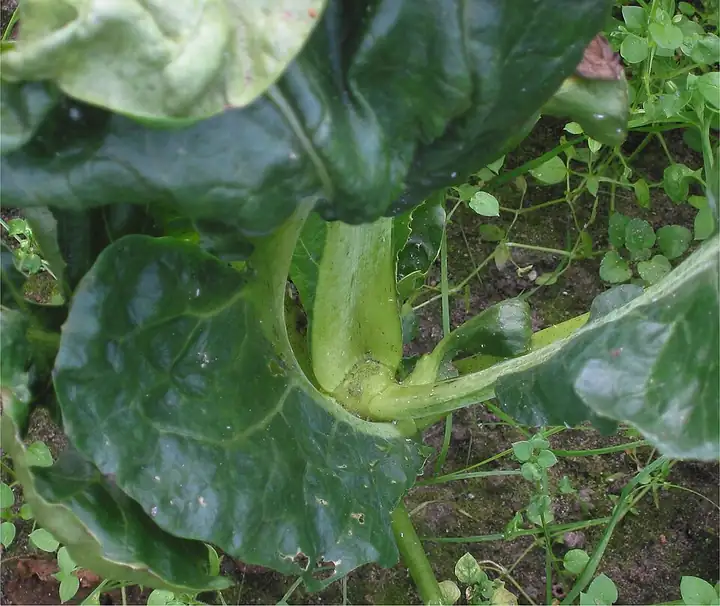
Swede midge
Contarinia nasturtii
| Type | Insect |
|---|---|
| When | Throughout the brassica season, with 2 to 5 generations a year. |
| Pressure by region | Moderate: Northeast, Midwest |
About
A tiny light brown to orange fly, about 2 mm long, first found in the US in New York in 2004 (UMN, Illinois). Its maggots hide in the growing tips of cabbage-family crops, so the damage is usually noticed long before the insect is.
Spotting it
Damage
Growing tips twist and crumple, leaf stalks swell, and brown, corky scars form at the base of stems and leaves. Broccoli and cauliflower may make several small heads or none at all ('blind' plants).
How to find it early
Watch for crumpled tips and corky brown scars near the growing point; the damage is easy to mistake for herbicide or weather injury. The insect itself needs an expert or a DNA test to confirm.
When
Throughout the brassica season, with 2 to 5 generations a year.
Life cycle
The maggots feed in the growing tips for about 1 to 2 weeks before dropping to the soil to pupate. There are 2 to 5 generations a year, and it spends winter in the top inch or two of soil, where it can stay dormant for several seasons (UMN).
What to do, gentlest first
Start at the top. Sprays are a last step; always read and follow the product label.
Rotate and clean up Prevent
Don't plant cabbage-family crops in the same spot for 1 to 3 years; the University of Vermont suggests at least three years. Remove crop leftovers right after harvest, and don't start transplants in soil that may hold pupae (UMN).
Insect exclusion netting Barrier
Cover plants with insect exclusion netting. In University of Vermont trials, netting used with plastic mulch cut damage by up to 100% when no gaps were left.
Netting only works if the midge is not already in the soil under it.
Plants it goes after
Broccoli, Brussels sprouts, Cabbage, Cauliflower, Collards, Kale, Kohlrabi
Pressure by region
This invasive pest was first found in the US in New York in 2004. It is now in Vermont, New Hampshire, western Massachusetts and southern Connecticut (UNH) and in Michigan, Ohio, Minnesota, Wisconsin and Illinois (Illinois Extension), and it is still spreading. Ratings outside the Northeast and Midwest are estimates; the sources found no reports there. Report suspected finds to your state department of agriculture.
| Northeast | Moderate |
|---|---|
| Southeast | Low |
| South Central | Low |
| Midwest | Moderate |
| Great Plains | Low |
| Mountain West | Low |
| Southwest | Low |
| Pacific Northwest | Low |
| California | Low |
| Alaska | Low |
| Hawaii | Low |
Ratings come from extension sources where available; some are estimates, as noted above.
Sources
Photo: Photo: Rasbak, CC BY-SA 3.0, via Wikimedia Commons (CC BY-SA 3.0). Photo resized for the web.

Planting dates and advice are general guidance; check with your local Cooperative Extension office for your area.