
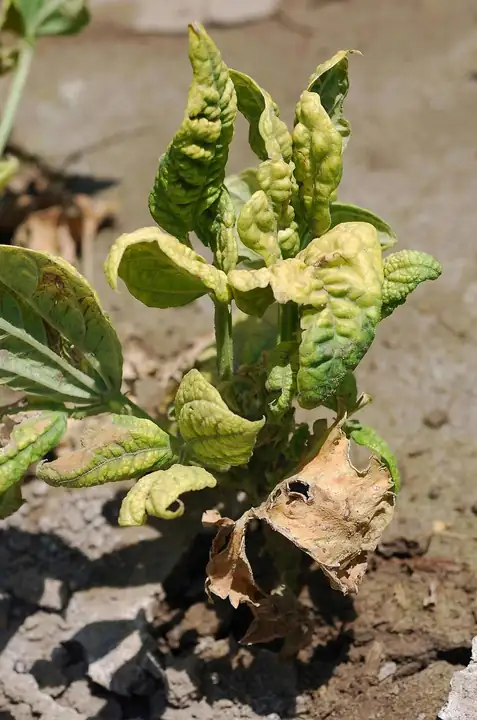
Curly top
Virus (beet curly top virus, a curtovirus in the geminivirus family) spread by the beet leafhopper
| Type | Virus |
|---|---|
| Cause | Virus (beet curly top virus, a curtovirus in the geminivirus family) spread by the beet leafhopper |
About
Curly top is a virus of tomatoes, peppers, beans, beets, squash and hundreds of other plants in the dry western US. The beet leafhopper carries it in from weedy wild land. Infected plants never recover, so shading young plants and keeping leafhoppers off them are the main defenses.
Also called beet curly top virus, BCTV, curly top virus, curly top of tomato
How to recognize it
Symptoms
Leaves roll or cup, twist and pucker, and turn thick, stiff and leathery. The plant yellows, and veins on the leaf undersides often turn purple. Growth stops, plants stay stunted, and young plants often die. Tomatoes ripen early and stay small, dull and wrinkled. Beet leaves become badly twisted and curled. Symptoms show about 1 to 2 weeks after infection.
Often confused with
On tomato, psyllid yellows, caused by potato psyllid feeding, looks much the same. Your county Extension office can help tell them apart.
Worse when
Hot, dry weather, sunny open spots, widely spaced plants with bare soil around them, and weedy land nearby with hosts such as Russian thistle and wild mustards.
How it spreads
Beet leafhoppers pick up the virus from infected weeds or crops in about a minute of feeding and carry it for life. They fly long distances, often moving into gardens as wild plants dry out. The disease doesn't spread from one garden plant to the next on its own; new cases come with new leafhoppers.
When
Late spring through summer, peaking when wild hosts dry out and leafhoppers move into gardens.
Where
Mostly the dry western US, including the Southwest, California, Utah and Washington.
What to do, gentlest first
Prevention works best; most sprays only protect healthy leaves and can't cure infected ones. Always read and follow the product label.
Give young plants some shade Prevent
Leafhoppers prefer to feed on plants in full sun. Plant tomatoes and peppers where they get partial shade, or shade young plants.
Plant closer and plant extra Prevent
Leafhoppers favor widely spaced plants surrounded by bare soil. Planting more densely, or setting two plants per spot, helps make up for losses.
Control weeds and choose neighbors Prevent
Keep weeds such as Russian thistle and wild mustards down. Don't plant tomatoes near beets or spinach, which can host both the leafhopper and the virus.
Try resistant or tolerant tomatoes Prevent
WSU lists the tomatoes 'Columbian', 'Rowpac', 'Roza' and 'Saladmaster' as resistant, though seed may be hard to find. Growing several varieties can help, since some cope better than others.
Oklahoma State says no tomato variety is truly resistant.
Pull infected plants By hand
Infected plants won't recover or set more fruit, so pull and destroy them and replant if there's time.
Fine netting or row cover Barrier
Cover young plants in full sun with row cover or fine netting to block leafhoppers and add shade. Keep the cover off the leaves, and remove it once plants are bigger.
Sprays don't stop curly top Organic spray
Insecticides for leafhoppers don't reduce curly top, because leafhoppers fly in and pass the virus before a spray can kill them. WSU recommends no chemical control.
Plants it affects
Beet, Cabbage, Cantaloupe (muskmelon), Cucumber, Dry beans (pinto, black, kidney, navy), Green beans (snap beans), Pepper (sweet and chili), Potato, Spinach, Tomato, Winter squash and pumpkin, Zucchini and summer squash
Sources
Photo: Photo: Howard F. Schwartz, Colorado State University, Bugwood.org, CC BY 3.0 us, via Wikimedia Commons (CC BY 3.0 us). Photo resized for the web.

Planting dates and advice are general guidance; check with your local Cooperative Extension office for your area.