
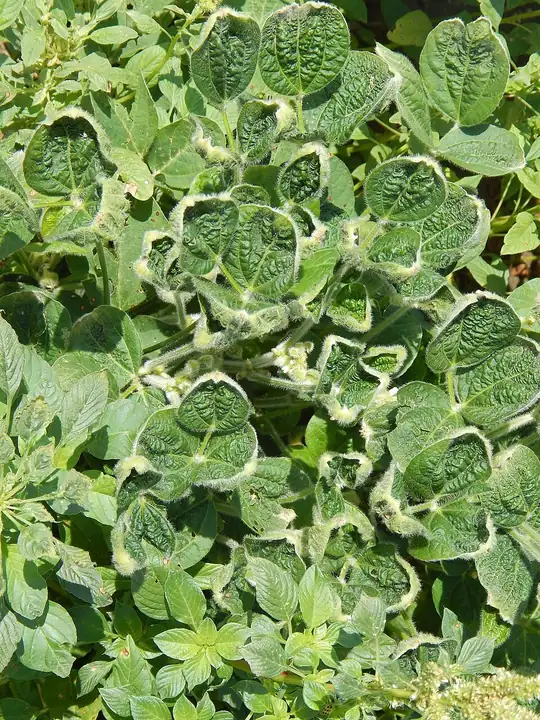
Herbicide injury
Not an infection: exposure to weed killers from drift, vapor, or contaminated manure, compost, hay, straw or grass clippings
| Type | Not an infection |
|---|---|
| Cause | Not an infection: exposure to weed killers from drift, vapor, or contaminated manure, compost, hay, straw or grass clippings |
About
Weed killers can twist, cup and stunt garden plants that were never meant to be sprayed. Lawn herbicides like 2,4-D and dicamba drift or vaporize onto gardens, and a few long-lasting herbicides survive in manure and compost.
Also called herbicide injury, herbicide drift, herbicide damage
How to recognize it
Symptoms
Growth-regulator herbicides (2,4-D, dicamba, triclopyr) make new leaves narrow, cupped, twisted or strap-like with odd, parallel veins, and stems twist or split; tomato fruit may be misshapen. Glyphosate yellows or whitens new growth between the veins. Symptoms often take a few days to 2 weeks to show.
Often confused with
Nutrient shortages and other stresses can look similar, so a professional diagnosis may be needed, especially before a formal complaint.
Worse when
Spraying on windy days or very still days (under 3 mph), hot weather that makes some herbicides vaporize, and garden inputs from treated pastures or lawns.
How it spreads
Drift and vapor move through the air during and after spraying; persistent herbicides (aminopyralid, clopyralid, picloram, aminocyclopyrachlor) pass through livestock into manure and can stay active in compost and soil for a year or more.
When
Spring and early summer, when lawns and fields are sprayed; any time contaminated compost or manure is used.
What to do, gentlest first
This is not an infection, so sprays for diseases won't help. Fix the cause below.
Keep weed killers away from the garden Prevent
Avoid broadleaf lawn sprays near the garden, never spray on windy, dead-calm or hot days, and do not mulch with clippings from treated lawns (UMN suggests waiting four to six mowings after treatment).
Tomatoes, peppers, eggplant, beans and grapes are very sensitive; grapes have been damaged by as little as 1/800th of a labeled rate.
Test manure and compost before using it Prevent
Ask suppliers whether manure, hay, straw or compost could contain persistent herbicides. To check, mix the material 1:1 with potting mix, plant three pea or bean seeds per pot, and watch 2 to 3 weeks for twisted, cupped growth.
Document it and report drift By hand
Take dated photos, note the weather and any nearby spraying, and talk with the neighbor or applicator. To file an official complaint, contact your state department of agriculture (the state pesticide regulator), which investigates at no cost to you.
An official complaint starts a process you cannot stop, and investigations can take a year or more.
Care for injured plants By hand
Plants that were drifted on, not directly sprayed, often outgrow the damage after several weeks with regular watering, though harvest may be delayed.
Do not overfeed. Plants grown in soil or compost with persistent herbicide residues are unlikely to produce a usable crop.
Plants it affects
Apple (backyard tree), Beet, Carrot, Eggplant, Grape, Green beans (snap beans), Lettuce, Peach, Peas, Pepper (sweet and chili), Potato, Raspberry, Spinach, Strawberry, Tomato
Sources
- extension.umn.edu
- extension.umn.edu
- extension.umn.edu
- content.ces.ncsu.edu
- ipm-drift.cfaes.ohio-state.edu
- ipm-drift.cfaes.ohio-state.edu
Photo: Photo: United Soybean Board, CC BY 2.0, via Wikimedia Commons (CC BY 2.0). Photo resized for the web.

Planting dates and advice are general guidance; check with your local Cooperative Extension office for your area.