
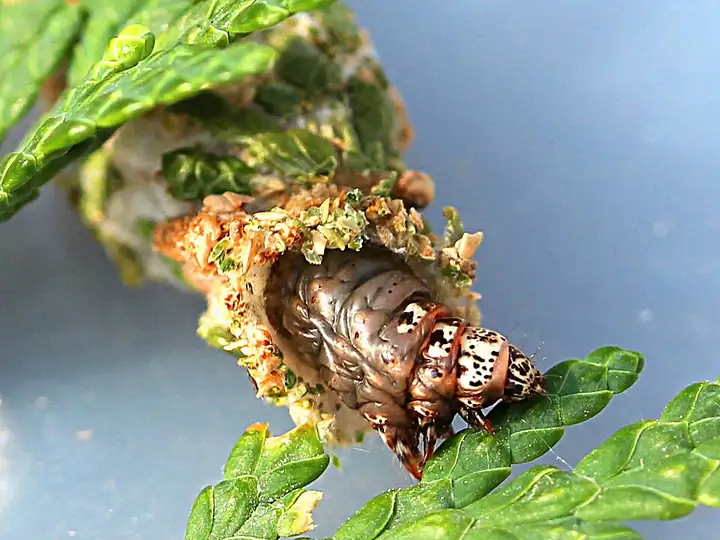
Bagworm
Thyridopteryx ephemeraeformis
| Type | Insect |
|---|---|
| When | Caterpillars feed late May through August; old bags hang on plants year-round |
| Pressure by region | High pressure: Northeast, Southeast, Great Plains |
About
A native moth whose caterpillar lives inside a cone-shaped bag made of silk and bits of leaves or needles. It is best known on evergreens like arborvitae and juniper, but it also feeds on many deciduous trees and shrubs, including persimmon and rose.
Spotting it
Damage
Young caterpillars scrape the leaf surface and leave brown spots; older ones eat whole leaves or strip needles, often leaving only the veins on broad leaves. Heavy feeding over several years can kill evergreens, which can't regrow lost foliage, and can badly damage or kill deciduous trees.
How to find it early
In winter, look for brown bags that look like small pinecones, 1 to 2 inches long, hanging from twigs. From late May into June, look for tiny new bags, about 1/8 to 1/4 inch long, moving across leaves.
When
Caterpillars feed late May through August; old bags hang on plants year-round
Life cycle
There is one generation a year. Each female lays 500 to 1,000 eggs inside her bag and dies; the eggs spend winter there, hatch in May and June, and the tiny caterpillars spread on silk threads in the wind, feed through summer, then seal their bags from late July to mid-August to pupate. Males fly in early fall to mate with the wingless females, which never leave their bags.
What to do, gentlest first
Start at the top. Sprays are a last step; always read and follow the product label.
Check new plants for bags Prevent
Bagworms have reached New Mexico several times on infested nursery stock, so look new trees and shrubs over for bags before you plant them.
Pick off the bags By hand
In fall, winter or early spring before eggs hatch, pick the bags off by hand or cut the silk band with garden shears or a knife. Soak them for 15 minutes in soapy water (about 1 fluid ounce of soap per gallon), or seal them in a trash bag, so the young can't escape.
One missed female bag can release 500 to 1,000 caterpillars the next spring.
Bt (Bacillus thuringiensis kurstaki) on tiny caterpillars Natural enemies
Starting in late May, when caterpillars are 1/8 to 1/4 inch long, spray the leaves about once a week for four weeks, in the morning or evening when they are most active. Bt must be eaten to work, so cover the foliage well.
Bt works poorly on caterpillars over about an inch long. It also kills butterfly caterpillars, so spray only plants with bagworms. Clemson calls it pollinator friendly. Read and follow the label and the pre-harvest interval on persimmon.
Spinosad Organic spray
Use it on the same schedule as Bt, while caterpillars are small. Like Bt, it must be eaten.
Spinosad is toxic to bees for about 3 hours to a day after spraying; don't spray plants in bloom or when bees are active. Read and follow the label and the pre-harvest interval on persimmon.
Pyrethroid on young caterpillars Conventional spray
NC State says pyrethroids such as permethrin or bifenthrin, applied in late May or early June while caterpillars are tiny, last longer than other choices. Sprays work poorly on big caterpillars and stop working once they pupate.
Pyrethroids are highly toxic to bees; Clemson says to use them sparingly, for heavy infestations when other methods have failed. Read and follow the label and the pre-harvest interval on persimmon.
Plants it goes after
Arborvitae, Bald cypress, Buckeye, Colorado blue spruce, Eastern hemlock, Fir, Juniper, Persimmon (American and Asian), Red twig dogwood, Rose (garden and landscape roses)
Pressure by region
Rutgers says bagworms are found across most of the U.S. but are most common in the East; NC State says they occur throughout the eastern U.S., and K-State calls them a major pest in Kansas. In New Mexico they are not native but have arrived several times on nursery stock. Ratings for the south-central, Midwest, western, Alaska and Hawaii regions are estimates.
| Northeast | High pressure |
|---|---|
| Southeast | High pressure |
| South Central | Moderate |
| Midwest | Moderate |
| Great Plains | High pressure |
| Mountain West | Low |
| Southwest | Low |
| Pacific Northwest | Low |
| California | Low |
| Alaska | Low |
| Hawaii | Low |
Ratings come from extension sources where available; some are estimates, as noted above.
Sources
- content.ces.ncsu.edu
- njaes.rutgers.edu
- bookstore.ksre.ksu.edu
- plantclinic.nmsu.edu
- hgic.clemson.edu
- s3.wp.wsu.edu
Photo: Photo: Peterwchen, CC BY-SA 4.0, via Wikimedia Commons (CC BY-SA 4.0). Photo resized for the web.

Planting dates and advice are general guidance; check with your local Cooperative Extension office for your area.