
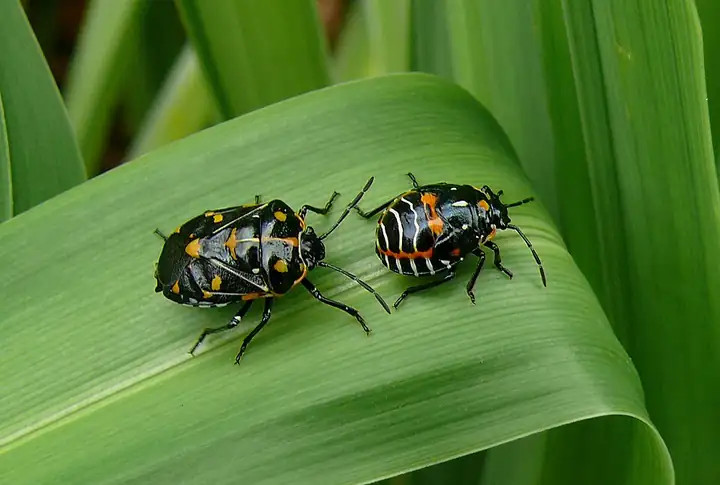
Harlequin bug
Murgantia histrionica
| Type | Insect |
|---|---|
| When | Spring through fall. |
| Pressure by region | High pressure: Southeast, South Central |
About
A shield-shaped stink bug a quarter to three-eighths of an inch long, black with vivid red, orange or yellow markings. It came north from Mexico after the Civil War and prefers the cabbage family.
Spotting it
Damage
Feeding leaves cloudy white or yellow blotches around each puncture, and young plants wilt, brown and can die. Unchecked, it can wipe out a crop of greens.
How to find it early
Check cabbage-family crops and wild mustards in spring for the brightly colored adults and nymphs and their egg clusters.
When
Spring through fall.
Life cycle
Adults overwinter among crop debris and come out in spring to feed and lay eggs. North Carolina sees two to four generations a year, each taking about 30 to 80 days depending on temperature.
What to do, gentlest first
Start at the top. Sprays are a last step; always read and follow the product label.
Clean up and control wild mustard Prevent
Remove crop debris in fall and pull wild mustards early in spring to cut the overwintering population.
Mustard or radish trap crop Prevent
Plant mustard, radish, turnip or kale as a trap in spring, then destroy the bugs that gather on it.
Watch the trap crop closely, or it becomes a nursery.
Hand-pick and crush eggs By hand
Drop bugs into soapy water and destroy egg masses. Killing adults in fall and early spring before they lay eggs pays off most.
Mulch for spiders Natural enemies
In New Mexico trials, mulch boosted spider predators and cut damage from 93 to 32 percent.
Spinosad Organic spray
Spinosad controlled harlequin bugs better than pyrethrins in New Mexico.
Toxic to bees while wet; do not spray flowering plants, spray in the evening, and follow the label and pre-harvest interval.
Labeled residential insecticides Conventional spray
Use products labeled for harlequin bug on your crop.
Avoid flowering plants and follow the label and pre-harvest interval.
Plants it goes after
Asparagus, Broccoli, Cabbage, Collards, Eggplant, Green beans (snap beans), Kale, Napa cabbage, Okra, Potato, Radish, Sweet corn, Tomato, Zucchini and summer squash
Pressure by region
A southern pest found coast to coast across the southern U.S. and rarely north of Colorado and Pennsylvania (UF/IFAS). In higher, colder parts of New Mexico few adults survive winter. It is not on Hawaii's home-garden pest list (CTAHR). The California, Alaska and Hawaii low ratings are estimates made for lack of a severity source.
| Northeast | Low |
|---|---|
| Southeast | High pressure |
| South Central | High pressure |
| Midwest | Low |
| Great Plains | Low |
| Mountain West | Low |
| Southwest | Moderate |
| Pacific Northwest | Low |
| California | Low |
| Alaska | Low |
| Hawaii | Low |
Ratings come from extension sources where available; some are estimates, as noted above.
Sources
Photo: Photo: Linda Tanner, CC BY 2.0, via Wikimedia Commons (CC BY 2.0). Photo resized for the web.

Planting dates and advice are general guidance; check with your local Cooperative Extension office for your area.