
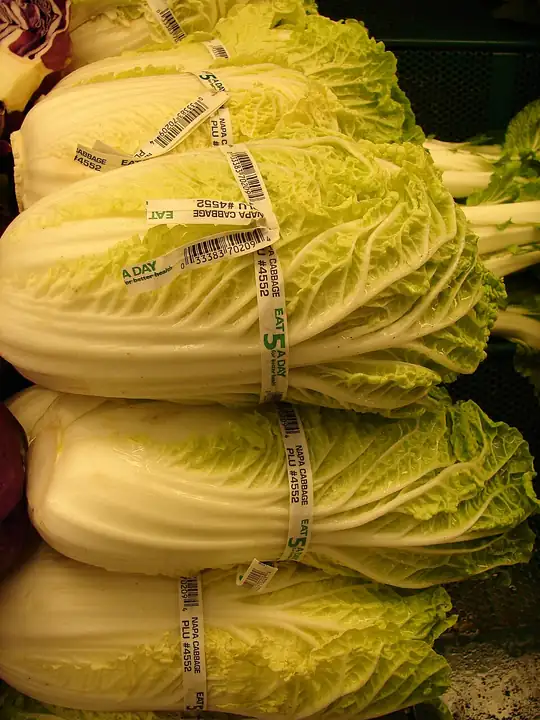
Napa cabbage
Brassica rapa Pekinensis Group · Cabbage family (Brassicaceae)
| Hardiness zones | 2 to 11 |
|---|---|
| Sun | full sun |
| Water | moderate |
| Life cycle | annual |
| Frost | Half-hardy: takes a light frost |
| Soil pH | 6.0–7.5 |
| Spacing | 12 to 18 inches |
| Days to harvest | 54 to 90 days |
About Napa cabbage
Napa cabbage (Chinese cabbage) forms a crisp, pale, barrel-shaped head; the taller Michihli type is a close relative. It is a cousin of bok choy and turnip, and it is the classic cabbage for kimchi. Cold spells in spring can make it bolt, so fall is its most reliable season.
Grown as a cool-season annual in every zone; fall crops are more reliable. It is the same species as field mustard, which the California Invasive Plant Council rates Limited (advisory).
When to plant
Timing is counted from your average last spring frost (and first fall frost). Sow & Tell works out the actual dates for your ZIP code.
- Set out plants: 2 to 4 weeks before the last frost
Days count from seeding (common hybrids take about 54 to 72 days; Florida lists 70 to 90). Spring plants set out 2 to 4 weeks before the last frost may bolt if nights stay below 50F for a week or more; in the North, sow in early July for a fall crop, since it needs about two months.
Soil
Fertile, well-drained soil that holds moisture; aim for about an inch of water a week, since uneven watering leads to tipburn.
Get a soil test first, aim for pH 6.0 to 7.5, and work in well-rotted manure or compost in spring or fall.
Feeding
Don't use fresh manure or weed-and-feed products; too much or late nitrogen can cause dark specks (pepper spot) on the midribs.
Harvest
Cut the head above the outer leaves when it feels firm and dense when pressed. Don't leave mature heads standing long, and cover them if lows below 30F are forecast.
Cut the whole head once it feels firm and dense, and don't leave mature heads standing; sow a fall crop in midsummer.
Varieties (10)
Extension lists name about 10 napa and Michihli varieties; few give full details.
| Variety | Type | Days | Notes |
|---|---|---|---|
| Michihli | Michihli | 78 days | Tall, semi-heading cylinder of light green leaves with broad white midribs; an heirloom suited to July planting in the North. |
| Jade Pagoda | Michihli, hybrid | 72 days | Tall, dark green, crisp heads; slow to bolt, cold tolerant, high yielding; resists soft rot and virus. Best for fall planting. |
| China Pride | Napa | 65 days | Heads about 5 1/2 lb; tolerates downy mildew, soft rot and tipburn and resists bolting; for spring or fall. |
| Monument | Napa | Tall, narrow heads. | |
| Optika | Napa | Vigorous barrel-shaped heads; tolerant of tipburn and bolting. | |
| Rubicon | Napa | Grown successfully at the Minnesota Landscape Arboretum. | |
| Bilko | Napa, hybrid | 54 days | Resists clubroot, fusarium yellows and bacterial soft rot; on Kentucky's fall list and Texas lists. |
| Blues | Napa, hybrid | 57 days | Blue-green leaves; resists downy mildew, viruses and soft rot, and resists early bolting. The one variety UMN says grows well in Minnesota. |
| China Express | Napa, hybrid | Slow-bolting, uniform, well-wrapped barrel heads. | |
| Minuet | Napa, hybrid | An F1 hybrid listed in North American cultivar descriptions. |
Good neighbors
Cabbage, Broccoli, Kale, Cauliflower, Brussels sprouts, Collards, Kohlrabi
UMN Extension names napa cabbage as a trap crop that can draw flea beetles away from other cabbage-family crops, working best in a mix of several trap species; expect the napa itself to get chewed.
Pests to watch for
Flea beetles, Imported cabbageworm, Cabbage looper, Diamondback moth, Cabbage maggot, Aphids, Harlequin bug, Cutworms, Beet armyworm, Whiteflies, Slugs, Brown garden snail
Diseases and problems
Black rot of cabbage-family crops, Alternaria leaf spot (cabbage family), Clubroot, Downy mildew, White rust, Tipburn, Bacterial soft rot, Bottom rot, Turnip mosaic
In the kitchen
Shredded raw into slaws and salads, used as wraps, or braised, stir-fried, added to soups and dumplings, and fermented into kimchi.
Keeping it: Refrigerate heads in a bag, away from produce that gives off ethylene gas, which yellows the leaves; in a root cellar at 32-40F with high humidity they can keep for weeks or months.
Pets: Not listed by the ASPCA
Sources
- extension.umn.edu
- hgic.clemson.edu
- sare.org
- plants.ces.ncsu.edu
- horticulture.oregonstate.edu
- ask.ifas.ufl.edu
- publications.mgcafe.uky.edu
- rvpadmin.cce.cornell.edu
- uidaho.edu
- extension.umn.edu
- cal-ipc.org
- ucanr.edu
- aspca.org
- aspca.org
- extensionpubs.unl.edu
Photo: Photo: Forest and Kim Starr / Wikimedia Commons, CC BY 3.0 US (CC BY 3.0 US). Photo resized for the web.

Planting dates and advice are general guidance; check with your local Cooperative Extension office for your area.