
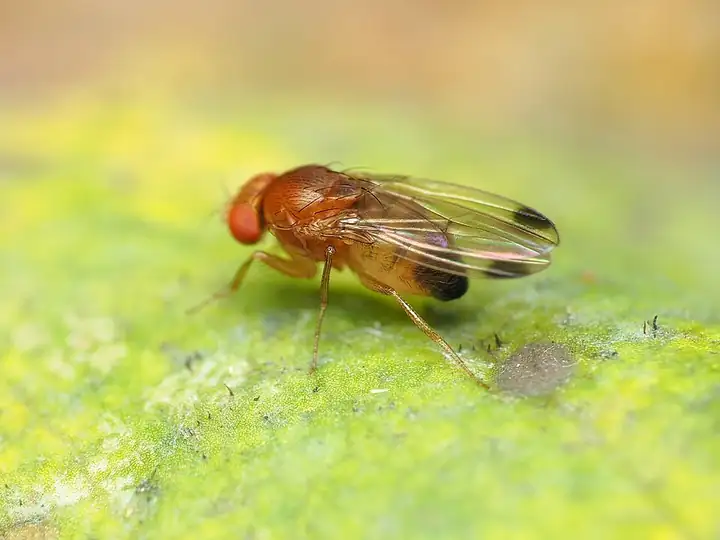
Spotted wing drosophila
Drosophila suzukii
| Type | Insect |
|---|---|
| Pressure by region | High pressure: Northeast, Midwest, Pacific Northwest |
About
A tiny red-eyed fruit fly from Asia; males have a dark spot on each wing. Unlike ordinary fruit flies, the female saws into sound, ripening fruit to lay her eggs.
Spotting it
Damage
Fruit looks fine at picking, then turns soft and sunken and is full of small white larvae.
How to find it early
Start checking when fruit begins to color. Crush a handful of berries in salt water (1 cup of salt per gallon) and watch for larvae floating up within 15 minutes, or use vinegar-baited traps.
When
Midsummer through fall; worst on late raspberries, blackberries, blueberries and day-neutral strawberries.
Life cycle
A generation takes 10 to 20 days in warm weather, and females live up to two months and lay hundreds of eggs. In the Northeast adult females are thought to survive winter in sheltered spots, and cold winters cut numbers sharply.
What to do, gentlest first
Start at the top. Sprays are a last step; always read and follow the product label.
Pick often and clean up Prevent
Harvest ripe fruit frequently and remove fallen, overripe and damaged fruit right away. Early-ripening varieties dodge the worst of it.
Monitor with traps and salt tests By hand
Vinegar-baited traps show when flies arrive, and the salt-water test shows whether fruit is infested.
Fine mesh netting Barrier
Cover bushes with fine mesh (about 1 mm, or 0.98 mm) before fruit starts to ripen.
Spinosad Organic spray
UC IPM rates spinosad the most effective option with the least environmental impact. Spray before fruit ripens.
Sprays cannot kill larvae already in fruit. Toxic to bees while wet, so spray in the evening when they are not foraging, and follow the label and its pre-harvest interval.
Malathion Conventional spray
An alternative when spinosad is not enough.
UC IPM says it is very toxic to bees and natural enemies. Spray only when bees are not foraging and nothing nearby is in bloom, and follow the label and pre-harvest interval.
Plants it goes after
Aronia (black chokeberry), Black raspberry (blackcap), Blackberry, Blueberry, Cherry (sweet and tart), Clove currant (golden currant), Elderberry (American), Fig, Grape, Hardy kiwi (kiwiberry), Plum, Raspberry, Salmonberry, Strawberry
Pressure by region
Found in Hawaii in the 1980s and in California in 2008; it spread along the West Coast in 2009 and reached Florida, Utah, the Carolinas, Wisconsin and Michigan by 2010. In the North it builds up late in the season, so June-bearing strawberries largely escape. South Central, Great Plains, Mountain, Southwest, Alaska and Hawaii are rated low for lack of a regional severity source; those ratings are estimates.
| Northeast | High pressure |
|---|---|
| Southeast | Moderate |
| South Central | Low |
| Midwest | High pressure |
| Great Plains | Low |
| Mountain West | Low |
| Southwest | Low |
| Pacific Northwest | High pressure |
| California | Moderate |
| Alaska | Low |
| Hawaii | Low |
Ratings come from extension sources where available; some are estimates, as noted above.
Sources
Photo: Photo: Katja Schulz, CC BY 4.0, via Wikimedia Commons (CC BY 4.0). Photo resized for the web.

Planting dates and advice are general guidance; check with your local Cooperative Extension office for your area.