
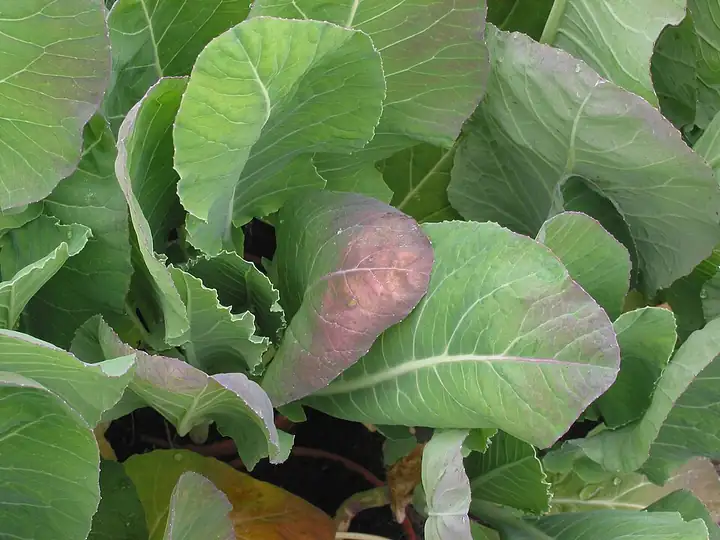
Nitrogen deficiency
Not an infection: the plant is not getting enough nitrogen, from poor or leached soil or from roots that can't take it up
| Type | Not an infection |
|---|---|
| Cause | Not an infection: the plant is not getting enough nitrogen, from poor or leached soil or from roots that can't take it up |
About
Nitrogen drives green, leafy growth, so a plant short on it turns pale and grows slowly. Real shortages are most common in leafy vegetables, sweet corn, lawns, fruit trees and container plants; most established trees and shrubs rarely need extra nitrogen.
Also called nitrogen shortage, lack of nitrogen, low nitrogen, nitrogen-deficient, N deficiency, nitrogen deficiency
How to recognize it
Symptoms
Older, lower leaves turn evenly pale green to yellow first, while the newest leaves stay greener. Growth slows, and leaves, shoots and fruit come in small; badly starved plants drop their lower leaves and mature early. In corn, the yellow starts at the leaf tip and runs down the middle of the leaf.
Often confused with
Potassium shortage also starts on older leaves, but it yellows and browns the leaf edges first (in corn, along the edge rather than down the middle). Magnesium shortage yellows older leaves between green veins, and iron chlorosis yellows the newest leaves first while their veins stay green. Root rot, poor drainage, compacted soil and cold spring soil can all cause the same pale look, so confirm with a soil test or a leaf tissue test compared with a healthy plant.
Worse when
Sandy or heavily leached soil, soil with lots of undecomposed organic matter mixed in, containers and planter boxes, and heavy feeders like leafy greens and corn; cold, wet spring soil can cause a short-lived shortage.
How it spreads
It does not spread from plant to plant.
When
Any time during active growth. Temporary yellowing can show in early spring until the soil warms and drains.
What to do, gentlest first
This is not an infection, so sprays for diseases won't help. Fix the cause below.
Soil test before you feed Prevent
Get a soil test through your state's Extension service and fertilize by the results. Vegetables, lawns, fruit trees, roses and container plants need regular nitrogen; most established trees and shrubs need little or none.
Too much nitrogen gives soft, lush growth that draws aphids and mites, can burn roots, and can pollute water.
Fix root problems first Prevent
If roots are struggling in soggy, compacted or cold soil, more nitrogen will not help. Improve drainage, ease compaction, and give cold spring soil time to warm.
Feed with a nitrogen fertilizer Prevent
Where a shortage is confirmed, use a nitrogen fertilizer such as ammonium sulfate or a slow-release coated urea, or a slowly breaking-down organic mulch, at soil-test or label rates, and water it in.
A complete fertilizer (N-P-K) adds nutrients the soil may not need, which can build up salts. Follow the label.
Plants it affects
Apple (backyard tree), Cabbage, Collards, Kale, Lemon, Lettuce, Mustard greens, Peach, Rose (garden and landscape roses), Spinach, Sweet corn, Swiss chard
Sources
Photo: Photo: Rasbak / Wikimedia Commons, CC BY-SA 3.0 (CC BY-SA 3.0). Photo resized for the web.

Planting dates and advice are general guidance; check with your local Cooperative Extension office for your area.