
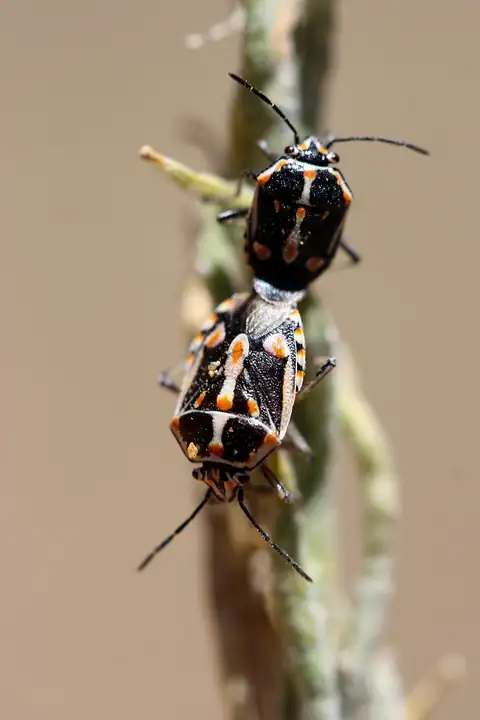
Bagrada bug
Bagrada hilaris
| Type | Insect |
|---|---|
| When | Warm months; numbers peak in late summer and fall. |
| Pressure by region | High pressure: California, Hawaii |
About
A small shield-shaped stink bug, about a quarter inch long, black with orange and white markings. It looks like a much smaller harlequin bug and was first found in the US in Los Angeles County in 2008.
Spotting it
Damage
Its feeding leaves pale starburst-shaped spots that merge into stippled, scorched-looking leaves. Cabbage-family crops end up stunted, with blind tips or several small heads, and seedlings can be killed outright. UC IPM also lists tomato, pepper and melon as occasional hosts.
How to find it early
Look for fresh starburst-shaped feeding spots, which are easier to see than the bugs. Shake plants over a tray or sheet of paper; on cool days check leaf undersides, stem bases and soil cracks.
When
Warm months; numbers peak in late summer and fall.
Life cycle
A female can lay up to 150 eggs in two to three weeks, mostly in the soil under host plants, and they can hatch in as little as four days. It has several generations a year in southern California and hides in leaf litter and topsoil during cold weather.
What to do, gentlest first
Start at the top. Sprays are a last step; always read and follow the product label.
Clear weed hosts Prevent
Remove wild mustards, shepherd's purse, London rocket and other weedy hosts in and near the garden. UC IPM also suggests removing very attractive plants such as sweet alyssum, which can be a source of bugs.
Hand-pick or vacuum By hand
Pick off bugs when there are only a few. With heavy numbers, a portable vacuum can suck them off plants.
Row cover or fine screen Barrier
Protect young plants with floating row cover or a screened tunnel fine enough to keep out the small nymphs. Hold it up off the plants and bury the edges.
Pyrethrins, azadirachtin or insecticidal soap Organic spray
Research suggests pyrethrins can knock back adults, while azadirachtin and insecticidal soap may reduce nymphs (UC IPM). Expect to repeat; adults often fly off and come back.
Pyrethrins are highly toxic to bees and azadirachtin is toxic to bees for up to 2 hours (PNW 591); spray in the evening and keep sprays off open flowers. Read and follow the label, make sure it lists home gardens, and observe the pre-harvest interval.
Plants it goes after
Arugula, Bok choy, Broccoli, Brussels sprouts, Cabbage, Cauliflower, Collards, Kale, Mustard greens, Radish, Sweet alyssum, Turnip
Pressure by region
This invasive bug is established in California, Nevada, Utah, Arizona, New Mexico and Texas (UC IPM), and in Hawaii, where it was first found on Maui in 2014 and has since been found on Hawaii Island and Oahu (Hawaii Department of Agriculture). It is still spreading. California and Hawaii are rated high because UC IPM and Hawaii say it can kill seedlings and ruin crops; the other ratings are estimates. Report new finds to your state department of agriculture.
| Northeast | Low |
|---|---|
| Southeast | Low |
| South Central | Moderate |
| Midwest | Low |
| Great Plains | Low |
| Mountain West | Moderate |
| Southwest | Moderate |
| Pacific Northwest | Low |
| California | High pressure |
| Alaska | Low |
| Hawaii | High pressure |
Ratings come from extension sources where available; some are estimates, as noted above.
Sources
Photo: Photo: Andrew Meeds, CC BY 4.0, via Wikimedia Commons (CC BY 4.0). Photo resized for the web.

Planting dates and advice are general guidance; check with your local Cooperative Extension office for your area.