
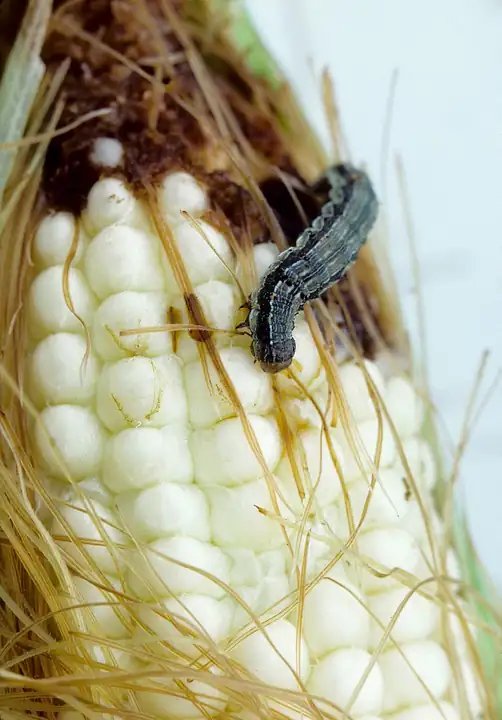
Corn earworm (tomato fruitworm)
Helicoverpa zea
| Type | Insect |
|---|---|
| When | Summer into fall; moths reach northern states between May and August. |
| Pressure by region | High pressure: Southeast, South Central |
About
A striped caterpillar up to about an inch and a half long, green, yellow or brown, that feels rough from short bristles. The same insect is called tomato fruitworm when it bores into tomatoes.
Spotting it
Damage
In sweet corn it eats the silks and kernels at the tip of the ear, usually the top inch or two. In tomatoes and other crops it bores watery holes into the fruit and often moves from one fruit to the next.
How to find it early
Look for tiny round white eggs laid one at a time on fresh green silks and upper leaves. By the time silk tips look brown and chewed, the caterpillar is already inside.
When
Summer into fall; moths reach northern states between May and August.
Life cycle
A female moth lays 500 to 3,000 eggs, which hatch in three to four days; caterpillars feed for about two weeks, then pupate in the soil. Generations range from one a year in Minnesota to four or five in southern Florida and as many as seven in Texas.
What to do, gentlest first
Start at the top. Sprays are a last step; always read and follow the product label.
Plant early and pick tight-husk corn Prevent
Early planting and harvest let corn escape the heaviest moth flights. Varieties with tight husks are harder for caterpillars to enter.
Mineral oil on the silks By hand
With a dropper, put about 0.75 to 1 ml of mineral oil on the silks of each ear five to seven days after silking.
Bt or beneficial nematodes Natural enemies
Spray Bt on young caterpillars before they get inside ears or fruit. UF/IFAS also lists beneficial nematodes applied to the silk.
Once a caterpillar is inside the ear or fruit, no spray reaches it, so timing matters more than the product.
Labeled garden insecticides Conventional spray
Pyrethroid-type products labeled for sweet corn or tomatoes can be used while silks are fresh.
UF/IFAS notes caterpillars burrow into the silk so quickly that sprays work less well than prevention, and resistance is growing. Pyrethroids are highly toxic to bees (PNW 591): do not spray open flowers where bees forage, and follow the label's pre-harvest interval.
Garden friends that go after it
Minute pirate bugs, Spined soldier bug, Syrphid flies (hover flies, flower flies), Trichogramma wasps
Protect these helpers: skip broad sprays when they're around.
Plants it goes after
Cucumber, Green beans (snap beans), Lettuce, Okra, Peanut, Pepper (sweet and chili), Sesame, Southern peas, Sweet corn, Tomato, Winter squash and pumpkin, Zucchini and summer squash
Pressure by region
It survives winter only south of about 40 degrees north, roughly zone 7 and warmer (a line through Kansas, Ohio and southern New Jersey), and moths migrate north each summer. It is on Hawaii's home-garden pest list (CTAHR). The Pacific Northwest is rated low because no source was found, not because it is known to be rare there.
| Northeast | Moderate |
|---|---|
| Southeast | High pressure |
| South Central | High pressure |
| Midwest | Moderate |
| Great Plains | Moderate |
| Mountain West | Moderate |
| Southwest | Moderate |
| Pacific Northwest | Low |
| California | Moderate |
| Alaska | Low |
| Hawaii | Moderate |
Ratings come from extension sources where available; some are estimates, as noted above.
Sources
Photo: Photo: Jack Dykinga, USDA ARS, Public domain (USDA ARS), via Wikimedia Commons. Photo resized for the web.

Planting dates and advice are general guidance; check with your local Cooperative Extension office for your area.