
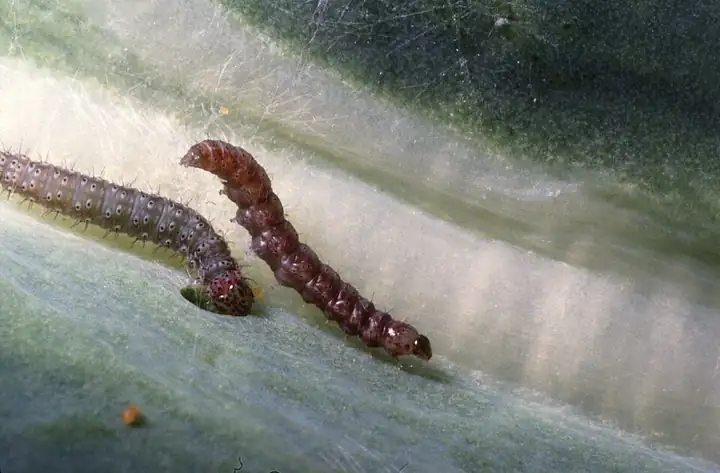
Diamondback moth
Plutella xylostella
| Type | Insect |
|---|---|
| When | Mid-May through fall in the upper Midwest; longer in the South. |
| Pressure by region | Moderate: Northeast, Southeast, South Central, Midwest, Great Plains, Mountain West, Southwest, Pacific Northwest, California, Hawaii |
About
A small, pale green caterpillar, only about a third of an inch long, that wriggles hard when touched. The slender brown moth shows a row of light diamonds along its back when its wings are folded.
Spotting it
Damage
Young caterpillars mine inside the leaf, then feed on the underside and eat everything but the top layer, leaving see-through 'windowpanes'. Older ones chew small holes in leaves and buds.
How to find it early
Check leaf undersides and growing tips of young cabbage-family plants for tiny caterpillars, windowpane feeding and small silken cocoons.
When
Mid-May through fall in the upper Midwest; longer in the South.
Life cycle
In the upper Midwest and North Carolina, adults spend the winter in sheltered spots or crop debris, and moths are also carried long distances on the wind. There are three to six generations a year depending on summer heat, and one can take as little as 15 days.
What to do, gentlest first
Start at the top. Sprays are a last step; always read and follow the product label.
Start with clean transplants and clean up Prevent
Transplants shipped north from southern states can carry insecticide-resistant diamondback moths, so inspect them. After harvest, remove cabbage-family debris where adults overwinter.
Hand-pick By hand
Drop caterpillars into soapy water.
Floating row cover Barrier
Cover cabbage-family crops with lightweight row cover to keep moths from laying eggs.
Natural enemies Natural enemies
The parasitic wasp Diadegma insulare often parasitizes 70 to 80 percent of the caterpillars in Minnesota, so avoid sprays that kill it.
Bt (Bacillus thuringiensis) Natural enemies
Bt works on small caterpillars and spares natural enemies.
This moth has developed resistance to many insecticides, including some Bt products; if one stops working, switch to a product with a different mode of action. Bt carries no bee warning on its label.
Spinosad Organic spray
Spinosad is a low-risk option for caterpillars on cabbage-family crops.
Spinosad stays toxic to bees for about 3 hours to a day after spraying (PNW 591), not just while wet; spray in the evening when bees are not foraging, keep it off open flowers, and follow the label and pre-harvest interval.
Avoid unnecessary sprays Conventional spray
Mississippi State advises against needless insecticide use; repeated spraying breeds resistance and kills the wasps that keep this pest in check.
If you spray, rotate modes of action, keep sprays off open flowers (many insecticides are highly toxic to bees, PNW 591), follow the label and observe the pre-harvest interval.
Garden friends that go after it
Spined soldier bug, Trichogramma wasps
Protect these helpers: skip broad sprays when they're around.
Plants it goes after
Bok choy, Broccoli, Brussels sprouts, Cabbage, Cauliflower, Collards, Kale, Kohlrabi, Napa cabbage, Rutabaga, Sweet alyssum, Tatsoi
Pressure by region
It is found wherever cabbage-family crops grow, and Hawaii's home-garden pest guide lists it (CTAHR). It was first collected in interior Alaska in a report published in 2008, so Alaska is rated low. No regional severity source was found, so the moderate ratings are estimates.
| Northeast | Moderate |
|---|---|
| Southeast | Moderate |
| South Central | Moderate |
| Midwest | Moderate |
| Great Plains | Moderate |
| Mountain West | Moderate |
| Southwest | Moderate |
| Pacific Northwest | Moderate |
| California | Moderate |
| Alaska | Low |
| Hawaii | Moderate |
Ratings come from extension sources where available; some are estimates, as noted above.
Sources
- extension.umn.edu
- vegedge.umn.edu
- content.ces.ncsu.edu
- scholarsarchive.byu.edu
- extension.msstate.edu
- www3.ctahr.hawaii.edu
- s3.wp.wsu.edu
Photo: Photo: Doug Wilson, USDA ARS, Public domain (USDA ARS), via Wikimedia Commons. Photo resized for the web.

Planting dates and advice are general guidance; check with your local Cooperative Extension office for your area.