
Eriophyid mites (rust, bud, blister and gall mites)
Family Eriophyidae, thousands of described species worldwide, including the tomato russet mite (Aculops lycopersici)
| Type | Mite |
|---|---|
| Pressure by region | Moderate: Northeast, Southeast, South Central, Midwest, Great Plains, Mountain West, Southwest, Pacific Northwest, California |
About
Carrot-shaped, see-through mites only about 1/100 inch long, with just four legs near the head, too small to see without a 20x lens (USU, CSU). Most cause only odd-looking galls, felty patches or russeting, but the tomato russet mite can make tomato leaves dry up and drop, and one eriophyid spreads rose rosette virus (USU, UF).
Spotting it
Damage
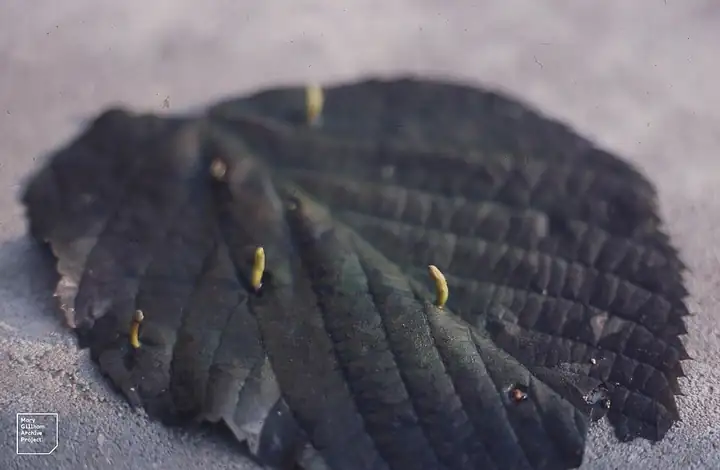
Depending on the species, you may see pouch- or finger-shaped galls, felty patches under leaves, blisters, curled or bronzed leaves, russeted fruit or witches' brooms (USU, CSU). On tomatoes, russet mites turn stems and leaves bronze; the leaves then curl, dry and drop, and bare fruit can sunscald (UF).
How to find it early
You'll see the symptoms first: galls, felty patches, bronzing or rusty leaves. Confirm the mites with a 20x hand lens or a microscope, because herbicide injury can also curl leaves; your county Extension office can help (USU, CSU, UF).
When
Spring through fall, starting at bud break; on tomatoes, whenever it's warm (about May through November in Florida).
Life cycle
Fertilized females spend winter under bud scales or in other sheltered spots and start laying eggs at bud break. A new generation comes every 2 to 3 weeks, so numbers build fast (USU, CSU). Tomato russet mites take about a week per generation and survive winter outdoors only in the South (UF).
What to do, gentlest first
Start at the top. Sprays are a last step; always read and follow the product label.
Tolerate cosmetic galls Prevent
Galls and felty patches on trees and shrubs look odd but rarely hurt the plant, so control is seldom needed (USU, CSU).
Start clean and pull host weeds Prevent
Buy mite-free plants, choose less susceptible kinds, and pull host weeds; for tomato russet mite, remove nearby nightshade and jimsonweed (USU, UF).
Prune out damage By hand
Clip off galled or deformed shoots, and remove badly infested plants (USU).
Protect predatory mites Natural enemies
Native predatory mites often keep eriophyids low, and eriophyids feed those predators when spider mites are scarce, so avoid needless sprays (USU).
Dormant oil, soap, summer oil or sulfur Organic spray
On fruit trees, spray dormant horticultural oil 7 to 10 days before bud break and again at bud break to hit overwintering mites. During the season, insecticidal soap, horticultural oil or sulfur can suppress them; cover both sides of the leaves (USU, UF).
Don't use sulfur above 90°F or in high humidity (USU). Test a few leaves first for plant injury, check that the label lists your plant, and follow it, including the pre-harvest interval on food crops.
Miticides only for severe cases Conventional spray
USU saves miticides such as abamectin for serious infestations that are really hurting the plant.
Broad-spectrum products kill predatory mites and can lead to resistance (USU). Abamectin is highly toxic to bees (PNW 591). Follow the label and its pre-harvest interval.
Plants it goes after
Apple (backyard tree), Eastern hemlock, Eggplant, Fir, Garlic, Grape, Lychee, Mango, Onion, Peach, Pear, Pepper (sweet and chili), Plum, Potato, River birch, Rose (garden and landscape roses), Thornless honeylocust, Tomatillo, Tomato, Tulip
Pressure by region
Eriophyid mites occur wherever their host plants grow, and no source rated them by region, so ratings are estimates. The tomato russet mite overwinters outdoors only in southern areas, and farther north only in protected places such as greenhouses (UF).
| Northeast | Moderate |
|---|---|
| Southeast | Moderate |
| South Central | Moderate |
| Midwest | Moderate |
| Great Plains | Moderate |
| Mountain West | Moderate |
| Southwest | Moderate |
| Pacific Northwest | Moderate |
| California | Moderate |
| Alaska | Low |
| Hawaii | Low |
Ratings come from extension sources where available; some are estimates, as noted above.
Sources
Photo: Photo: Dr Mary Gillham Archive Project / Wikimedia Commons, CC BY 2.0 (CC BY 2.0). Photo resized for the web.

Planting dates and advice are general guidance; check with your local Cooperative Extension office for your area.