
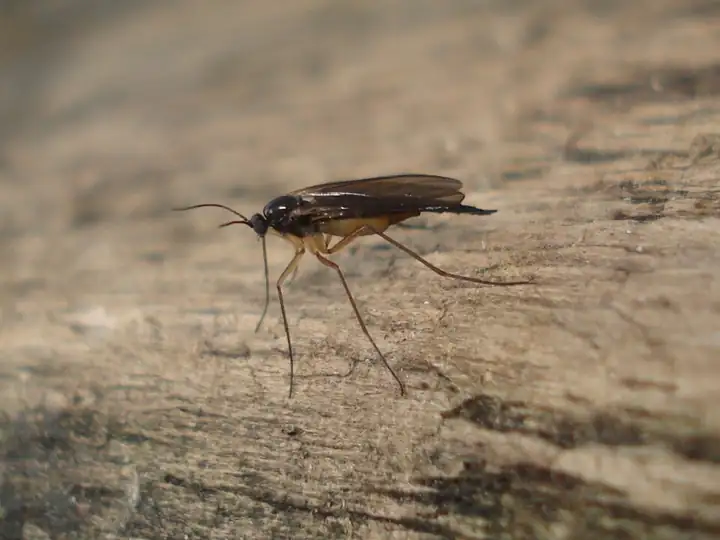
Fungus gnats
Several species of small flies
| Type | Insect |
|---|---|
| When | Year-round indoors; worst during seed starting and in overwatered pots. |
| Pressure by region | Moderate: all regions |
About
Tiny, dark, mosquito-like flies about 1/16 to 1/8 inch long that flit around seed trays, houseplants and greenhouses. The adults are mostly a nuisance, but large numbers of larvae can damage the roots of seedlings.
Spotting it
Damage
Larvae feed on fungi and decaying matter in the top 2 to 3 inches of potting mix, but in large numbers they chew roots and stunt seedlings and young plants. They also nibble leaves resting on the soil surface.
How to find it early
Put yellow sticky cards at soil level to catch adults, or push chunks of raw potato into the mix for a few days and check underneath for clear larvae with shiny black heads.
When
Year-round indoors; worst during seed starting and in overwatered pots.
Life cycle
At about 75 degrees F the whole life cycle takes about 17 days, and a female can lay up to 200 eggs in the potting mix. Indoors they can breed all year wherever the mix stays moist.
What to do, gentlest first
Start at the top. Sprays are a last step; always read and follow the product label.
Let the mix dry out Prevent
Avoid overwatering and let the top 1 to 2 inches of mix dry between waterings; make sure pots drain well.
Avoid half-finished compost Prevent
Do not use incompletely composted material in seed-starting or potting mix, since it feeds the larvae.
Yellow sticky traps Trap
Yellow sticky cards catch many adults and show whether your other steps are working.
Bti drench Natural enemies
Water the mix with Bti (Bacillus thuringiensis israelensis), a bacterium that kills the larvae.
Colorado State notes some Bti products are hard to find in stores. Follow the label.
Beneficial nematodes Natural enemies
Steinernema feltiae nematodes applied as a drench kill larvae within a few days and can give season-long control after a few applications.
Plants it goes after
Basil, Broccoli, Cabbage, Christmas cactus, Dieffenbachia (dumb cane), Eggplant, Hoya (wax plant), Lettuce, Money tree, Monstera (Swiss cheese plant), Peace lily, Peperomia, Pepper (sweet and chili), Pilea (Chinese money plant), Strawflower, String of pearls, Succulents (echeveria, haworthia, sedum), Tomato
Pressure by region
A pest of seed-starting trays, houseplants and greenhouses, so it can show up indoors in any region. These ratings are estimates, not regional survey data.
| Northeast | Moderate |
|---|---|
| Southeast | Moderate |
| South Central | Moderate |
| Midwest | Moderate |
| Great Plains | Moderate |
| Mountain West | Moderate |
| Southwest | Moderate |
| Pacific Northwest | Moderate |
| California | Moderate |
| Alaska | Moderate |
| Hawaii | Moderate |
Ratings come from extension sources where available; some are estimates, as noted above.
Sources
Photo: Photo: AfroBrazilian, CC BY-SA 3.0, via Wikimedia Commons (CC BY-SA 3.0). Photo resized for the web.

Planting dates and advice are general guidance; check with your local Cooperative Extension office for your area.