
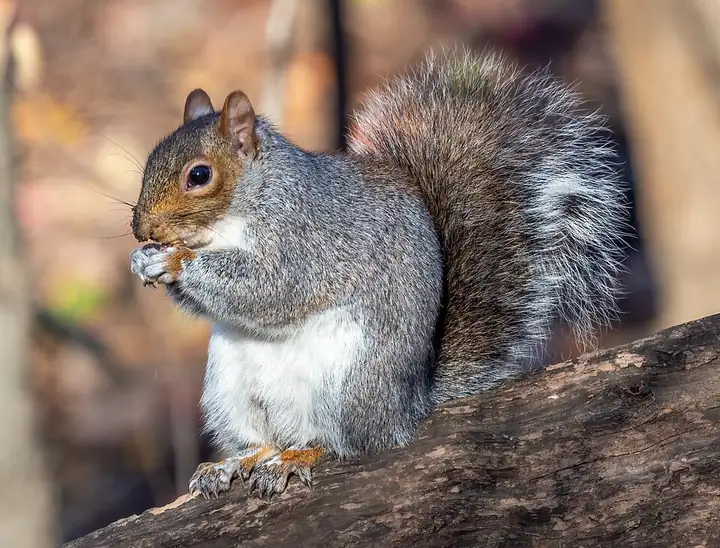
Tree squirrels
Eastern gray squirrel (Sciurus carolinensis) and fox squirrel (Sciurus niger); native western gray and Douglas squirrels in the West
| Type | Animal |
|---|---|
| When | Year-round. |
| Pressure by region | Moderate: Northeast, Southeast, South Central, Midwest, Great Plains, Mountain West, Southwest, Pacific Northwest, California |
About
Bushy-tailed squirrels that escape by climbing trees, unlike ground squirrels and chipmunks. In gardens they dig in beds, eat planted seeds, and raid fruit, tomatoes and corn.
Spotting it
Damage
Look for freshly dug holes in beds and lawns where they bury or hunt for nuts, missing or half-eaten fruit, and stripped bark or clipped twigs on trees. They may also eat newly planted seeds.
How to find it early
Watch the garden in early morning and late afternoon, and check for small dug holes and partly eaten fruit.
When
Year-round.
Life cycle
Tree squirrels have one or two litters a year of three to five young. They are active in the daytime, especially in early morning and late afternoon.
What to do, gentlest first
Start at the top. Sprays are a last step; always read and follow the product label.
Isolate fruit trees Prevent
Trim branches that let squirrels jump into a tree from roofs, wires or other trees, then wrap the trunk with a 2-foot-wide metal collar about 6 feet off the ground.
Wire cages Barrier
Cover seedbeds and small crops with frames of 1-inch chicken wire, or use 1/4-inch hardware cloth.
Squirrels chew through plastic netting, so use metal wire where they are a problem.
Trapping is regulated Trap
Rules differ widely: in California, gray squirrels need a permit and it is illegal to release any tree squirrel elsewhere without one, while Pennsylvania lets property owners deal with damaging squirrels without a hunting license.
Trapping and relocating wildlife is regulated by state law, and the rules differ from state to state. Check with your state wildlife agency before you set a trap.
Capsaicin and scare devices Repellent
Hot-pepper (capsaicin) repellents may help, but UC IPM calls repellents questionable, and squirrels ignore scare devices within a couple of days.
Penn State notes capsaicin products can go on fruit and vegetable plants only before fruit forms or after harvest. PNW 591 rates capsaicin toxic to bees, so keep it off open flowers. Use only products labeled for food crops if you spray anything you will eat, and follow the label. Keep children and pets off treated plants until the spray dries.
Plants it goes after
Apple (backyard tree), Apricot, Cornelian cherry, Crocus, Fig, Hazelnut (filbert), Jaboticaba, Pecan, Pineapple, Saffron crocus, Strawberry, Sweet corn, Thimbleberry, Tomato, Tulip
Pressure by region
Eastern gray and fox squirrels were introduced to California, where UC IPM calls the fox squirrel the most serious pest of homes and gardens among its tree squirrels. No regional severity source was found, so all ratings are estimates, including Alaska and Hawaii.
| Northeast | Moderate |
|---|---|
| Southeast | Moderate |
| South Central | Moderate |
| Midwest | Moderate |
| Great Plains | Moderate |
| Mountain West | Moderate |
| Southwest | Moderate |
| Pacific Northwest | Moderate |
| California | Moderate |
| Alaska | Low |
| Hawaii | Low |
Ratings come from extension sources where available; some are estimates, as noted above.
Sources
Photo: Photo: Rhododendrites, CC BY-SA 4.0, via Wikimedia Commons (CC BY-SA 4.0). Photo resized for the web.

Planting dates and advice are general guidance; check with your local Cooperative Extension office for your area.