
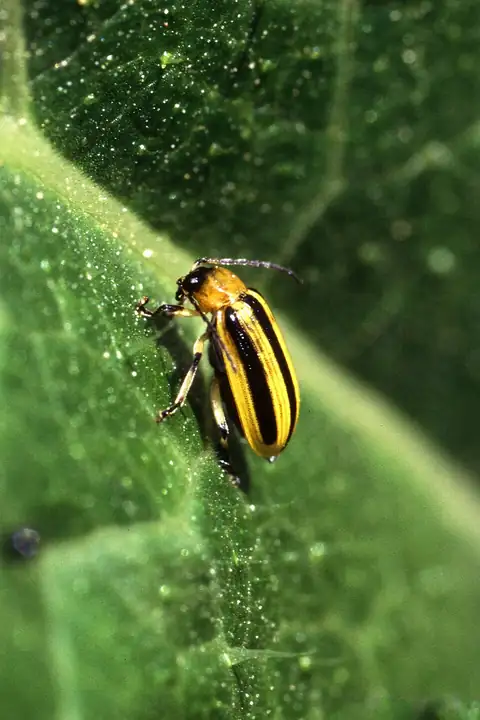
Cucumber beetles
Striped cucumber beetle (Acalymma vittatum), western striped cucumber beetle (Acalymma trivittatum) and spotted cucumber beetle (Diabrotica undecimpunctata)
| Type | Insect |
|---|---|
| When | Late spring through summer; seedlings are most at risk. |
| Pressure by region | High pressure: Northeast, Midwest |
About
Quick, fifth-of-an-inch beetles that are yellow with three black stripes, or yellow-green with 12 black spots. They pile onto cucumber, melon and squash seedlings as soon as they come up.
Spotting it
Damage
Adults chew seedlings, leaves and flowers and can defoliate small plants, while larvae feed on roots. The striped beetle also spreads bacterial wilt, which makes cucumbers and melons wilt and die weeks later.
How to find it early
Scout seedlings two or three times a week from the moment the seed leaves open, especially at the edges of the patch, and look inside open squash flowers.
When
Late spring through summer; seedlings are most at risk.
Life cycle
Striped beetle adults overwinter in leaf litter, become active in late spring (usually the first week of June in southern Minnesota) and lay eggs in the soil at the base of vine crops; egg to adult takes about 40 to 60 days. Spotted beetles do not survive northern winters and fly in from the South in early summer; striped beetles have one generation in the North and up to three in the far South, and the western striped beetle up to three in California's Sacramento Valley.
What to do, gentlest first
Start at the top. Sprays are a last step; always read and follow the product label.
Delay transplanting and mulch Prevent
Setting out transplants a little later skips the most vulnerable stage. Black plastic or straw mulch cuts egg-laying and larval survival.
Trap crop Prevent
Plant Blue Hubbard squash one to two weeks early around the main planting to pull beetles away, then deal with them there.
Swat into soapy water By hand
In a small garden, knock beetles into soapy water. Act at two or more beetles per seedling on a quarter of your plants.
Floating row cover Barrier
Cover young plants until they flower, then remove the cover so bees can pollinate.
Kaolin clay, spinosad or pyrethrins Organic spray
Apply kaolin before beetles arrive as a deterrent. Spinosad and pyrethrins give moderate control.
Spinosad and pyrethrins are toxic to bees, and pyrethrins kill beneficial insects too. Spray before 8 a.m. or after 6 p.m. (UMN) or when flowers are closed, and follow the label and pre-harvest interval.
Labeled insecticides at threshold Conventional spray
Treat only when thresholds are reached, not on a schedule.
Bees are essential for cucurbit fruit; never spray open flowers, and apply before 8 a.m. or after 6 p.m. (UMN). Follow the label and pre-harvest interval.
Garden friends that go after it
Garden orb weavers (incl. yellow garden spider), Wolf spiders
Protect these helpers: skip broad sprays when they're around.
Plants it goes after
Cantaloupe (muskmelon), Chayote, Cucumber, Dry beans (pinto, black, kidney, navy), Gladiolus, Lingonberry, Luffa (loofah gourd), Statice (annual statice), Watermelon, Winter squash and pumpkin, Yacon, Zucchini and summer squash
Pressure by region
The striped cucumber beetle lives east of the Rockies and is worst in the Northeast and Midwest; the western striped cucumber beetle replaces it in the West and Southwest and matters most in California. Bacterial wilt is endemic in the Midwest, mid-Atlantic and Northeast but absent from the western states. Mountain, Pacific Northwest, Alaska and Hawaii are rated low for lack of a regional source, so those ratings are estimates.
| Northeast | High pressure |
|---|---|
| Southeast | Moderate |
| South Central | Moderate |
| Midwest | High pressure |
| Great Plains | Moderate |
| Mountain West | Low |
| Southwest | Moderate |
| Pacific Northwest | Low |
| California | Moderate |
| Alaska | Low |
| Hawaii | Low |
Ratings come from extension sources where available; some are estimates, as noted above.
Sources
Photo: Photo: Scott Bauer, USDA ARS, Public domain (USDA ARS), via Wikimedia Commons. Photo resized for the web.

Planting dates and advice are general guidance; check with your local Cooperative Extension office for your area.