
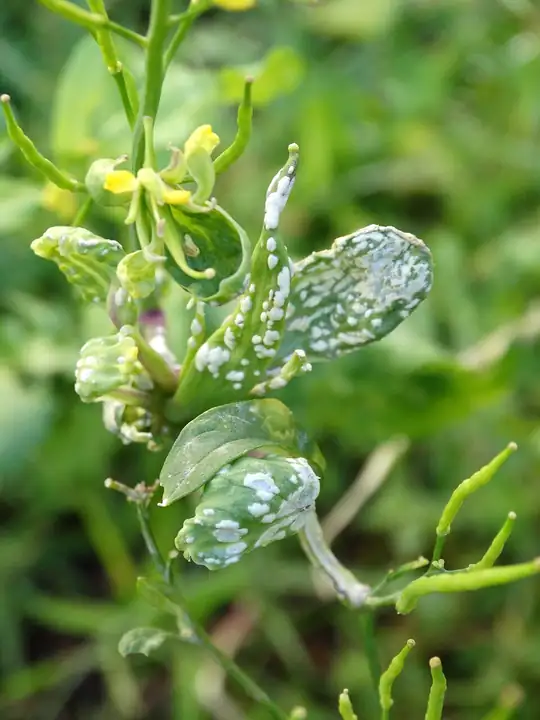
White rust
Water mold (Albugo candida on cabbage-family crops)
| Type | Water mold |
|---|---|
| Cause | Water mold (Albugo candida on cabbage-family crops) |
| When | Cool, wet weather in fall, winter and early spring. |
About
White rust makes chalky white blisters on the undersides of leaves, mostly on leafy cabbage-family greens such as arugula, mustard, bok choy and turnip greens, and also on spinach. The same products that control downy mildew also work on it (UC IPM).
Also called white rust
How to recognize it
Symptoms
Raised, white, blister-like pustules form on the undersides of leaves, often with pale yellow spots above them. The blisters break open and release white powdery spores, and heavy infections twist and deform growth and kill leaves.
Often confused with
Downy mildew makes a fuzzy gray growth rather than firm white blisters.
Worse when
Cool, wet conditions; UC IPM says it is consistently worse in winter and early spring.
How it spreads
Spores spread in wet weather, and thick-walled resting spores survive in soil and crop residue.
When
Cool, wet weather in fall, winter and early spring.
What to do, gentlest first
Prevention works best; most sprays only protect healthy leaves and can't cure infected ones. Always read and follow the product label.
Avoid infested beds Prevent
Do not plant susceptible greens where white rust has been a problem, and clear crop residue after harvest.
Keep leaves dry Prevent
Space plants and water at the base; UC IPM notes dry leaves may reduce severity even though skipping sprinklers will not fully prevent it.
Remove infected leaves By hand
Pick off and destroy blistered leaves early.
Copper Organic spray
UC IPM lists copper compounds among products that work on white rust, as preventives.
Copper only protects leaves it coats before infection; it will not heal spots already there. It can burn young leaves, especially in weather above 85°F, and some plants are sensitive (Purdue lists celery, strawberry, apple, pear and plum among them). PNW 591 rates copper hydroxide toxic to bees, so spray when bees are not foraging. Follow the label, including the days to wait before harvest.
Water-mold fungicides Conventional spray
UC IPM lists mefenoxam and fosetyl-aluminum; products that control downy mildew generally also control white rust.
Follow the label, including which crops it may be used on and how many days to wait before harvest.
Plants it affects
Arugula, Bok choy, Broccoli raab (rapini), Brussels sprouts, Cabbage, Cauliflower, Collards, Mustard greens, Napa cabbage, Radish, Rutabaga, Salsify (oyster plant), Spinach, Turnip
Sources
Photo: Photo: Scot Nelson, CC0, via Wikimedia Commons (CC0). Photo resized for the web.

Planting dates and advice are general guidance; check with your local Cooperative Extension office for your area.